Drawing Sound: Xenakis and the Machine That Had No Keyboard
In 1977, an architect-turned-composer built a tablet where you drew and it sang. No notation, no keyboard, no code. The entire system fit under a megabyte.
I keep coming back to one sentence: "The entire system fit in under a megabyte."
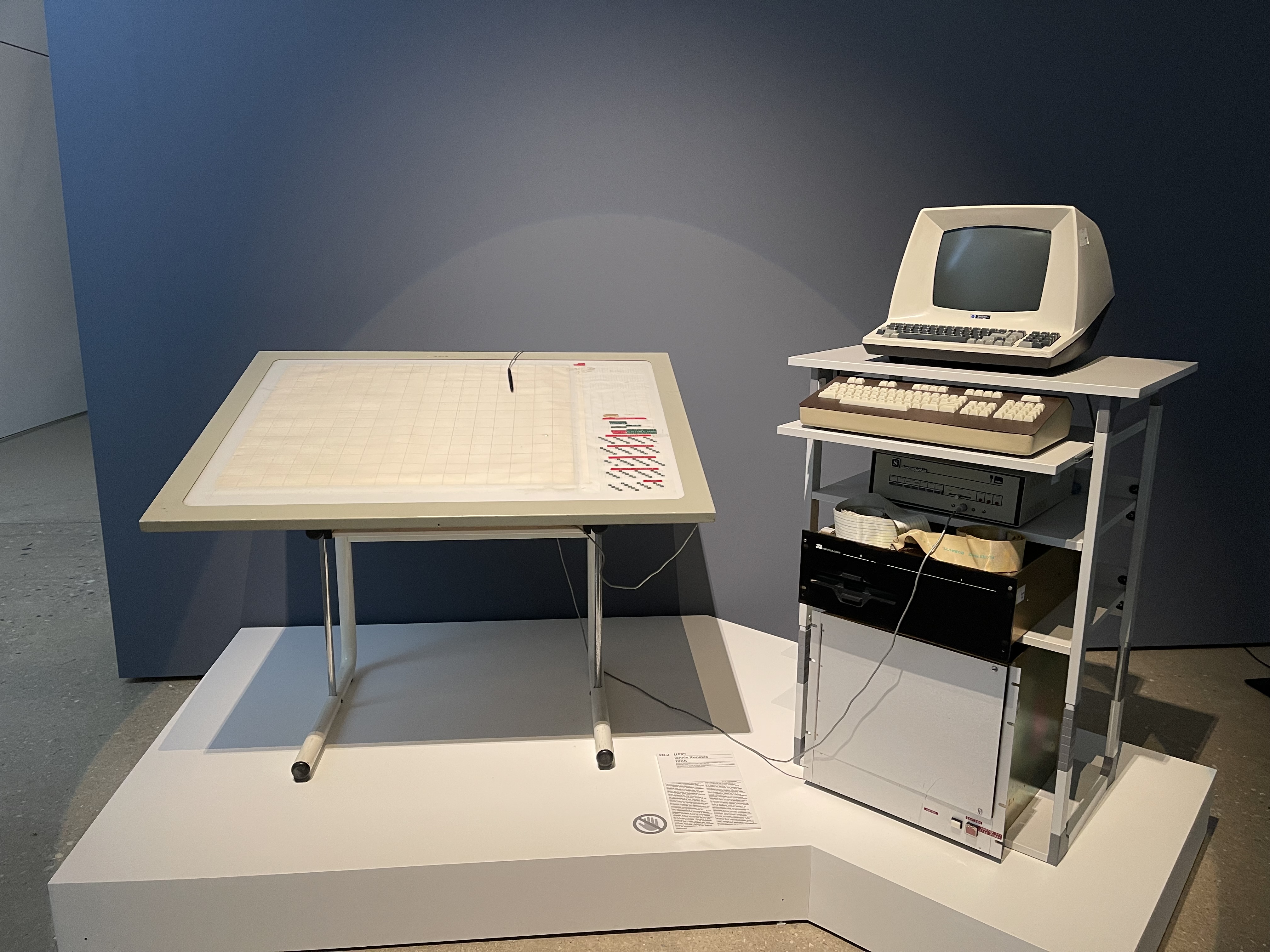
A megabyte is smaller than a single photo on your phone. And yet the UPIC — Iannis Xenakis's 1977 drawing tablet for making music — fit its operating system, synthesis engine, and composition software into that space. The machine let anyone draw a line and hear it become sound. No keyboard. No musical notation. No code. Just a stylus on a large electromagnetic tablet, and three simple rules.
X-axis equals time. Y-axis equals pitch. And the shape you draw in the waveform box is the timbre — a sine wave, a sawtooth, or a jagged squiggle that sounds like nothing in nature.
The architect who thought in glissandi
Xenakis spent twelve years working for Le Corbusier before he became famous as a composer. He designed the Philips Pavilion for Expo 58 — a sculptural structure of hyperbolic paraboloids, poured concrete warped into shapes that seemed to have no edges. The same math showed up in his music. The string glissandi in Metastaseis (1954) were drawn as straight lines on a time-versus-pitch grid. When you look at those sketches, you're seeing the same curves that became the Pavilion's walls. Xenakis had been drawing music for two decades before the UPIC existed. The machine just gave his drawings a voice.
Or, more precisely, it gave his drawings a voice so that anyone's drawings could have one.
Three stages, no instruction manual
The UPIC workflow was so simple it reads like a fable:
Step one: Draw a waveform — a single cycle of whatever sound you want. You hold the stylus, drag it across the waveform window, and the computer registers every curve as a timbre.
Step two: Draw an amplitude envelope — how the sound should swell, hold, and decay. A sharp spike for percussion. A slow rise and fall for something breath-like.
Step three: On the main composition grid, where time runs left to right and pitch rises bottom to top, draw a line. That line is your melody. A horizontal line holds a note. A diagonal is a glissando — pitch sliding continuously. A curve accelerates the slide.
Press play. The machine synthesizes your drawing into sound.
There was no menu system, no file format to learn, no concept of "saving your work" in the modern sense. The entire thing was a single unified act of translation: hand to line, line to sound. Xenakis called it "polyagogic" — his own coinage from the Greek for "many expressions" — because every musical parameter was under direct manual control.
The children who composed at the Acropolis
Xenakis designed the UPIC to be used by children with no musical training. He wrote, with characteristic directness: "Anybody, even myself or you, or children, can draw lines or graphics with an electromagnetic ballpoint, and they are transformed by computer directly into sound."
He meant it literally. In 1979, he helped found KSYME, the Athens UPIC center. By 1986, the center announced courses for up to 5,000 students aged 10 to 15. Kids who couldn't read a note of music were composing by drawing. Xenakis's own first UPIC piece, Mycènes Alpha, had premiered at the Acropolis of Mycenae in 1978 — the same ancient stones where Greeks had once sung to gods, now hosting a concert performed by a computer reading a man's hand-drawn lines.
There is something almost mythic about this pairing, and Xenakis, an engineer who never lost his sense of the monumental, would have understood exactly what it meant.
"Under 1mb and it shits on everyone"
In 2006, Aphex Twin was interviewed by Future Music magazine. Asked about inspiring tools, he didn't name a synthesizer or a drum machine. He named the UPIC: "UPIC by Xenakis puts almost everything else to shame. Under 1mb and it shits on everyone."
What Richard D. James recognized was the same thing I see when I look at the UPIC: it is not a tool with features. It is an idea with conviction. Most music software gives you a metaphor — a piano roll, a mixing desk, a score editor — and asks you to learn its version of making music. The UPIC gave you a blank grid and said: draw what you mean.
Over a hundred composers have created works with the UPIC and its successors. IanniX, an open-source graphical sequencer directly inspired by it, is sponsored by the French Ministry of Culture. UPISketch runs on iPads. The lineage continues — not because the technology was advanced (it wasn't), but because the interaction model was honest. The distance between your hand and the sound was the thickness of a stylus tip.
Most of the artifacts in this museum are about bridging a gap: between the body and the machine, between speech and text, between the real and the virtual. The UPIC bridges a gap nobody else thought was bridgeable: between the act of drawing and the act of composing. It turned a line into a note, a squiggle into a timbre, a child's doodle into music. And it did it in under a megabyte.