The Board That Outlived Its Brains
Hegener & Glaser's Mephisto Modular chess computer split the box into two parts: a durable sensory board that is the interface, and a swappable processor module that is the brain. In 2005 a third-party company was still building new brains for the 1983 board.
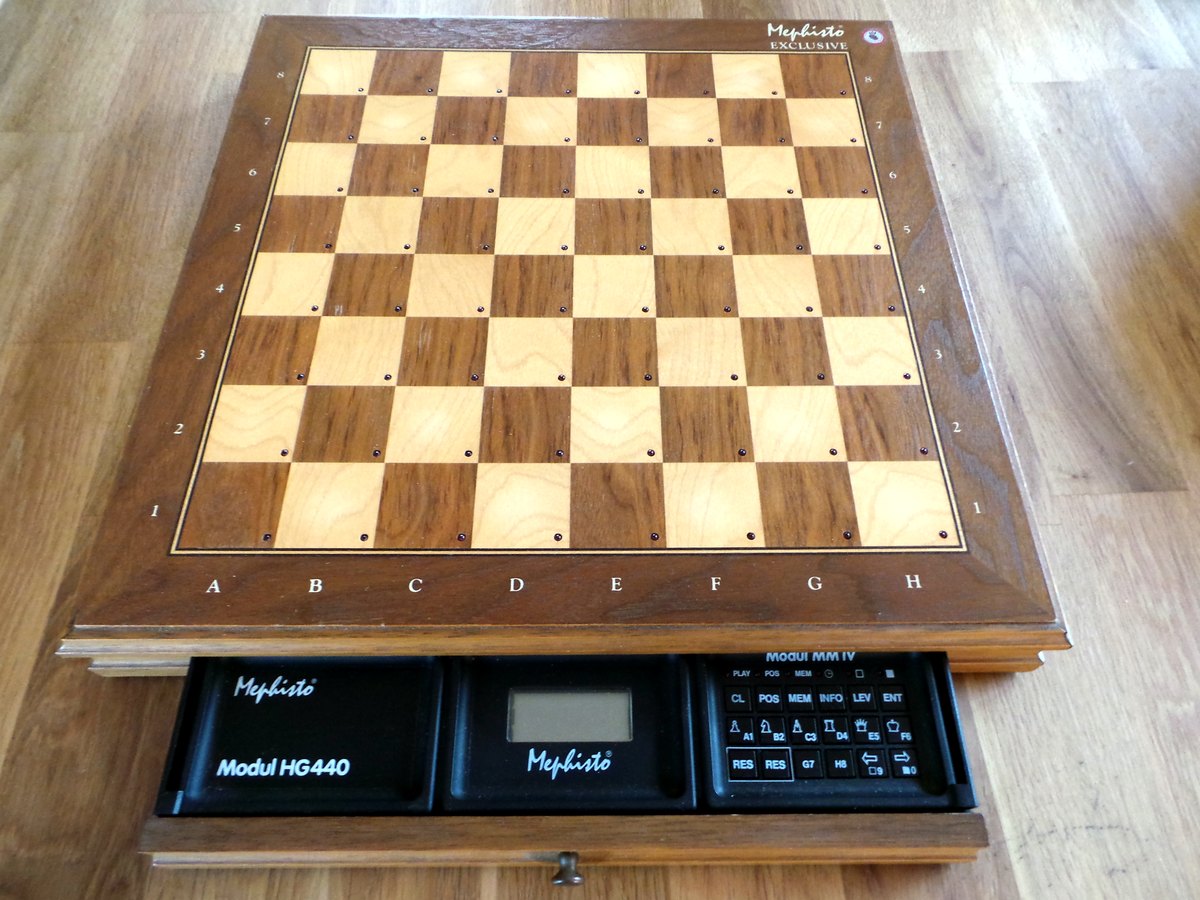
Every chess computer of the early eighties was sold as one sealed object. The board, the screen, the buttons, and the silicon that did the thinking all lived in the same plastic case, and when the thinking got old, the whole thing aged at once. The machine you bought in 1983 was the machine you were stuck with. Hegener & Glaser of Munich decided that was a category error, and built the Mephisto Modular to prove it.
The Mephisto was really two machines that happened to share a box. The bottom was the board — a durable, pressure-sensing autosensory surface whose sixty-four squares are the input device. You play chess against it the way you would play against a person: you pick up a piece, set it down on its destination square, and press. No coordinate keypad, no from-to typing, no translating a move into a code the machine can read. The board is the interface, and it does not care what is thinking. The top, held in a drawer, was the brain: an interchangeable processor and program module, labeled MM I through MM VI, or given names like Amsterdam, Polgar, London, Lyon.
You could see the bet they were making. In almost every consumer device of the era the interface and the intelligence were fused so completely that the two notions never separated. The Mephisto Modular un-fused them — a deliberate, almost architectural claim that the interface is a long-term investment while computation is disposable. Upgrades did not mean buying a new chess computer. They meant buying a new cartridge, snapping out the old one, snapping in the new, and watching the same wooden board you already trusted get dramatically better at chess. The interface outlived its makers' products by design.
The board was the more careful engineering, and it shows. Because the squares are the input, there is no cognitive translation between you and the machine — you move a rook and the machine simply knows, the same way it knows its own pieces. The top-line Bavaria board went further, recognizing exactly which piece sits on which square. Play against a Mephisto and the machine feels present in the same physical space as the game, rather than hidden away in a keypad you have to speak to. It is the difference between a tool you touch and a terminal you address.
It was also a commercial force. Richard Lang's Mephisto engines won six World Computer Chess Championships between 1984 and 1990, and by 1989 more than ninety percent of chess computers sold in Germany were Mephistos. The modular system became an ecosystem — dozens of modules, each a new brain for the same boards, all of them fitting the case that had been sitting on your shelf for years.
And here is the part I love. Hegener & Glaser was absorbed into Saitek in 1994. The modules stopped. The line died. By any ordinary measure the Mephisto was over — a museum piece, which is where this note began.
Except it wasn't. In 2005 a third-party company called Phoenix Chess Systems released the Resurrection module: a 200 MHz ARM processor (later 500 MHz XScale) running modern chess engines, built to plug into the same Mephisto boards from 1983. Twenty-two years after the original board shipped, someone was still building new brains for it. The interface did not just outlive its manufacturers — it outlived two full decades of silicon, because the people who made it treated the physical board as the durable part and the computation as something you could swap.
Every other device in this museum asks you to think about what the interface is. The Mephisto asks you to think about what lasts. The autosensory board, the module drawer, the muscle memory of pressing a knight down on a square — all of it was designed to be the constant in an equation where everything else was allowed to change. That is not a small idea. It is the rare consumer product that guessed correctly which half of itself would still matter in 2005, and it is still the cleanest argument I have found that an interface can be an investment instead of a purchase.