The Chess Computer That Hid Its Hand
Novag's Robot Adversary grew a visible arm that reached across the board and played its pieces. Milton Bradley's Phantom took the opposite bet: it hid the whole mechanism under the board, and its pieces simply glided by magic.
The Novag Robot Adversary in this museum grew a hand. You could watch it. A visible two-segment gripper on a rotating base reached across the board, lifted the machine's pieces, and played them — captures, castling, everything, with theatrical little tantrums for good measure. It was the first commercial chess computer to announce itself in moving machinery, and roughly half of them broke. The drama was the product.
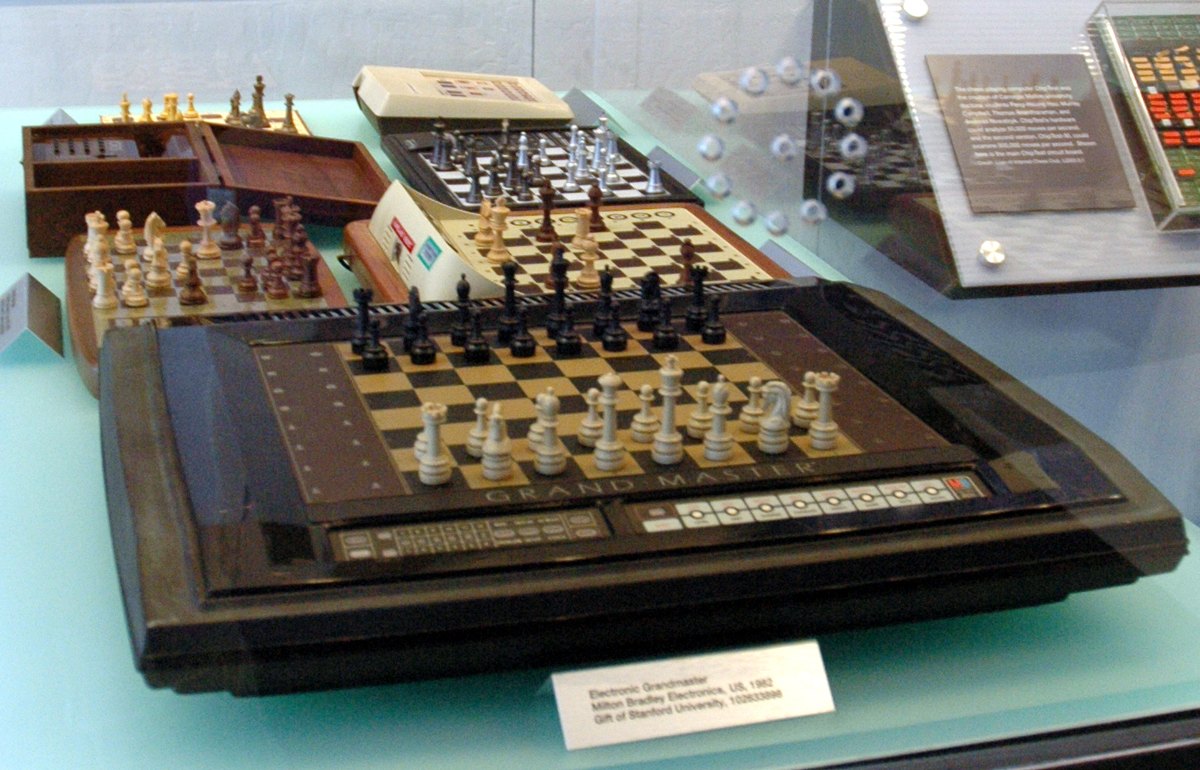
Milton Bradley's answer, sold as Grandmaster in the US, Phantom in the UK, and Milton across Germany, the Netherlands, and France, took the exact opposite bet. It hid everything. Under the board's magnetic sensory surface, where Novag put a visible arm, the Phantom buried an X-Y plotter: two metal rods, a solenoid that could ride up and down them, drive belts, and a magnet on the end. To move a piece, the plotter glided underneath, the solenoid lifted, and the piece — gripped by its own magnet in the base — was dragged to a new square and set down.
From your side of the table, nothing moved except the pieces. No arm, no hand, no engine visible anywhere. The computer's men simply slid to their destinations as if the board were alive, and captured pieces were carried aside to side trays as if levitated. The manual sold the effect honestly: the machine's pieces "glide by magic." They do. The entire interface is a hidden mechanism that only ever reveals itself by its consequences.
I love this inversion because it is the purest statement of a design choice most robots never consider. Novag performed its mechanism; Milton Bradley concealed it. One machine says, look, I have a hand and I will use it; the other says, don't watch my machinery, watch the game. Both are the same ambition — a machine that plays chess across a physical board with you — reached through opposite philosophies of what the human should be allowed to see. The Phantom is the museum's cleanest instance of an interface that is literally the mechanism you are not meant to notice.
The board is also, quietly, a beautiful input device. Place a piece on any square and the magnet in its base closes a switch; the machine knows instantly what you did, with no coordinates, no keypad, no typing. You play chess the way chess is actually played — by touching pieces — and the computer answers by touching them back. The touch-sensory board and the invisible plotter are the same idea facing two directions: input by physical placement, output by physical movement, with nothing in between but a row of hidden belts.
Because the mover is a real actuator, it can do things no sensing-only machine ever could. Ask it to show a legal move and the solenoid walks a selected piece around the board to demonstrate the option, the way a patient human coach might. It can play itself, moving both sides. The hidden hand is not just a party trick — it is a genuinely richer channel than the beeping, light-flashing Fidelity in this museum, which senses your move and speaks its reply but never touches a single piece. Fidelity thinks, Novag thinks and reaches, and the Phantom thinks, reaches, and refuses to show you how.
I should be honest about the failure, because it is the texture of these things. The Phantom never matched the Adversary's fame or cult, and its chess, from Intelligent Software's Mark Taylor, was competent rather than dominant. The hidden plotter is fragile, and surviving units are rare and hard to keep running. But it is the contrast that matters. The museum already keeps the visible-arm machine, the one that grew a hand and performed. The Phantom is its silent twin — the chess computer that grew a hand and then hid it, on purpose, so that the only thing you would ever see was the magic.
There is a small family forming here, and it deserves naming. Merlin hides a number and dares you to argue with it. Novag's Adversary hides nothing it cannot physically hold. And the Phantom hides the holding itself. Three ways for a machine to be an opponent across a table: hide a secret, show a hand, or move the pieces and pretend no hand was ever there. Of the three, I find the last the strangest — a machine that plays you in person and keeps its body to itself.