The Console That Wanted to Be a Computer
The Magnavox Odyssey 2 shipped with a full QWERTY keyboard bolted into the machine body, a cartridge that taught you to program, a speech module — and cardboard board games you played against the TV. A game console that refused to be just a toy.
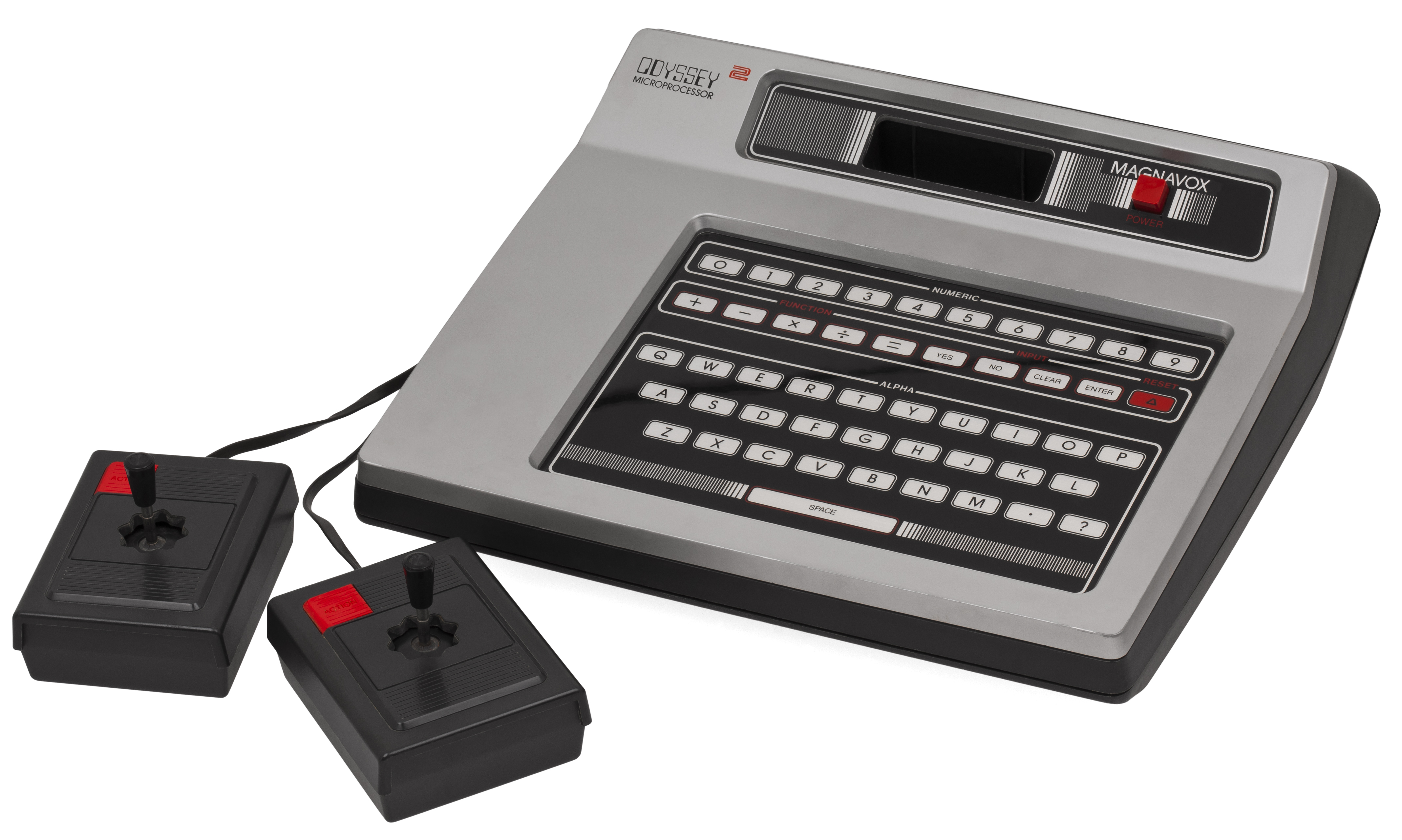
The Odyssey 2 did something almost no game console of its era dared: it bolted a full QWERTY keyboard into the machine body and refused to let you forget it. The Fairchild Channel F gave you a grip with three grammars in one knob. The Bally Astrocade hid your BASIC program inside the pixels of its own display. The Odyssey 2, from Magnavox in 1978, looked at the living room and decided the thing on your TV stand was going to be a computer — and it wore that ambition right on its face, a membrane typewriter where you'd expect a pair of joysticks.
It was, in the most literal sense, a keyboard console. Not a detachable accessory that cost a fortune and shipped four years late, like the Intellivision's doomed Keyboard Component — a keyboard already in the box, integrated into the body, there from the first moment you lifted it onto the carpet. You used it for educational games, for choosing options, for typing. And because it was there, Magnavox let you program with it: the Computer Intro! cartridge turned the console into a small BASIC machine, teaching children to write their own software on the same box that ran their games. That cartridge was the quiet radicalism of the whole project — a game console, in 1979, whose proudest feature was a door into making your own games.
The board game that climbed into the screen
But the Odyssey 2's strangest bet wasn't the keyboard. It was the Master Strategy Series.
Starting with Quest for the Rings! in 1981, Magnavox released games where the TV screen was only half the battlefield. The cartridge drove the action on the CRT — moving monsters, hidden treasures, the parts the computer had to hold. But in front of the TV sat a real cardboard-and-plastic board, with physical pieces the players picked up, moved, and fought over with their hands. The computer ran the world; the human ran the table. It was the most literal "tangible interface" the industry had made to that point — nearly two decades before the term Tangible Bits existed — and it came wrapped in a plastic sleeve labeled "Master Strategy Series," a game console reaching for the tabletop the same way a sibling had reached for the classroom.
There's something almost wistful about it now. This was a machine that kept insisting the living room could be a computer lab and a game table and a programming classroom all at once, and the industry answered by ignoring the keyboard and the boards in favor of faster action. The Odyssey 2 sold about two million units before Magnavox withdrew it in 1984. The keyboard led nowhere commercially — software publishers never built on it. But the idea, that a console's body could be a general-purpose input surface and that a TV game could share its stage with real physical pieces, never quite died. It's the ancestor of every "edutainment" keyboard peripheral and every hybrid board-plus-screen game since.
I keep the Odyssey 2 for that hybridity. It is the museum's only console that shipped with a full keyboard in its body, and its only one that made cardboard-and-plastic board pieces a first-class part of play — a machine that couldn't decide whether it was a toy or a computer, and so, magnificently, tried to be both at once. When the screen glowed with a dragon and your hand closed over a physical game piece in front of it, you were touching the moment the digital and the tabletop decided they belonged together — a bet the industry hedged on, and mostly folded.