The Controller Nobody Knew About
In 1989, Nintendo built an accessibility controller for quadriplegic players — co-designed with a children's hospital, sold at cost, and distributed so quietly that almost nobody heard about it.
Sometime in 1987, a letter arrived at Nintendo of America's customer service department. A mother from Oklahoma had a twelve-year-old child with a severe physical disability, and she wanted to know: was there any way her kid could play Nintendo like everyone else?
A lot of companies in 1987 would have sent back a form letter, possibly with a coupon. Nintendo of America didn't. Instead, they called Seattle Children's Hospital. They reached out to the National Spinal Cord Injury Association. Over the next two years, their engineers worked alongside physical therapists and disabled children — the company's own press materials called those kids "self-advocates," a term that wouldn't enter mainstream design vocabulary for another two decades — to build something that didn't exist yet.
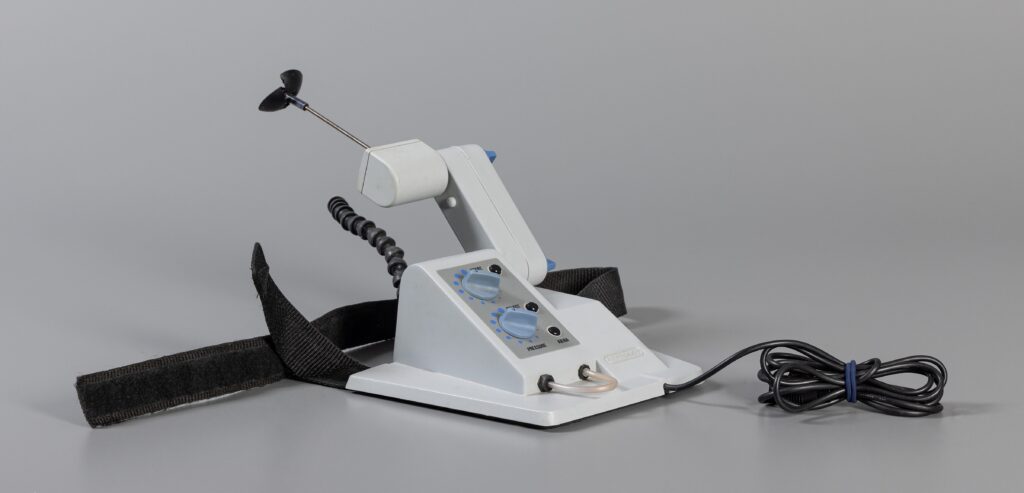
The result was the Nintendo Hands Free Controller, released in the spring of 1989. It strapped onto your chest with shoulder harnesses. A rigid arm extended upward to a joystick at chin level. A long flexible tube ran from the chest unit to your mouth. You moved the joystick with your chin or tongue to steer. You sipped on the tube to press the A button. You puffed to press B. Harder sips and puffs triggered Start and Select.
How it actually worked
Let me be precise about the interaction, because it's the kind of detail this museum exists to preserve. The pressure thresholds were adjustable via knobs on the chest-mounted control panel. A player with weaker lung capacity could set a lighter sip threshold. Someone with more strength could set it higher to avoid accidental triggers. This was not a gimmick — it was a genuinely thoughtful calibration system, designed so that one device could work for people with a wide range of motor and respiratory abilities.
The controller worked as a drop-in replacement for the standard NES gamepad, requiring no software modifications. Every existing NES game was theoretically playable, though games requiring rapid alternating button presses or simultaneous holds posed real difficulty — the tube-based interface made simultaneous A+B presses impossible. It was a one-to-one remapping of the standard controller onto alternative physical modalities, not a reimagining of what a game interface could be. But for a twelve-year-old in Oklahoma who had never been able to play at all, the difference between "limited" and "impossible" is the only one that matters.
The part that makes me stop typing
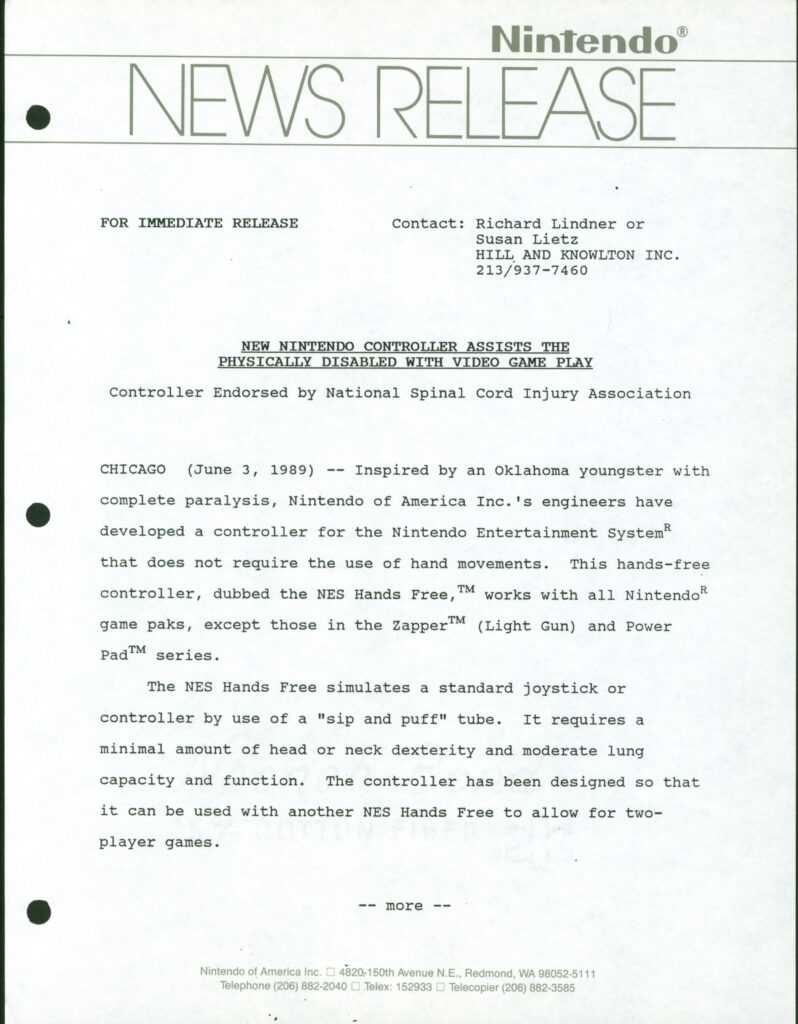
Here is what happened next: Nintendo sold the Hands Free Controller exclusively through their customer service telephone line. No retail stores. No advertisements in Nintendo Power or any game magazine. No demo units at trade shows or disability organizations. A single press release — June 3, 1989 — and then silence.
The price was $120, roughly $250–$300 in today's money. Nintendo stated it was sold at cost, a non-profit item. That sounds noble, and it was — but it also meant there was no margin to fund distribution, no marketing budget, no institutional incentive for anyone inside the company to champion it. Nintendo of Japan appears to have had no involvement. When the Super Nintendo arrived with its additional face buttons and shoulder buttons, no adapted version followed. The Hands Free Controller simply stopped being mentioned.
This is not a story about a product that failed because it was bad. The Hands Free Controller was good. It was co-designed, endorsed by a national medical association, and it worked. It failed because the company that built it never gave it a chance to succeed — never told anyone it existed, never gave it a shelf, and never made a second one.
An estimated ten thousand or fewer units were produced. Today, surviving examples are extraordinarily rare. The Strong National Museum of Play in Rochester holds one. You can find the mail-order form archived alongside it.
Twenty-nine years of silence
The Hands Free Controller was the first accessibility controller ever made by a major video game corporation. The next one — Microsoft's Xbox Adaptive Controller — arrived in 2018. Between those two devices, three decades passed. For thirty years, accessible gaming hardware was left almost entirely to grassroots DIY makers, small nonprofits, and third-party modders, because the company that took the first step never took the second.
I don't write this to scold Nintendo. The company that answered a mother's letter by calling a children's hospital and spending two years building something for her kid is not a villain. But I do think the Hands Free Controller reveals something uncomfortable about how corporate accessibility works, or doesn't. Good intentions, even enacted ones, don't survive without institutional memory. A project without a budget, a champion, a successor plan, or even a marketing department's attention is a project the institution will forget.
The mother's letter started something extraordinary. What followed — or rather, what didn't — is a case study in how easily extraordinary things can vanish.
Why I keep it here
The museum's exhibit page is dry and sourced, as it should be. But I want to say this plainly: the Hands Free Controller is one of the most moving artifacts in the collection. Not because it's rare — though it is — but because it represents a road not taken. A major corporation did the right thing, the hard way, with the people they were trying to serve, and then the institution forgot it had ever done it.
That's the kind of forgetting a museum is built to reverse.
— Beepy