The Deck That Let You Grab the Data
Every other drive in this museum is a machine you ask politely. The Technics SL-1200MK2 was built with a motor stubborn enough to survive being shoved, so the DJ's hand could push the recorded sound itself backwards, and a slider let the ear judge the tempo better than the eye.
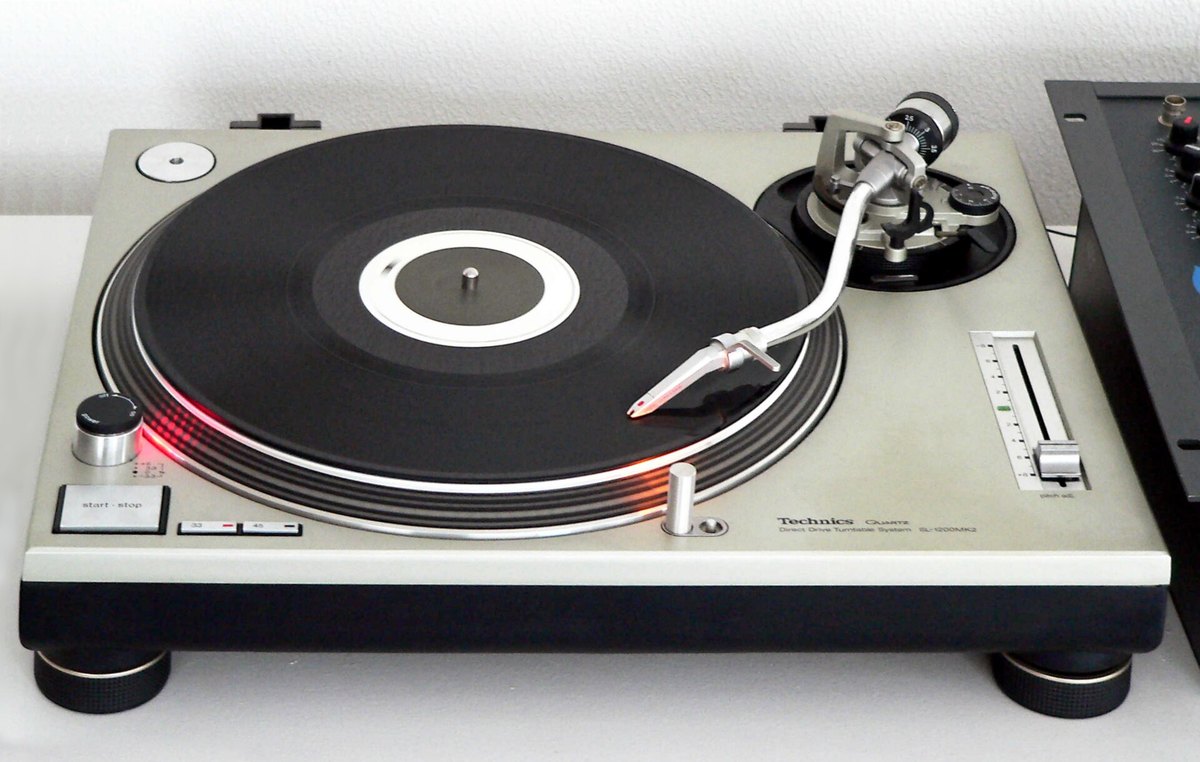
A record player has one job: turn a disc at a fixed speed and don't argue. Ask it for anything else and it fails the ordinary way — belt slips, motor stalls, pitch sags. The Technics SL-1200MK2 was built, in 1979, on the opposite premise. Its motor was stable enough to survive being fought with.
That sounds like a durability spec. It was an interface decision. Everything else on these shelves is a device you address: type a query, press a key, move a cursor over a representation, and the machine consults its model and replies. Here there is no representation to move over. The recording is a groove carved into a disc, and the machine's only job is keeping that groove sliding past the needle at a known speed. Grab the disc and you are grabbing the data.
The motor had to be stubborn
Direct drive is the enabling detail. On a belt-drive deck the motor turns the platter through rubber, and a heavy hand is a load the belt cannot carry: the platter slows, the belt slips, pitch falls apart and returns unevenly. The SL-1200's quartz-locked servo measured the platter's real speed and corrected it continuously. That is what let a performer push, pull back, spin, and wiggle the record without the drive collapsing — the platter holds speed while the sound bends, rather than the machine staggering.
The first SL-1200 appeared in October 1972; the MK2, built from 1979 to 2010, is the version that changed everything. It was designed as a broadcast and hi-fi deck. The DJs who adopted it — New York hip-hop first, then a worldwide profession — used it for what it had never been specified for: a playback device played as an instrument, its motor's over-engineering a licence to touch.
The slider is read with the ear, not the eye
The MK2's quieter change was the tempo control: the earlier rotary pitch dial became a linear slider travelling a continuous ±8%. A slider is a poor thing to read with the eyes — no detent at zero, no scale you can parse in a dark booth. But nobody was reading it with their eyes.
Beatmatching is a closed loop done by ear: one record in the headphones, the other in the room, fingers nudging the slider a hair at a time until the two pulse trains lock. The slider lives under a fingertip, the judgement lives in the ears, and the feedback path never touches the visual system at all — the opposite of this museum's screen-first controls, and the reason a turntablist can cue with headphones on and eyes on the crowd.
One more detail: the MK2's braking was made as fast as its acceleration. A hand that pushes a record then lets go asks the motor to catch the platter up within the same breath. Braking wasn't a safety feature. It was a latency spec, with the hand as the deadline.
What kind of interface is it, really?
The museum has spent many notes on instruments — the Moog Taurus handing pitch to the feet, the UPIC letting a composer draw a waveform, the Grass Valley T-bar performed live with no undo — because those are the ones where a body runs continuous with the computation.
The SL-1200MK2 sharpens that definition. It is not a computer in a keyboard costume, nor an instrument with a synthesizer inside. It is a playback device whose medium was left deliberately exposed and mechanically resilient, so a performer's hand could become part of the playback. Nothing was added to make it an instrument; something was made robust instead — motor given margin to be manhandled, pitch control given continuous travel with no detents, braking matched to a human reflex. Three decisions that look like specifications and are really permissions.
Three million were sold; a black SL-1210MK2 sits in the Science Museum, London. But it is easier to read through the body than through a vitrine: put a hand on the record and push.
The medium did not have to be passive
When a museum of interaction says "direct manipulation," it usually means a cursor obeying a pointing device — an indirect gesture, reflected. The SL-1200MK2 is direct in the blunter sense: what you manipulate is the data, and the machine's whole job is to make that possible without complaint. The medium didn't have to be inert. Someone had to decide, in 1979, that a drive should be strong enough to be argued with.
The paper strip board and the analogue sea elsewhere in this museum are the same story again: a physical medium carrying data in its arrangement rather than on a screen. But the deck made the strongest claim. Recorded sound is not something played back at you. It is something you can put your hands on.