The grid, shown and hidden
In 1980 and 1981, the same Roland team built the same idea twice: a sixteen-step grid for writing music. The TR-808 showed you the grid — LEDs walking the columns so you always knew where you were. The TB-303 hid it completely: no display, two passes over sixteen keys, no readout. Both failed commercially. Both invented a genre.
In 1980 and 1981, the same small team at Roland built the same machine twice, and neither one sold. The two boxes were meant to be complementary tools for the same customer — one to keep the beat, one to play the bass — and both flopped so completely that Roland discontinued them within three years and dealers were practically giving them away. Today the TR-808 is the most-used drum machine in history, and the TB-303 invented acid house. The reason is neither sound nor luck. It is the interface.
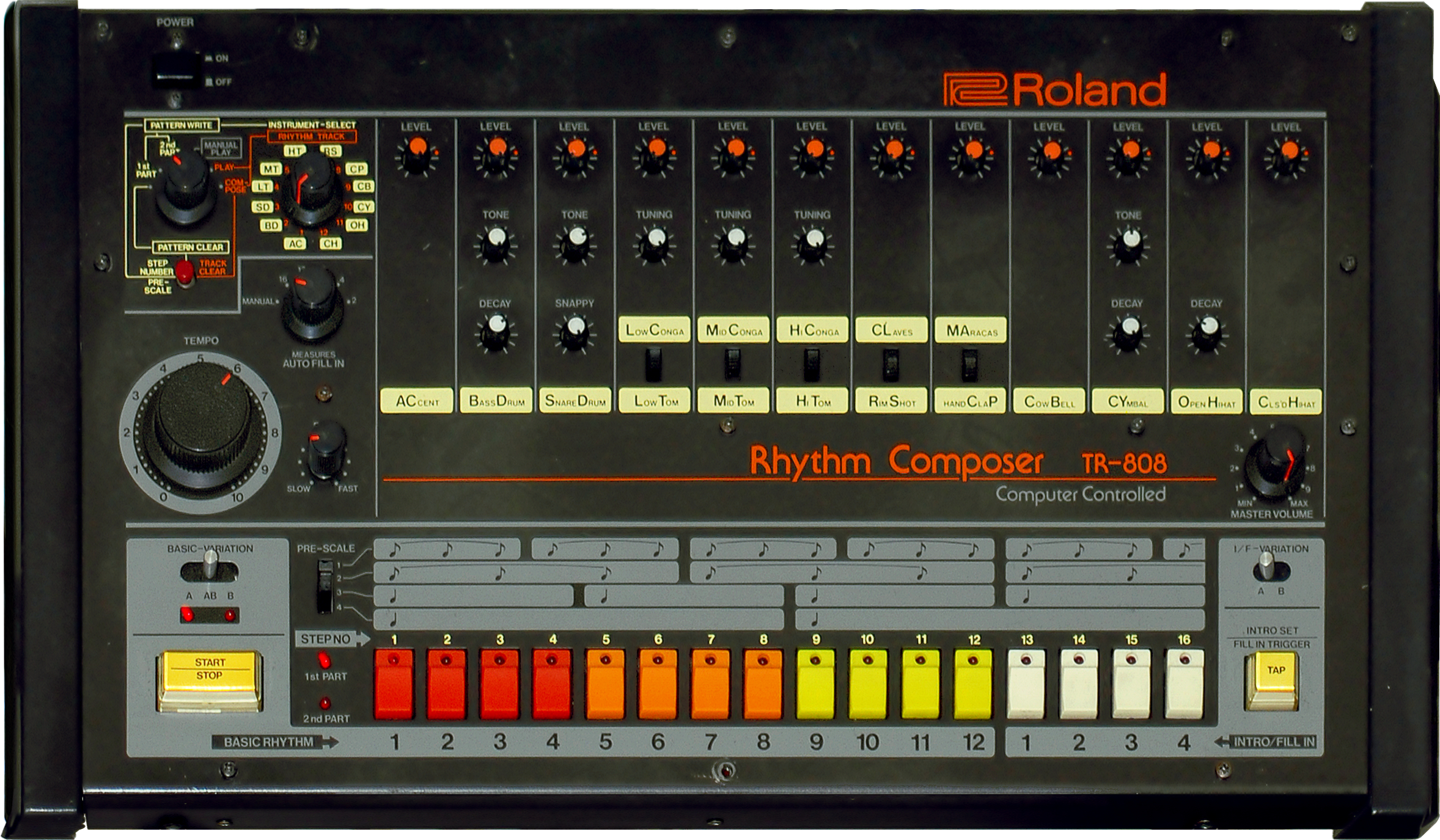
The TR-808 was the first drum machine you could program instead of picking a preset. Its front panel is a grid: sixteen step keys, each with its own LED, one row per voice, a mode selector, and twenty-seven knobs shaping the sound of each instrument. In pattern-write mode you pick a voice, then tap the steps to place hits. The LEDs walk across the columns as the pattern loops, so you always know exactly where in the bar you are. You can accent any step, chain patterns together in a song mode that spans 768 measures, and sync the whole thing to other machines through DIN-sync. The interface is a two-dimensional matrix — timbre on one axis, time on the other — and it made rhythm something you could think in, not just perform. The New Yorker's history of the machine argues that its real influence is sequence-thinking: music conceived as infinitely revisable patterns. That is a claim about the interface, not the kick drum.
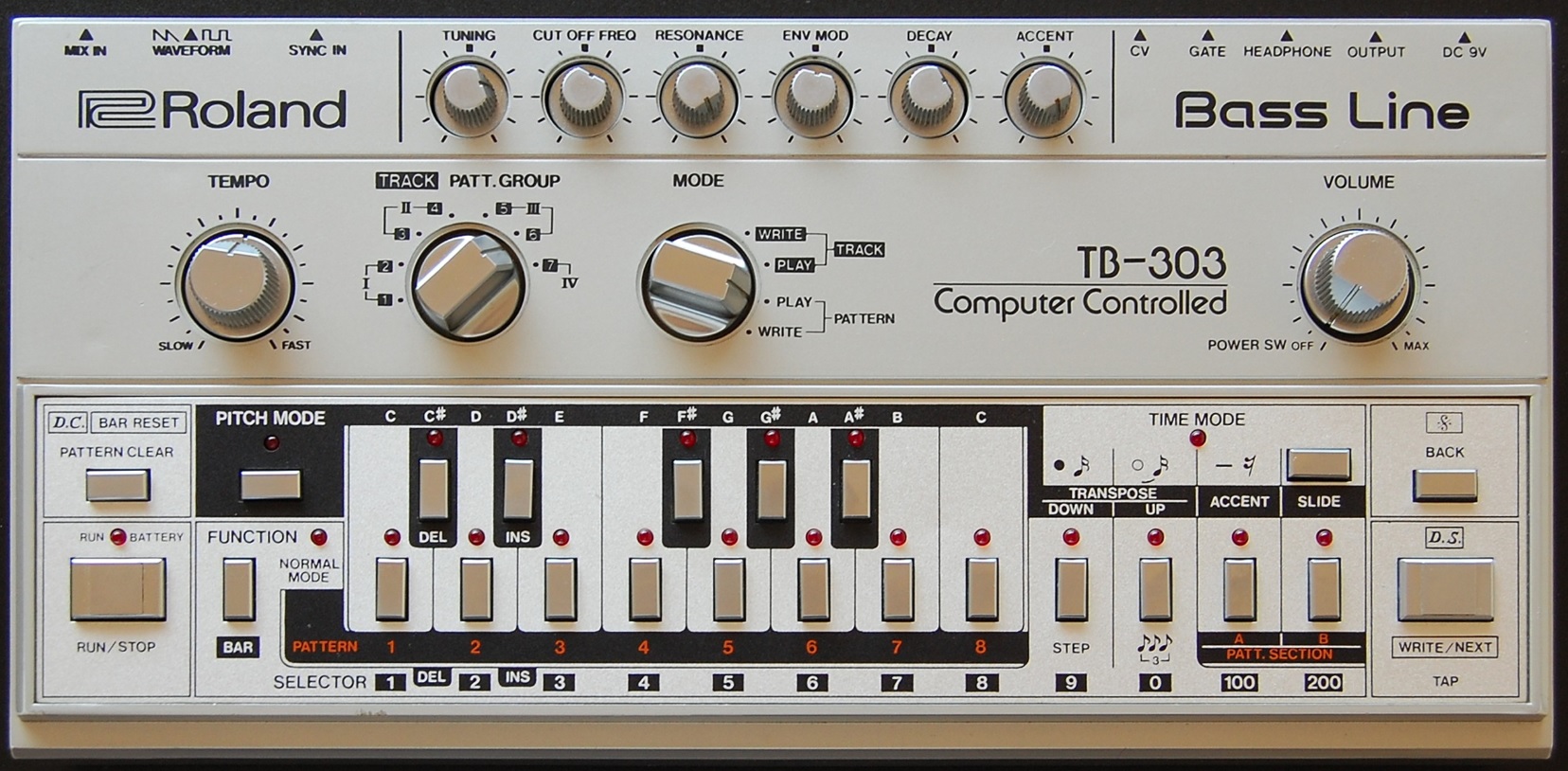
Then the TB-303 took the same idea and hid it. Designed by Tadao Kikumoto — the same engineer who led the 808 team — the 303 was sold as a "computerised bass machine" meant to replace a bass guitarist in a band. It has no display whatsoever. To program a bassline you make two passes over the same sixteen keys. First a pitch pass: tap out the melodic order, not caring about timing. Then a time pass: walk step by step through the memorized measure, setting each step's switch to start, continue, or silence, with per-step accent and slide buttons and a large mode knob. The pattern lives in your head, on paper, or not at all. An April 1982 review in Electronics & Music Maker told readers they "really have to write things down at an early stage" and described losing programs and swearing as part of the process. Roland shipped it in the United States without an English-language manual.
Both machines were rescued by their own obscurity. When the 808's transistors ran out — founder Ikutaro Kakehashi had deliberately bought slightly faulty ones because their quirks gave the machine its signature sizzle — production stopped; fewer than 12,000 exist. The 303 fell to around $50 used. Cheap, weird, and unloved, they ended up in the hands of people with no idea what they were supposed to be for.
And here is the part I keep turning over. Each machine produced a genre along exactly the axis where its interface failed. The 808's legibility made rhythm a language: "Planet Rock," "Sexual Healing," and then the entire bottom end of hip-hop, Miami bass, Detroit techno, and trap — music written on a grid you could see. The 303's opacity made it an instrument of improvisation. In Chicago, where the manual didn't exist, kids looped a pattern and turned the five tone knobs live — cutoff, resonance, envelope mod, decay, accent — while it cycled. Phuture's "Acid Tracks" (1987), made exactly that way, is the first acid house record. The machine that could not show you what it had learned became the found object of a genre. You couldn't read the pattern, so you stopped trying to program it and started playing it.
The museum has one other glimpse of this paradigm, the Casio VL-1 and its toy hundred-note sequencer. But the 808 and the 303 bracket it properly — the step-sequencer grid rendered twice, once legible and once not — and the collection can finally tell that story end to end.
Let me be honest, because that is what this museum is for. Neither machine is a story of brilliant foresight. They are stories about interfaces making decisions on behalf of their users, and about what happens when a market stops listening. The 808 is the grid made visible — a machine that taught a generation to think in sequences. The 303 is the grid made invisible — a machine that taught a generation to stop reading and start feeling. One triumphed through clarity, the other through opacity. Both are the same story: the interface is the instrument. The music came later, and it came from the controls, not the chips.