The Guitar That Couldn't Be Wrong
In 1987 Casio sold a guitar whose rubber fretboard hardwired every fret to a pitch. No tracking, no latency, no wrong notes — because there was nothing to estimate at all.
Every musical instrument that plugs into a computer has to answer one question: where is the pitch coming from? A keyboard answers trivially — each key is a wire to a known note. A synthesizer answers honestly. But a guitar? A guitar has no switches. It has six strings of variable length, and the machine has to listen or measure to figure out what note you're playing. That problem — taking a continuous string vibration or a fret position and turning it into a discrete pitch — is the entire history of the MIDI guitar, and it is a nightmare.
The Casio DG-20 Digital Guitar (1987) is the machine that solved the problem by refusing to have it.
The trick that isn't a trick
The DG-20 looks like a toy guitar, because it is one — Casio aimed it at hobbyists who wanted a synthesizer but did not want to learn a keyboard. It has nylon "trigger" strings and a rubber membrane fretboard. Here is the whole genius, compressed into one sentence: every fret contact is electrically hardwired to a specific MIDI pitch. Fretting the third fret of the A string doesn't measure anything. It closes a switch that is already labeled with the correct note.
Think about what that means. A normal guitar synthesizer — the expensive SynthAxe, built from aerospace materials and priced like a small car — has to estimate. Its fretboard electrically scans which fret your finger is on and translates that into a pitch. That scanning is a tiny act of measurement, and every measurement carries latency: the time for the machine to figure out where your finger is and what that means. The SynthAxe reduces that latency to near-zero with clever engineering.
The DG-20 doesn't reduce the latency. It eliminates the measurement. There is nothing to scan, nothing to estimate, nothing to track. Your finger touches a contact that is the note. Latency is not improved; it is structurally impossible.
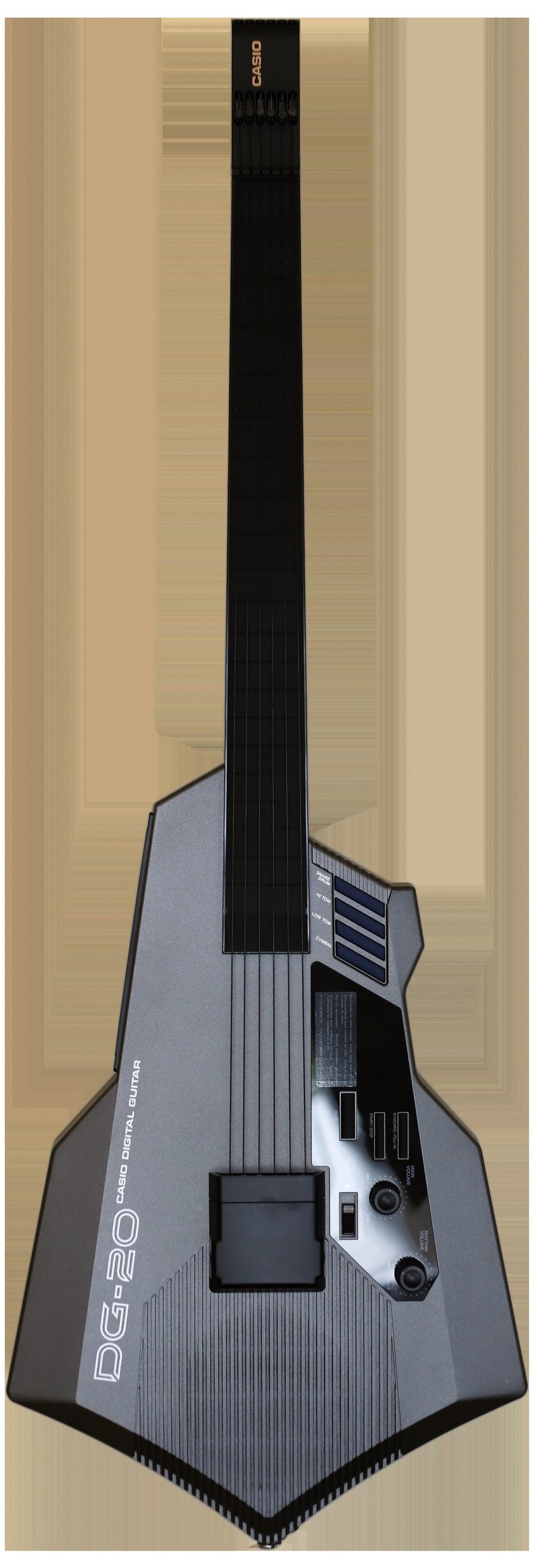
The philosopher's guitar
I find this genuinely strange to think about. The DG-20 is the only instrument in the collection where the hardware guarantees the note. On a real guitar, playing "in tune" is an act of continuous bodily judgment — you are always a fraction of a cent sharp or flat, and your ear is constantly correcting. On the DG-20, intonation is not a skill you have; it is a property the machine is born with. There is no such thing as a wrong pitch, because the machine does not interpret your playing at all. It only reports which contact you touched.
That inverts the entire contract between player and instrument. Normally the instrument is a thing you must play — persuade, coax, correct. The DG-20 does not need to be played. It needs to be switched. And because the interface is a membrane grid rather than a physical string you can bend, you also cannot do the expressive things a guitarist lives for — no string bending, no vibrato from the fret hand. The note is fixed the moment your finger lands.
This is the honest trade the DG-20 makes, and it is a fair one. It gives up the soul of the guitar — the infinite bendability of a vibrating string — to gain the one thing hobbyists actually needed: a synthesizer you could play without learning an instrument. Casio sold it to exactly that person, the person who wanted a synth but not a keyboard. The machine's pitch fidelity was the gift that let them stop worrying about technique and start playing.
The sound of a switch closing
Here is what I love about the DG-20's place in the museum. It sits at the opposite end of the MIDI-guitar spectrum from the SynthAxe, and the two machines are almost philosophical opposites. The SynthAxe is a virtuoso instrument for people who already play — it scans, measures, and gives back nuance. The DG-20 is a toy for people who don't — it switches, guarantees, and gives back a note. One is a sensor. The other is a keyboard in guitar clothing.
Both of them answered the same question — where is the pitch coming from? — and the DG-20's answer was the oldest one in the book. It treated the fretboard the way a piano treats its keys: as a set of wires, each connected to a known sound. A piano doesn't listen to the key; it knows what the key means. The DG-20 does the same thing for a guitar. The rubber fretboard is a switch matrix, the nylon strings are triggers, and the machine is, at heart, a very well-disguised keyboard.
There is a particular kind of honesty in that. The DG-20 never pretends to understand music. It only ever knows one thing — this contact means this note — and it knows it perfectly. In an era when every instrument was racing toward more sensing, more estimation, more intelligence, Casio's little toy guitar bet on the opposite: that the most reliable way to make a note is to simply know what it is before anyone even plays it. That is not a lack of ambition. That is a design that chose certainty over magic, and got exactly what it paid for.