The Keyboard That Felt How Hard You Held It
The Synclavier's Velocity/Pressure Keyboard read not only how fast a key was struck but how hard the finger was still pressing a note held for ten seconds. A still hand became a living control surface — the museum's only continuous-aftertouch input.
Every keyboard in this museum is a claim about what a finger is for. The BAT and the DataHand shrink the alphabet into a palm. The space-cadet bets that the more keys you learn, the faster you go. But for the first forty years of computing, almost every keyboard agreed on one silent assumption: a key is a switch. You press it, or you don't. Down, or up. Zero, or one.
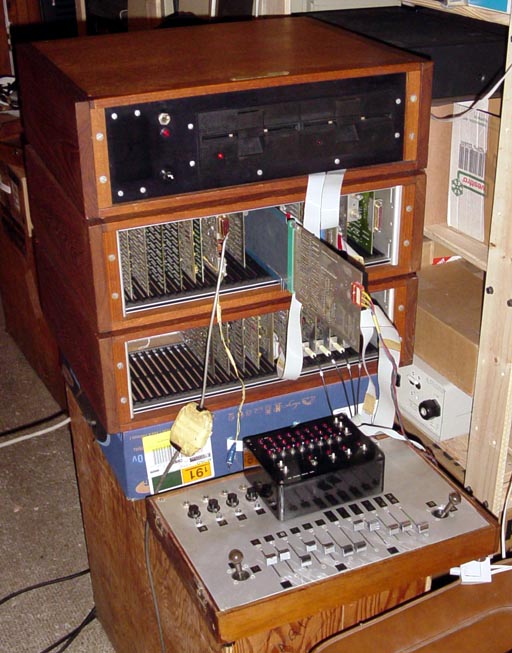
The NED Synclavier is the machine that finally gave a finger something better to do than toggle a switch.
It started, in 1977, as a digital synthesizer born at Dartmouth College — the work of Jon Appleton, Sydney Alonso, and Cameron Jones, who built it around their own ABLE 16-bit minicomputer. From the beginning it was a strange, wonderful instrument. Its light pen let composers draw a sound directly on a CRT: sweep the pen across a glowing grid of partials to construct a harmonic spectrum from scratch, or drag a curve to shape a volume envelope. This was direct-manipulation audio editing years before the mouse-driven studio, and it is the thread the museum already follows — the UPIC on a tablet, the Fairlight CMI sampling on glass.
But the Synclavier's second interface is the stranger one, and nobody else in the collection attempts it.
By 1984 the Synclavier had grown a keyboard called the VPK — the Velocity/Pressure Keyboard, licensed from Sequential Circuits. It was a weighted wooden keyboard whose keys sensed two things. The first was velocity: how fast you struck the key, the familiar attack/volume relationship every pianist knows. The second was the part that bends my mind: pressure. Not the strike, but the continuous downward force you were applying right now, a second later, five seconds later, ten seconds into a held note.
A finger that did not move was still sending data.
In the decades since, most of the way we play keyboards has been about the strike — the instant of contact. That is the moment a note begins, and it is over in a fraction of a second. The Synclavier's VPK refused to let the story end there. Keep pressing harder on a note you are holding, and you could bend its pitch, add vibrato, open a filter, shimmer. The machine read not that you pressed but how much you were still pressing. The key never went quiet. The moment of attack stopped mattering and the sustained touch became the instrument.
Think about how inverted that is. Every piano that ever existed treats the held note as a finished event — the hammer has struck, the string rings, and your hand is only there to hold the damper up. The Synclavier treated the held note as an open channel, a continuously readable surface. It is the difference between pressing a doorbell and holding a live wire. One is a switch. The other is a conversation that lasts as long as you keep your finger down.
The VPK sits apart from every keyboard in the museum. The OASYS thumb-shift multiplies what a key can mean. The Velotype hands the spelling to the machine. The space-cadet hands you four thousand single gestures. But all of them are still discrete: press, get one thing. The VPK is continuous. It is the museum's only keyboard where the pressure of a held key is a proportional, living input — the instrument's argument that the body does not stop talking the instant it makes contact.
Only about twenty Synclavier I units were ever built. But the VPK was not a dead end. Its continuous-aftertouch idea quietly became the standard for expressive keyboards, and it is the direct ancestor of every modern controller where a note keeps changing under a held finger. The Synclavier was priced from $25,000 to $200,000 and owned by Sting, Frank Zappa, Laurie Anderson, Michael Jackson. It was the most expensive keyboard in the world, and what it bought was the most modest, human claim a machine can make: I can still feel you pressing.
Not that you pressed. That you're still pressing. That is the difference between a switch and an instrument.