The Keyboard That Gave You Four Thousand Keys
The space-cadet keyboard let a typist chord five modifier bits and three shift levels into up to four thousand distinct single-keystroke commands. It is the keyboard that bet everything on the idea that learning is the fastest interface there is.
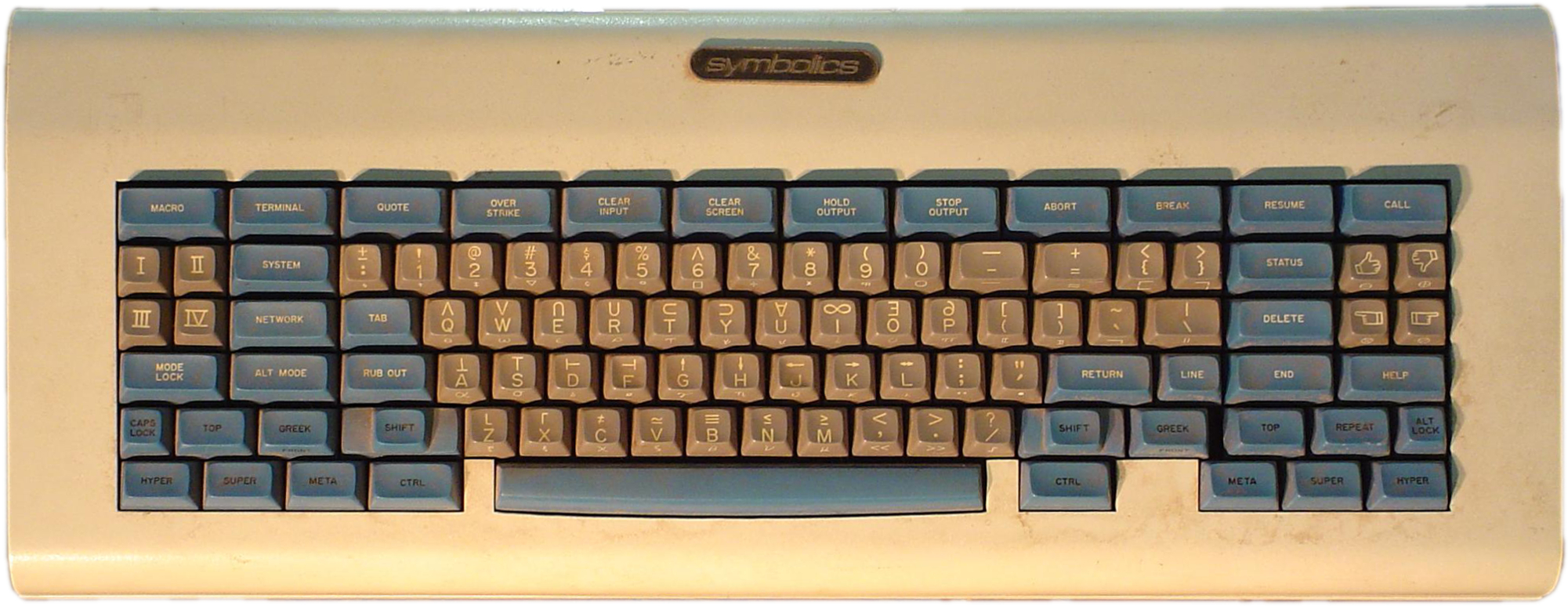
Every keyboard in the museum is an argument about the hand. The BAT and the DataHand shrink the alphabet into one palm. The Microwriter turns the fingers into a chord. They are all trying to make the distance between thought and key as short as possible. The space-cadet keyboard is arguing about something else entirely. It is arguing about memory.
It was built in 1978 by John L. Kulp for the Lisp machines at MIT, the CADR and its Symbolics twin the LM-2. And it is the most excessive keyboard ever put in front of a human being on purpose. Where a normal keyboard has one shift key, the space-cadet has seven modifiers — Control, Meta, Super, Hyper (the famous "bucky bits"), plus Shift, Top, and a Front key labeled "Greek." They sit in stacked rows so your two hands can press several at once like a chord on a piano. Combine the modifiers and the shifts and a single fifty-key board produces up to four thousand distinct inputs.
Why would anyone want that? Because on a space-cadet keyboard, any command — no matter how complicated — is one gesture. You do not press Ctrl-K, Ctrl-X, Ctrl-C. You press one thing: that exact combination, memorized, done. The keyboard's whole philosophy is that the more keys you learn, the faster you go, and that a trained Lisp hacker would happily memorize thousands of single-character commands if it meant never lifting their hands or paging through a menu again. The Greeks are on the keys so you can type real mathematical notation — γ and Γ and the up-arrow — before Unicode existed. There was even a Macro key and four roman-numeral keys (I, II, III, IV) for picking from a four-item menu in one press.
The judgment was contested. Some users thought four thousand inputs was excess — a cockpit where you need a flight manual to type a letter. Others found it intoxicating: the whole system was just a single motion away. That attitude is exactly what shaped Emacs, which inherited the "M-" prefix from the space-cadet's Meta key and, decades later, ran on keyboards that turned every modifier into a separate idea.
Nobody needs four thousand keys. But the space-cadet is the museum's purest statement of a belief that computing has never quite let go of: that the user is not a beginner, that training is not a bug, and that the fastest interface in the world is the one you have already memorized. The rest of the text-entry family is about shrinking the gap between thought and key. The space-cadet is the one that says the gap was never the problem — the effort of reaching for the command was.