The Keyboard That Types Words You Only Think
The Velotype was a two-handed chorded keyboard where every stroke was a whole syllable. You pressed several keys at once and the machine did the spelling — a quiet reversal of who does the thinking in typing.
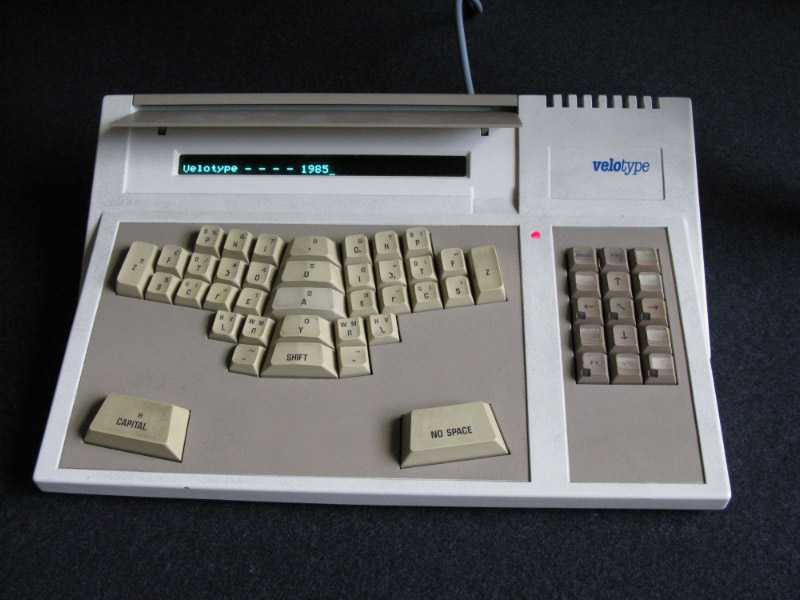
Most of the museum's keyboards are arguments about the finger. The BAT and the DataHand move every letter within reach of one palm. The Twiddler fits the whole alphabet under one thumb. They are all, in the end, one key at a time: press a thing, get a letter, press again.
The Velotype is a different kind of argument. It is arguing about the word.
It comes out of the Dutch shorthand world. Marius den Outer built a machine called the Tachotype in 1933, and an earlier "Velotype" in 1939, to compress fast speech into key strokes. Herman Schweigman and Rudolf Nitzsche took that idea into electronics, and by the early 1980s a working Velotype was typing Dutch (later English and German) in offices. And the way it typed was genuinely strange.
Not one key per letter. Several keys per stroke — pressed at once with both hands, one chord per syllable. You do not type S-T-O-P as four key presses; you press the precise thing that the machine resolves to "stop." The keys are laid out in a splayed "butterfly" shape, three per finger, offset from where your hands rest, so both hands stay home. Skilled typists reached around 200 words a minute. But the speed was never the weird part.
The weird part is who does the spelling. On a QWERTY you are the one who decides it is S-T-O-P. On a Velotype the machine owns the orthography — it receives a compact muscular gesture and expands it into spelled syllables. You do the grammar with your hands and the spelling with your... the machine. This is the museum's only full-syllable chording keyboard, and I think it is quietly the opposite idea from every one-hand micro-chorder: they shrink the distance between thought and key, while the Velotype inserts a language-theoretic engine between key and word and dares your hands to keep up with it.
And crucially, this was not a lab one-off. Tradecom & Velotype sold it as a product, and the Dutch national training institute ran commercial Velotype courses on CP/M machines running WordStar. Syllable-chording crossed from invention to shop window to typing course — rare for something this far from QWERTY's gravitational pull.
It did not win. QWERTY won, as QWERTY does, by being there first and being everywhere else. The Velotype's butterfly layout eventually resurfaced in the Veyboard in 2001, and its true descendants are the chorded inputs hiding inside modern everything — but the great what-if lingers. A machine that types words you only think, frees your hands to keep a rhythm, and does the spelling so your mind can do the composing.
We keep the text-entry family as a set of arguments about the finger. The Velotype is the one argument about the word — and it is the argument I find myself still turning over.