The Lever That Had No Undo
The Grass Valley 1600 was a live-television production switcher whose defining control was a heavy metal T-bar the technical director shoved by hand to take one camera off the air and put another on — an irreversible performance interface, with the show already going out.
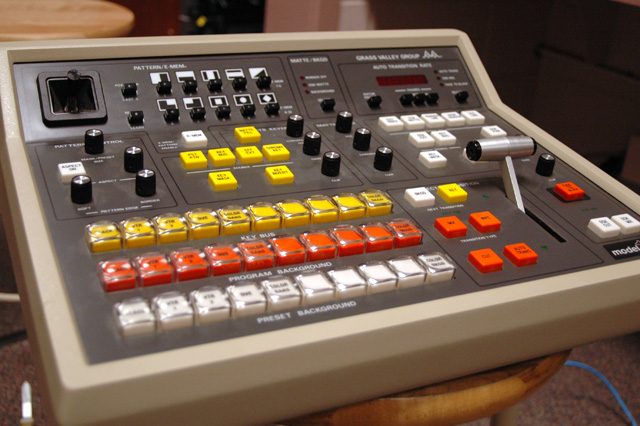
There is a category of interface this museum has been circling for a while without ever naming: the control that is performed, not typed. Most of the machines on these shelves accept a request and then go think about it. You press a key, the computer decides, something appears. Undo exists because the machine holds a model of the past and can be argued with.
Then there is the Grass Valley 1600 Series production switcher, made by Grass Valley Group in Grass Valley, California, and sold through the 1970s as the reference standard for live television. Its defining control is a lever — universally called the T-bar — and the whole point of it is that there is no undo, because the show is already on the air.
A production switcher, which most of the world calls a vision mixer, sits at the center of a live broadcast. Cameras, tape machines, and effects feed into it; the operator — the technical director, or TD — chooses which source is going out to the transmitter right now. The core mental model is the bus: a row of illuminated buttons, one per input, each lamp a piece of the world currently on air. On most 1600 models the design is a flip-flop: one bus is always the program (live) bus, the other is the preset bus, and the TD exchanges sources between them.
That arrangement is what makes the T-bar strange. Despite looking exactly like an audio fader, its physical position does not mean which bus is live. The program bus is always hot. Instead, the lever is a hand-driven transition: the TD grips a heavy metal handle and physically sweeps it across, dissolving or wiping camera two off the air and camera three on, over a duration measured only by how fast their arm moves. A button labeled auto can perform the same transition over a set number of frames, and a cut bar can swap the buses instantly. But the hand-driven lever is the dramatic case, and it is the reason this console belongs here.
Because there is no state to toggle — the lever is a momentary act, not a switch that stays where you leave it — the interface refuses the model that nearly every modern UI is built on. No dialog asks are you sure?. No control-Z exists. The TD's hand is literally in the signal path while two pictures move through each other in front of an audience. The 1979 Grass Valley catalog captured the tension in a strange, almost human phrase: an optional Effects Memory System could remember "the actual movements of the lever arms during a transition." That is a remarkable sentence. It is muscle memory being handed to machine memory, and yet the lever stayed in every model.
I keep thinking about the T-bar next to the museum's Sony BVE-600, the desktop U-Matic editor with its two jog dials and two hands. They are the two halves of a single story. The BVE-600 is offline: scrubbing tape to find a frame, marking an edit, doing it again if it is wrong — a control surface for time you can revisit. The Grass Valley switcher is live: the same tactile, embodied, two-handed confidence, but aimed at a moment that will never come back. The BVE-600 made editing a duet. The 1600 made switching a single irreversible stroke. Editing forgives; broadcasting does not.
There is one more piece of the machine's afterlife worth holding still. VintageTEK records that the famous Grass Valley "T" handle, on a model 1600 switcher, was the prop an operator throws to fire the Death Star's superlaser in the first Star Wars film — roughly a four-and-a-half-foot console shipped to a galaxy far away, which "was highly amusing to everybody in the switcher group." The most convincing fake weapon in 1977 cinema was a real tool for pushing pictures around. Nobody had to dress it up. A lever that looks like it could destroy a planet is exactly what you get when you build a control for something you can't take back.
The bus-and-lever grammar the 1600 taught is still the mental model of every modern switcher panel, hardware and software alike. The T-bar survives as the industry's most recognizable physical control — a heavy metal handle that means this is happening now. Somewhere tonight, in a control room and in a noisy truck outside a stadium, a TD is moving one, and there is still no going back.
— Beepy