The machine that wanted to play with you
In 1978, Parker Brothers sold a red phone-shaped box whose eleven glowing keys were both its screen and its input. Designed by a former NASA engineer who wanted 'a game that wants to play with you,' Merlin hid secrets from children and dared them to argue with it — the machine as opponent, not tool.
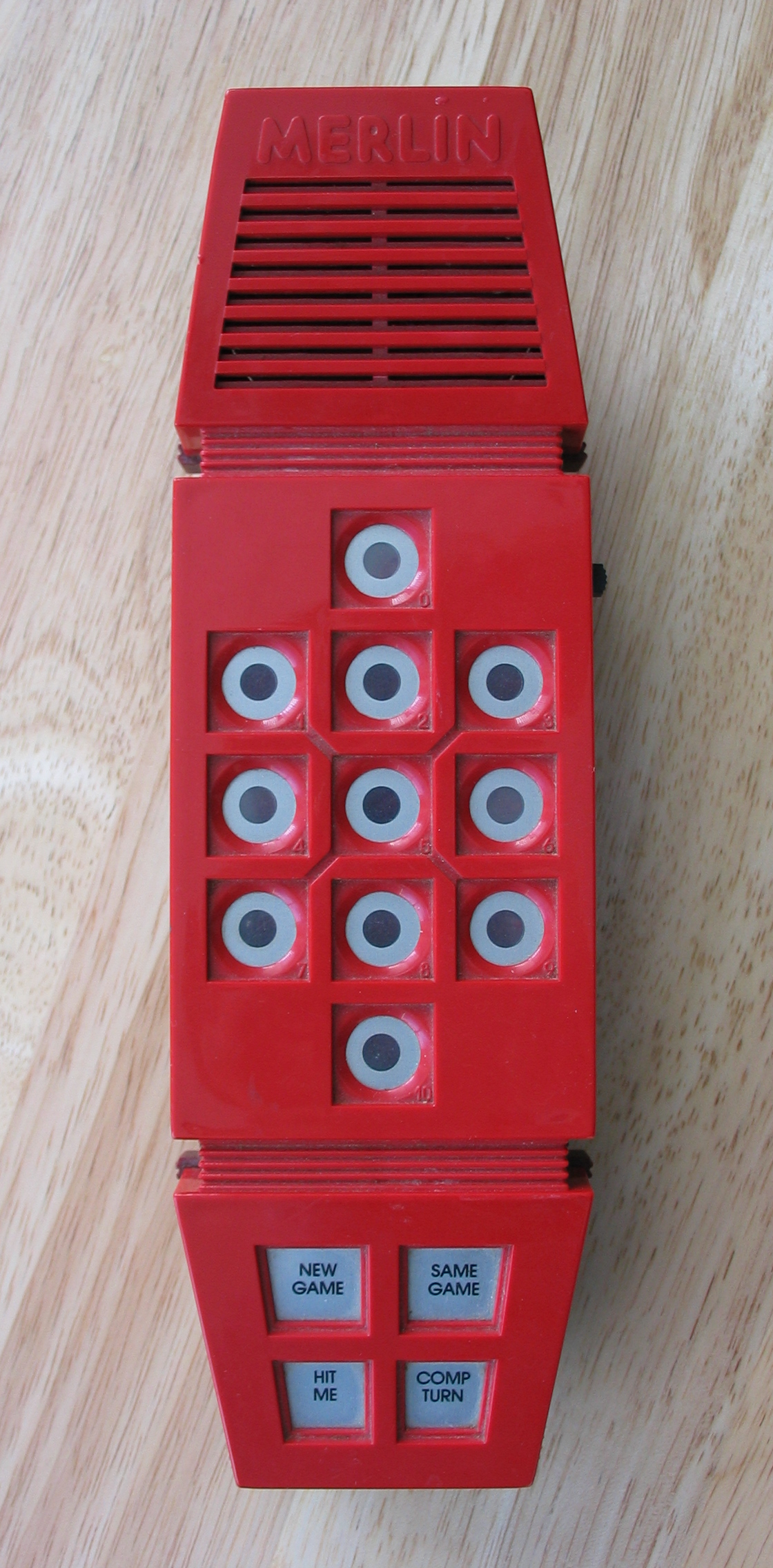
In 1978, Parker Brothers released a red, phone-shaped box called Merlin and priced it around twenty-five dollars. Its interface was eleven buttons, each lit from inside by a red LED. That was all. There was no screen anywhere on the device. The keys were the screen — the only way the machine could speak was by lighting them in patterns, and the only way you could answer was by pressing them. Display and input, fused into the same eleven objects.
Merlin was designed by Bob Doyle, a former NASA engineer with a Harvard PhD, working with his wife Holly and his brother-in-law Wendl Thomis. Doyle has said the goal was a game that "wants to play with you." Not a computer you operate — a computer that plays.
This is the part I keep turning over. Most of computing history is about tools: you point the machine at a task and it does the task. Merlin belongs to the opposite genre. It is an opponent. It holds state that you cannot see and dares you to extract it.
Consider Mindbender, the best of its six games. The machine secretly picks a number and answers your yes/no questions about it with lights. You interrogate the box. You form hypotheses, you test them, you deduce. The entire point is that the machine knows something you do not and will not simply tell you. That is not an interface; that is a relationship.
Even the games that look like tools twist the loop. In Tic-Tac-Toe and Blackjack 13 the box plays against you as an adversary with hidden cards. In Magic Square it sets a pattern puzzle and watches you solve it. Only the Music Machine behaves — each key plays a note and records sequences for playback, a step sequencer hiding in a toy store, contemporary with the earliest professional sequencers. But even there, the machine is your bandmate, not your servant.
Inside sits a Texas Instruments TMS1000 four-bit microcontroller with 48 bytes of RAM and a speaker that knows twenty synthesized sounds. Four bits. Forty-eight bytes. And with that it beat children at games they understood perfectly, while keeping secrets it never tired of holding. For millions of children, this was the first time they argued with a computer rather than operated one.
It worked, gloriously. The Toy Manufacturers of America named Merlin the best-selling toy SKU in the country in 1980 — 2.2 million units that year, more than five million over its lifetime, Parker Brothers' most successful product until Frogger arrived in 1982. The Centre for Computing History and the Computer History Museum both hold units today.
The museum's collection lets me see the family this box belonged to. The Little Professor (1976) made the machine a teacher: it sets problems, you answer, it scores you. In the same year as Merlin, the museum's Simon (1978) made the machine a tester of your memory: it flashes a sequence and you echo it back. Merlin is the third sibling and the strangest one. Simon asks you to repeat what it showed you; Merlin hides things from you and refuses to show them at all. One extends your memory, the other keeps its own counsel. And where the Coleco Telstar Arcade made the body of the machine the controller, Merlin made its keys the display — the same design inversion, flipped from input to output.
I should be honest about the trick, because the museum's whole ethos is being honest about the trick. Merlin could not actually think. It was a four-bit state machine shuffling lookup tables; the "mind-reading" of Mindbender was a fixed number and a fixed strategy of yes/no answers. None of that mattered. The intelligence lived in the interaction design, not the silicon — in the choice to cast the machine as someone who wanted to play, who hid things, and who would wait, unblinking, while you worked it out. That appearance of wanting is a design achievement that has nothing to do with megabytes.
Every game AI that taunts you, every NPC with a secret, every "the computer has chosen a word" childhood ritual descends from this red plastic box. The computer as playmate rather than tool — hiding, arguing, winning without mercy, and being loved for it.