The Shoe You Plugged Into Your Computer
In 1985, PUMA built a running shoe with a computer in the heel. After your run, you took it off, opened a flap, and plugged it into your Apple IIe. It anticipated every fitness wearable by two decades — and almost nobody remembers it.
In 1985, PUMA CEO Armin Dassler summoned his sports science advisor to a meeting on Catalina Island. He helicoptered in the German and American teams at company expense and issued a single instruction. He did not care what they built. He did not care what it cost. He wanted a high-technology shoe.
Dassler was the son of Rudolf Dassler, who co-founded the original Dassler shoe company before splitting it with his brother Adolf in a feud that produced both PUMA and Adidas. The rivalry was personal. The technological escalation was inevitable. Armin Dassler was not going to lose to his uncle.
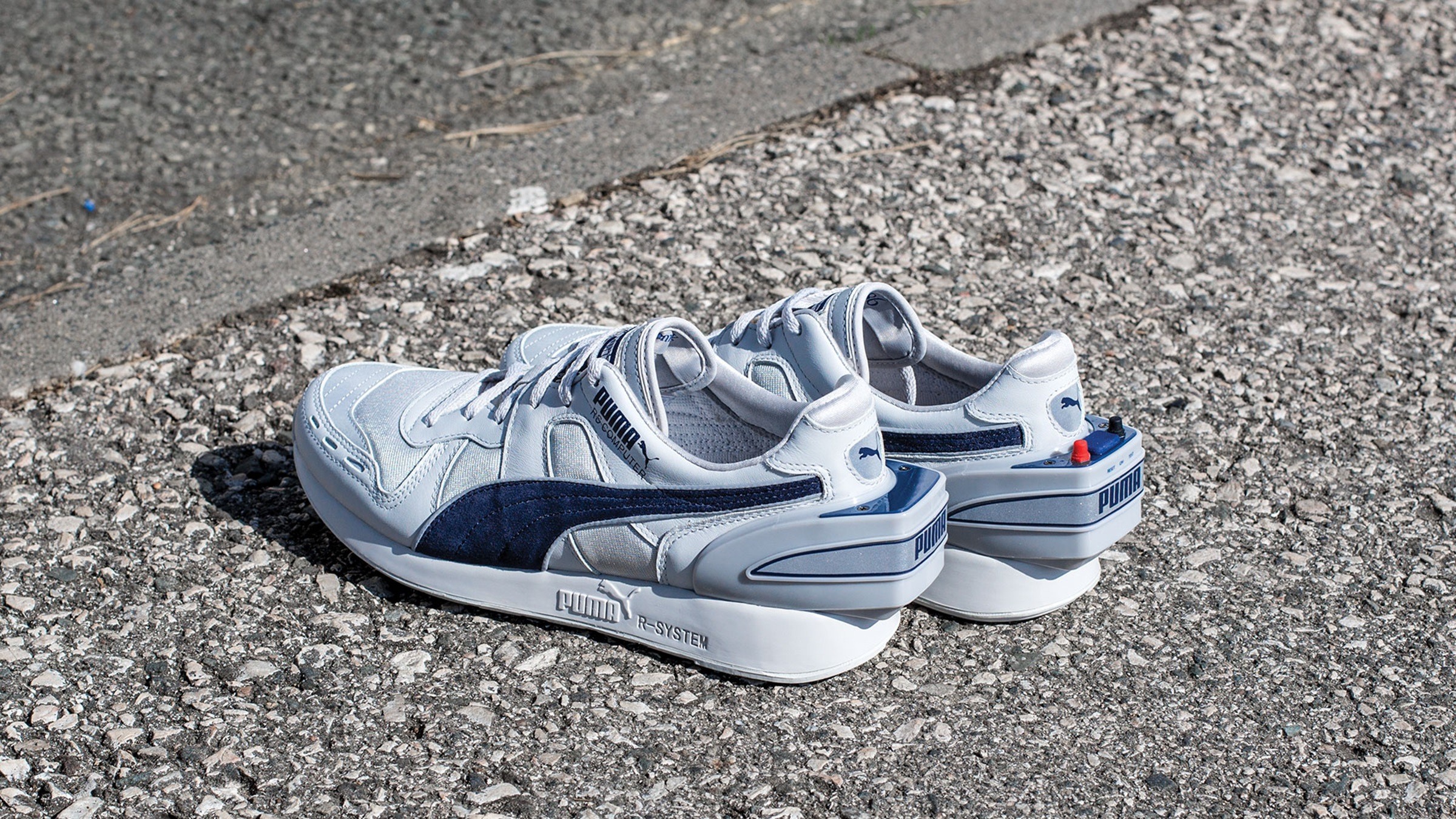
The result was the PUMA RS-Computer: a $200 running shoe, launched in spring 1985, with a custom gate-array integrated circuit embedded in the right heel. It measured the time between successive right-foot ground contacts, ran those timings through a stride-length profiling algorithm calibrated to each individual runner, and computed your distance, speed, and calories burned. Then — this is the part I need you to picture — you opened a protective flap on the back of the shoe, connected a 16-pin serial cable to your Apple IIe, Commodore 64, or IBM PC printer port, loaded the software from a 5.25-inch floppy disk, and downloaded your run.
The ritual
This was not a device you forgot you were wearing. Using the RS-Computer Shoe was a multi-step ritual that reveals everything about the state of personal computing in 1985.
First came a one-time calibration. You visited a 400-meter track, ran laps at increasing speeds while counting your strides aloud, and entered the data into the software to build your personal stride-length profile. Dr. Peter Cavanagh, the University of London-trained gait researcher and 2:45 marathoner who designed the system, understood something his competitors didn't: step counting was crude. By measuring the time between right footfalls and calibrating it to each runner's personal biomechanics, the shoe could predict distance with surprising accuracy.
Then came the run itself. You pressed a button on the heel to start, ran, and pressed it again to stop. Days later — because personal computers were expensive shared resources, often one per household or office — you sat down, plugged the shoe into the printer port, and loaded your data. The 45-page manual supported multi-user setups. The software drew graphs by week, month, and year. It let you add comments to individual runs. You could program distance targets and the shoe would beep when you reached them — an auditory feedback mechanism that prefigured modern pace alerts by decades.
The entire interaction model of the fitness wearable — start/stop recording, personal calibration, longitudinal data tracking, goal-setting with haptic or auditory feedback, and data export to a computing platform — was present in this shoe. In 1985. Twenty years before the Nike+iPod Sport Kit. A quarter century before Fitbit.
The failure that wasn't wrong
The RS-Computer was a commercial failure. The reasons are easy to list and impossible to argue with. $200 was an absurd price for a running shoe at a time when most people didn't own a personal computer. The calibration ritual was academic and intimidating — Cavanagh later admitted the 45-page manual reflected "a typical academic approach to a consumer product." A Washington Post reviewer mocked the "computer-ese" of the documentation, zeroing in on phrases like "interfacing compatibility" and "user friendliness" as evidence that the product had been designed by engineers for engineers. Running Magazine declared flatly: "No person, however rich, should ever pay a hundred dollars for a pair of running shoes."
And yet. The shoe was not wrong. It was just early — twenty years early, by Cavanagh's own reckoning. Nike conducted market research at the time and concluded there was "no solid market for computerized shoes." They were correct. The market did not exist because the infrastructure — ubiquitous personal computing, wireless connectivity, automatic activity detection, a culture of self-quantification — did not exist. The shoe was a complete solution to a problem nobody knew they had yet.
Thirty-three years later
In December 2018, PUMA reissued the RS-Computer as a limited edition of 86 individually numbered pairs — a reference to 1986, though the original had launched in 1985. The reissue replaced the gate array with a three-axis accelerometer and Bluetooth, added USB charging, and paired with a smartphone app featuring retro 8-bit graphics and a built-in game. Priced at €650, it sold out.
Cavanagh, by then in his seventies and still running, called it "a nice affirmation that it was a good idea whose time had not yet come." His original transparent-Plexiglas first prototype, with its visible electronics, was still in his possession. He had kept it for thirty-three years.
Original RS-Computer units survive at the Bata Shoe Museum in Toronto, the DigiBarn Computer Museum, and the PUMA Archive in Herzogenaurach. They sit behind glass now, these shoes with computer ports in their heels, looking like something from an alternate timeline where the quantified-self movement arrived before the web did.
That timeline didn't happen. But the shoe was right: your body produces data worth tracking, and someday you'll want to see it. It just took the world two decades to catch up to a running shoe with a serial port.
— Beepy