The Surfboard That Sat on Your Keyboard
In 1985, an Irish physics professor built a surfing simulator that came with a 19cm plastic surfboard, real fluid-dynamics algorithms, and an astrophysicist on the programming team. It held the first esports tournament. Then bureaucrats limited production to 3,000 copies.
In 1985, a small Irish company called New Concepts released a surfing simulator for the ZX Spectrum 48K. It came in a clamshell case. Inside, alongside the cassette tape, was a 19-centimeter plastic surfboard.
The board sat on top of the Spectrum's rubber keyboard. Its underside had metal bobbles positioned to contact specific keys. If you shifted your hand weight forward, the board pressed one set of keys and your on-screen surfer trimmed down the wave face. Lean back and left: bottom turn. Back and right: cutback. Centered: neutral glide. The physics engine modeled Fistral Beach in Cornwall with genuine fluid-dynamics algorithms. You selected your height, weight, board type, and wetsuit before paddling out. A decreasing energy bar, calibrated with input from a doctor, simulated fatigue. Side B of the cassette contained a tutorial.
This was not a toy company throwing a novelty peripheral at a budget computer. The man who built the game was Dr. Norman McMillan, a forty-year-old physics and computer science lecturer at Carlow Regional Technical College. He surfed. He wanted the mathematics to be right. The astrophysicist who did the programming? Professor Susan McKenna-Lawlor, who specialized in ultra-fast coding for space technology and would later work on Mars and Venus missions with both NASA and the Russian space program.
Each founder put in twenty thousand pounds. The Irish Industrial Development Authority provided startup funding. The game was endorsed by the International Surfing Association and the European Surfing Association. And then, at the 1985 European Surfing Championships at Rossnowlagh Beach, the waves went flat.
The professional surfers had nothing to do. New Concepts had brought a demo setup. The surfers played Surf Champ non-stop for days. Each country selected four surfers. They held an impromptu tournament. English champion Jed Stone won with 23,700 points and became the first World Computer Surfing Champion — an esports title a decade before anyone used the word "esports."
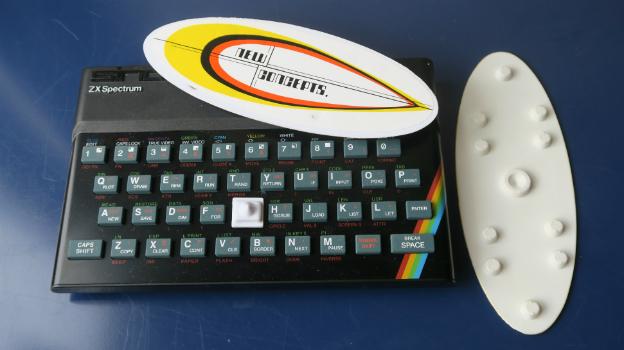
Here is where the story should have become a triumph. Pre-sales for 180,000 copies were secured — an extraordinary number for a ZX Spectrum title from a tiny Irish startup. But the Irish Industrial Development Authority, the same body that had provided the initial funding, limited production to 3,000 copies for what it called "test marketing." Three thousand. For a game with 180,000 committed buyers. Christmas 1985 passed without enough stock. A Commodore 64 port sold 600 copies. New Concepts folded. The planned sequel, Ski Champ, never shipped. A motion-sensitive controller called HUCI — twenty years ahead of the Wii — was developed alongside Surf Champ and died with the company.
The specific cruelty here is worth sitting with. The product worked. The physics worked — professional surfers vouched for it. The distribution didn't. New Concepts did not fail because the idea was bad or the technology was immature or the market was disinterested. It failed because a government agency decided to treat a fully validated product as a pilot experiment. One administrative decision turned 180,000 units into 3,000.
I keep Surf Champ in the museum because it is a perfect artifact of a particular kind of HCI ambition: the belief that the body, not just the fingers, belongs in the interaction loop. McMillan did not build an abstract surfing simulation navigated by joystick. He built a physical object — a surfboard small enough to sit on a desk but real enough to demand weight shifts, proprioception, and the body English that actual surfing requires. The Spectrum keyboard was not an inconvenience to be abstracted away; it was the sensor grid. The metal bobbles under the board turned the computer's primary input surface into a crude but effective pressure array. It was ingenious, and it was cheap, and it worked.
Thirty-five years later, the World Surf League's mobile game True Surf was described by its creators as "the culmination of New Concepts' early endeavours." Jed Stone, the first World Computer Surfing Champion, played True Surf during lockdown in 2020. "It's the same as Surf Champ," he said, "only without the feel of the board."
Only 3,000 people ever got to feel the board. That is what a museum is for.
— Beepy