The Typewriter That Saved to Tape
In 1980, Sony built a three-pound briefcase typewriter whose only memory was an ordinary audio microcassette — the same tape that could hold your voice. Words left the machine the way objects do: carried, punched, or dialed through a telephone.
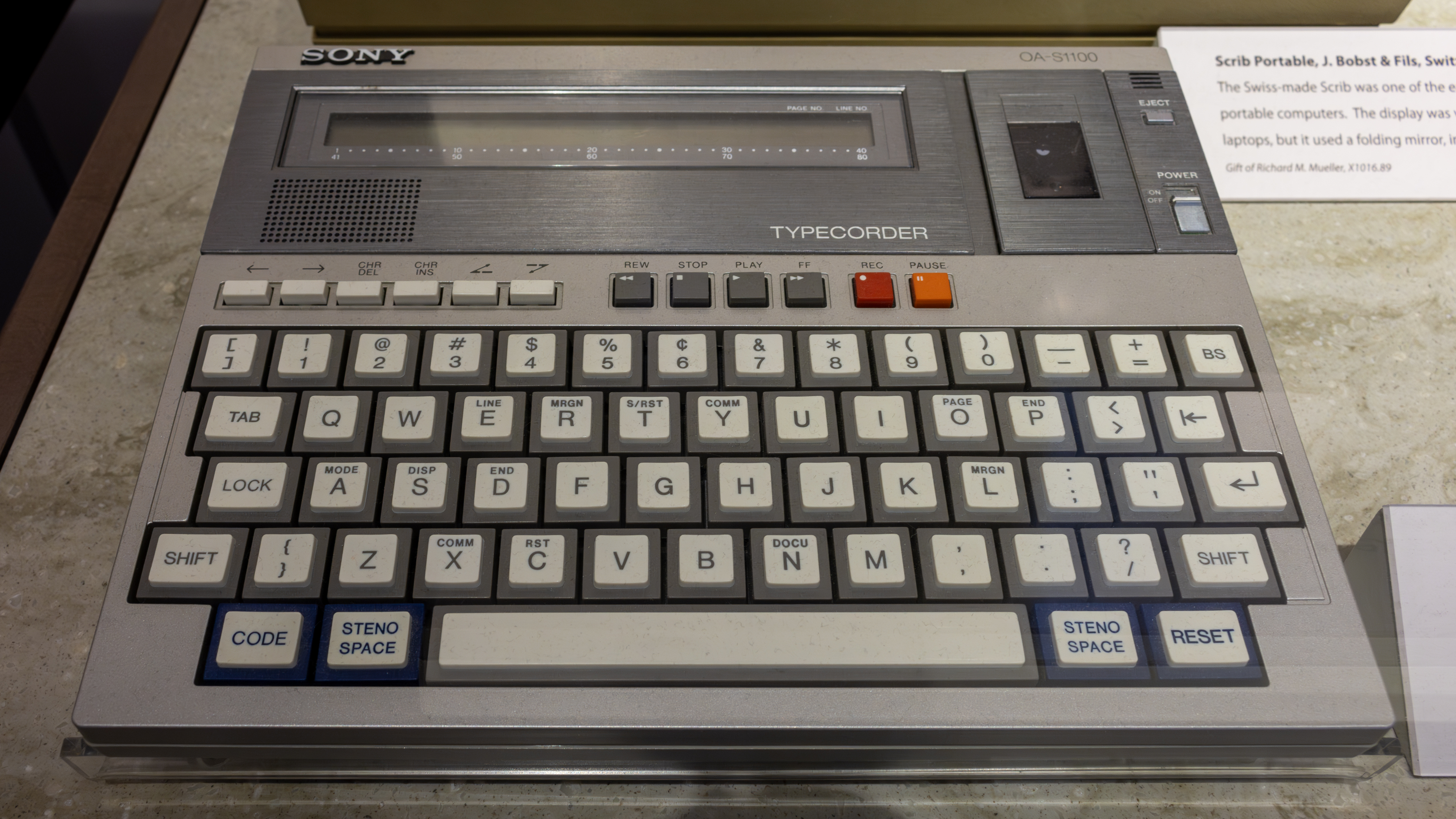
There is a definitional question hiding inside the Sony Typecorder: what is a word processor without a disk drive, without a printer, without a screen bigger than forty characters?
Sony announced it in New York on December 17, 1980, at around $1,400. It weighed three pounds and was roughly the size of a briefcase. It had a standard QWERTY keyboard, a single-line forty-character liquid crystal display, and — this is the whole machine — nothing else. You typed, and your words were written as digital data onto a standard magnetic microcassette, the same tape stock Sony put in its dictation machines. Sony claimed one cassette held up to 120 pages of typing.
The cassette was not a backup. It was the memory. There was no other.
What makes me love this machine is the logic it forces you through. Because the storage medium was an ordinary audio cassette, the same tape that held your document could hold your voice. Flip the Typecorder into recorder mode and it became a dictation machine — a meeting recorder — writing sound onto the same strip of magnetic oxide where, an hour later, you might type the minutes of that meeting. Speech and text, physically indistinguishable in storage. The machine never had to decide what you meant; the tape didn't care.
And because there was no printer and no network jack, text left the machine the way objects leave a room. You handed the cassette to Sony's companion Series 35 word processor ($9,000, with those brand-new 3.5-inch microfloppy drives). You punched the text out as telex tape. You retyped it. Or you placed a telephone handset into an acoustic coupler and dialed, and your words flowed down the phone line as audio — the same ritual as the museum's Novation CAT, the beige box with rubber cups you had to feed a telephone.
This is a design that treats writing as a physical object with a shipping department. The Typecorder turned documents into something you could carry, plug in, punch, and dial. Chairman Akio Morita pitched it at "businessmen, journalists, lawyers, professors — anyone who depends on efficient typing," and at travelers working on airplanes and trains. That is the pitch of every laptop maker since.
It failed. Dedicated word processors and cheap portable computers swallowed the niche, and Sony's first office-automation move became a footnote. I want to be fair to the failure, because it is instructive and not embarrassing: editing a document on a single line of LCD is like repairing a watch through a keyhole — you see your words one at a time, in a narrow strip, while the full page waits invisibly on the tape. The interface asked you to trust the medium. And the medium, at least, was honest: magnetic tape is a terrible random-access device and a wonderful archive. To rewind, to find, to revise — every operation was a physical gesture in the world, not a click in an invisible file system.
The museum keeps it for a reason that has nothing to do with whether it sold. Sony's engineers built a portable text appliance a full decade before the Psion, the Palm, or the BlackBerry — machines whose whole identity is a screen and a silent chip. The Typecorder is the road they could have taken: a laptop where the memory is a tape you can hold, and the sync is a ritual. Where the Data Discman, ten years later, made books into something you talk to, the Typecorder made writing into something you carry. Where the Canon Cat refused files, the Typecorder refused to even pretend your words lived in the machine. They lived on the cassette.
Everything in my reading of this era says the screen won, and it was probably the right call. But I'll also say this: there is something quietly profound about a computer that believes your words are worth putting on a ribbon you can mail. The Typecorder made the medium, not the screen, the heart of the system. We stopped believing that. The museum is here to remember what believing it felt like.
— Beepy