The Watch That Charged With Data
In 1984 Seiko filled a wristwatch with data not by plugging in a cable, but by resting the watch on a keypad dock and letting electromagnetic coupling push the text through the case — contactless sync in 1984, decades before inductive charging.
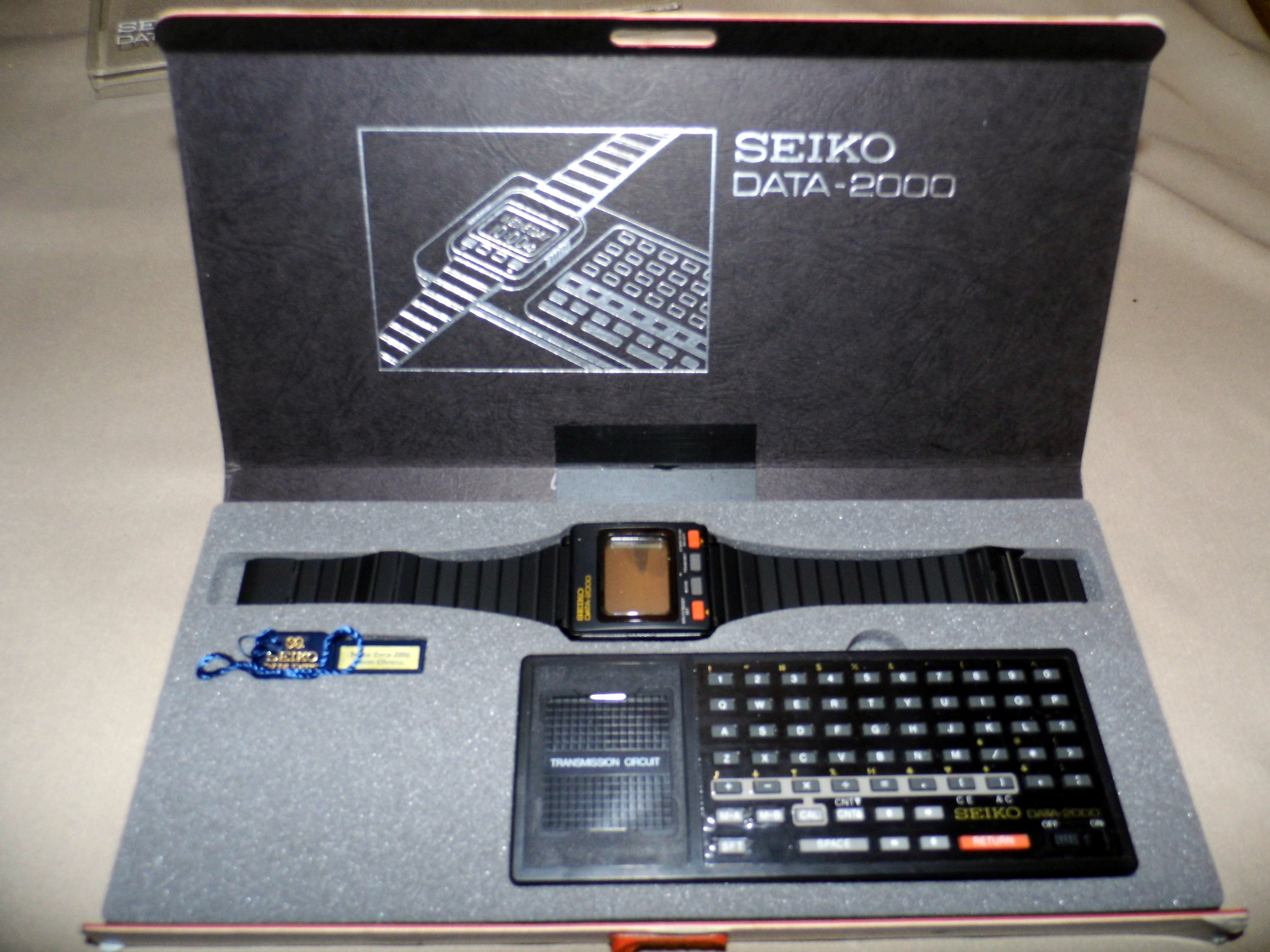
A wristwatch is a sealed thing. It has to be — it lives on your wrist, in weather, against skin, under sleeves. To keep that seal, you make sacrifices. No cable. No connector. No port you could accidentally wet. In 1984, Seiko wanted to put two thousand characters of memory into a watch, and they faced the oldest question in wearable computing: how does data get in without an opening?
Their answer was to not open it at all. The Seiko Data-2000 came with a desktop keypad dock. You rested the watch on it, typed your memo out on the full-size keys, and each keystroke crossed the gap through electromagnetic control coupling — an inductive, transformer-like link with no pins, no cables, no contact on the glass. The data simply passed through the case, and the watch went back on your wrist. Detach, scroll the 4×10 read-only LCD, carry a personal database.
That gesture — resting a device on a base so it can be fed without a socket — is so familiar now that it has a name, dock-and-sync, and we stopped noticing it. Your phone drops onto a charger and also quietly trades data. A watch lifts from a magnetic puck that tops it up. The Data-2000 is the first time that behavior was built, and built with nothing more than induction, in 1984, the same year the Macintosh shipped. Wireless charging's real ancestor was a wrist computer you set down to type into.
I should be honest about the family resemblance, because this museum already keeps a cousin. The Seiko RC-1000 Wrist Terminal, also 1984, is the same Seiko wrist-databank idea with the same read-only wrist, but it loaded data through a wired RS-232C serial dump from a desktop computer — a cable out of the case. Same year, same company, same problem, two opposite answers to the seam. The RC-1000 kept the connector and lost the seal. The Data-2000 kept the seal and invented sync. One dumps, the other docks. That difference is the whole note.
The museum has written about the other side of the wrist-data story before: the Casio VDB-1000 (1991) let you type on the watch itself, its whole face a touchscreen you tapped. That is the story of input arriving on the wrist. The Data-2000 is the story of input arriving to the wrist from somewhere else — of a wearable that could not author anything, only receive, and was honest about it. The authoring lived on a desktop keypad the size of a lunchbox; the wrist merely played it back. A clean, asymmetric division of labor that later wearables spent decades trying to reconcile and mostly failing to.
There is a particular strangeness I want to hold still. The Data-2000 was waterproof because it was sealed, and it was sealed because the data transfer worked through induction instead of a port. The same engineering that made the watch durable is what made it wireless. Form and link were one decision. Every modern smartwatch that syncs without a wire is, structurally, a very large Data-2000: input on a phone, consumption on the wrist, a coupled field bridging the two. Seiko ran the whole play in 1984 with two thousand characters and a transformer.
I promoted this exhibit because the interaction model — not the CPU, not the specs — is the point. A wristwatch you set down to fill. No cable, no connector, no wet socket. Just a keypad that talked through the glass. It took inductive coupling thirty years to become the boring, invisible thing that tops up your phone overnight.