Active Badge
Your location, broadcast every 10 seconds
Overview
The Active Badge system was one of the first building-scale indoor location systems. Developed at the Olivetti Research Laboratory (ORL) in Cambridge, England, it let a computer system track where people were inside an office by having them wear small infrared badges. The idea pioneered “location-aware” or context-aware computing: applications could route phone calls, find colleagues, or move virtual desktops based on a person’s physical location.
Deep dive
The Olivetti Research Laboratory was founded in 1986 by Hermann Hauser and Andy Hopper after Olivetti acquired Acorn Computers. The Active Badge was conceived, designed, and prototyped between 1989 and 1992.
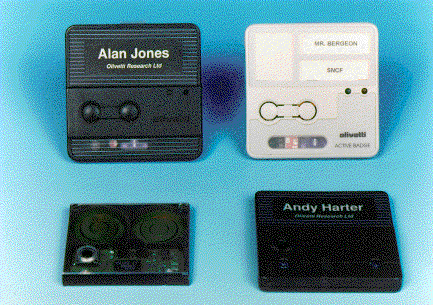
Each badge was a small wearable device that transmitted a unique infrared signal every 10 seconds. Rooms were equipped with networked sensors that received these signals and forwarded them to a central location service. The original badge sent a 5-bit unique code; later versions expanded to 10-bit and then 48-bit addresses, with the final version adding a microprocessor and bi-directional communication. Because infrared signals do not pass through walls, the system could locate a badge at roughly room-level granularity. * Location information was exposed through a web service called the WWW Active Badge Service.
Deployments reached over 1,500 badges and 2,000 sensors across European universities and U.S. research labs. The largest single site was the Cambridge University Computer Laboratory, with more than 200 badges and 300 sensors in daily use. The system enabled early “follow-me” applications such as phone call forwarding and moving a user’s desktop session as they walked between rooms.
The Active Badge is widely cited as a foundational system for indoor localization, context-aware computing, and what later became known as sentient/ubiquitous computing. Follow-up work evolved into the Active Bat ultrasonic system and the broader Sentient Computing project.
The Active Badge was once the subject of a cartoon in a British national newspaper. The system raised early privacy questions: wearing a badge that broadcasts your location every few seconds was a novel social concern in the early 1990s. * ORL later became AT&T Laboratories Cambridge and is also famous for developing VNC.
Team & pioneers
- Roy Want Researcher at Olivetti Research Ltd.; led development of the infrared Active Badge system.
- Andy Hopper Director of Olivetti Research Ltd. in Cambridge, UK; championed ubiquitous computing and location-aware systems.
- Olivetti Research Ltd. (ORL) The Cambridge lab that produced the Active Badge and explored the social implications of always-on location tracking.
Media
Sources
- Cambridge Computer Laboratory, “The Active Badge System.”
- Cambridge Computer Laboratory, “The Active Badge.”
- Roy Want, Andy Hopper, Veronica Falcão, Jonathan Gibbons, “The Active Badge Location System,” ACM Transactions on Information Systems, Jan 1992.
- Wikipedia, “Olivetti Research Laboratory.”
- Microsoft Research, “Location-Aware Computing Comes of Age,” IEEE Computer, 2004.
- YouTube, “The Active Badge System | ACM SIGCHI.”