Air Traffic Control Flight Progress Strips
A strip of paper in a plastic rack whose position, tilt, and pen colour are as much data as its printed text — the physical original of the word 'handoff'
Overview
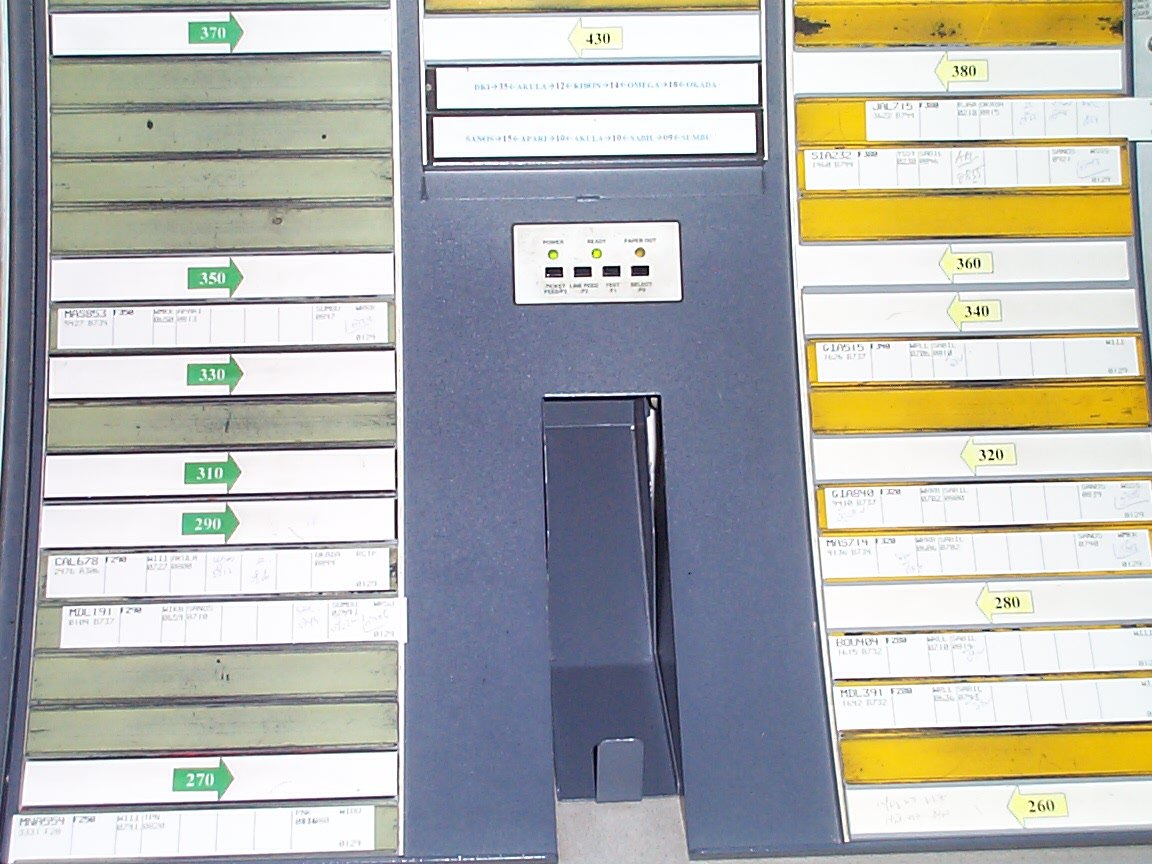
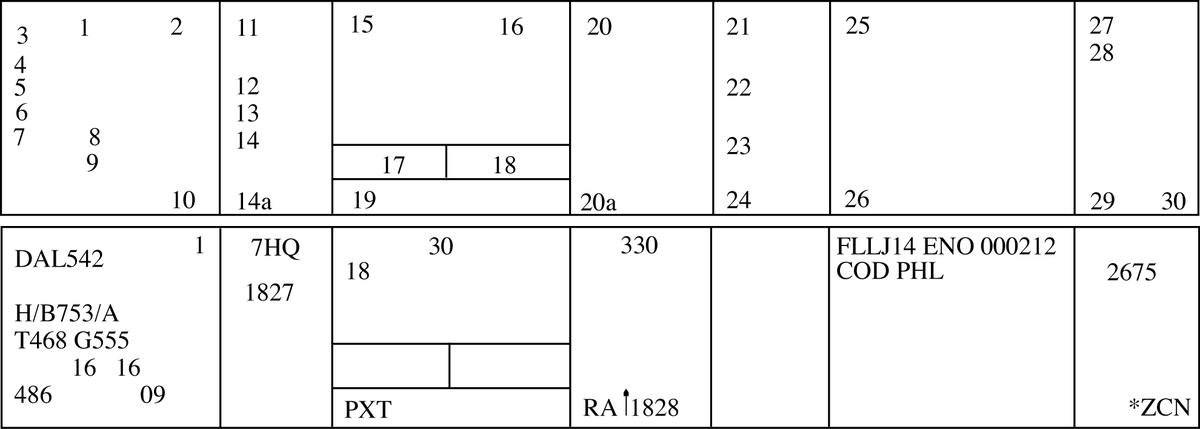
A flight progress strip (or "flight strip") is a small strip of paper used to track an individual flight in air traffic control. The strip is mounted in a plastic "strip holder" and placed with others in a "strip board," a rack with vertical rails that constrain the strips into several stacks, or bays. Together the strips in a board represent all the flights in a particular sector of airspace or on an aerodrome, and the position of each strip on the board is itself information: approach and area controllers typically keep strips in level/altitude order, while tower controllers use the bays to represent the ground, the runway, and the air. A strip may be "cocked out" — deliberately offset from normal alignment — as a personal reminder or as a communication to other controllers. Strips are computer-printed for filed flight plans and then annotated by hand with colored pens whose colors denote the role of the person making the note; free-calling aircraft have fully hand-written strips. The system has been supplemented by radar and by electronic flight strips, but is still used today in many places as a quick annotation surface, a legal record of issued instructions, and a way to let others see instantly what is happening. The museum-relevant object is not a machine but a disciplined physical medium: data lives in paper, plastic, ink, and arrangement.
Deep dive
The central interaction idea is that a strip's location on the board is a second data channel alongside the text on the strip. Approach and area controllers keep their strips in level/altitude order, so the vertical ordering of the board encodes a sector's altitude profile at a glance. Tower controllers instead use the bays to represent the ground, the runway, and the air, so a strip crossing bays represents an aircraft progressing through a procedural state. Special strips and metal bars can subdivide a bay further to show airspace statuses, physical obstructions, or vehicles on the ground. A controller can read a whole sector's state by scanning arrangement rather than parsing text — the board is a physical dashboard whose layout is the model.
A strip can be "cocked out," offset from the normal alignment, to highlight a potential issue — a private reminder or a message to a colleague. This is a tiny, silent, embodied gesture: the diagonal of a paper strip becomes a flag. Then annotation: for filed flight plans the strip is printed by a computer, but controllers and assistants add further information in colored pens, with color encoding the role of the person who wrote it. Authorship is legible from color, so a strip becomes a layered, auditable conversation between controllers. The medium supports a kind of traceability and low-friction editing that early electronic replacements struggled to match.
The system's most revealing legacy is linguistic. The term "handoff" — today a routine word for the computerized transfer of control of an aircraft from one sector to another — comes from the older technique of physically handing the flight progress strip to the next controller to denote transfer of responsibility. In some towers the ground controller may still physically hand the strip to the local controller as the aircraft reaches the runway, or drop it down a chute to the departure radar controller below once takeoff is cleared. The ritual of transferring a physical token of responsibility was so central that its name became the name of the abstract operation. It is a peerless example of physical convention becoming digital vocabulary.
Electronic flight progress strips, generally on touchscreens, reproduce the flight information while trying to keep some of the physical character of paper strips and strip racks. The transition has not been problem-free: physical strips have characteristics a computer system cannot easily replicate — glanceability of arrangement, cheap annotation with pens, the ability to cock a strip, the tangible token for a handoff, and the resilience of paper when the network is down. For the museum, the strips are a case study in why a purely graphical replacement can lose embodied affordances, and a reminder that "interface" can mean a procedure and a set of objects rather than a screen.
Team & pioneers
- Air traffic control practice (FAA and international). A procedural system evolved by controllers and aviation authorities rather than a single product's engineering team.
- Federal Aviation Administration (FAA). US authority that codified flight progress strip use (FAAO 7110.65) and supplied public-domain example imagery.
Media
Sources
- Wikipedia — Flight progress strip (strip holder, strip board, bays, altitude order, cocked out, colored-pen annotation, handoff origin, electronic replacement)
- FAA — Instrument Flying Handbook, Ch. 2 "The Air Traffic Control System" (FAA-H-8083-15B, 2012)
- Wikimedia Commons — File:Flight Progress Strip.png (public domain, FAA)
- Wikimedia Commons — File:Flight control strip at Jakarta control.jpg (public domain)