Big Trak
A programmable toy tank with a membrane keypad and a Texas Instruments brain, executing 16-step programs in the physical world
Overview
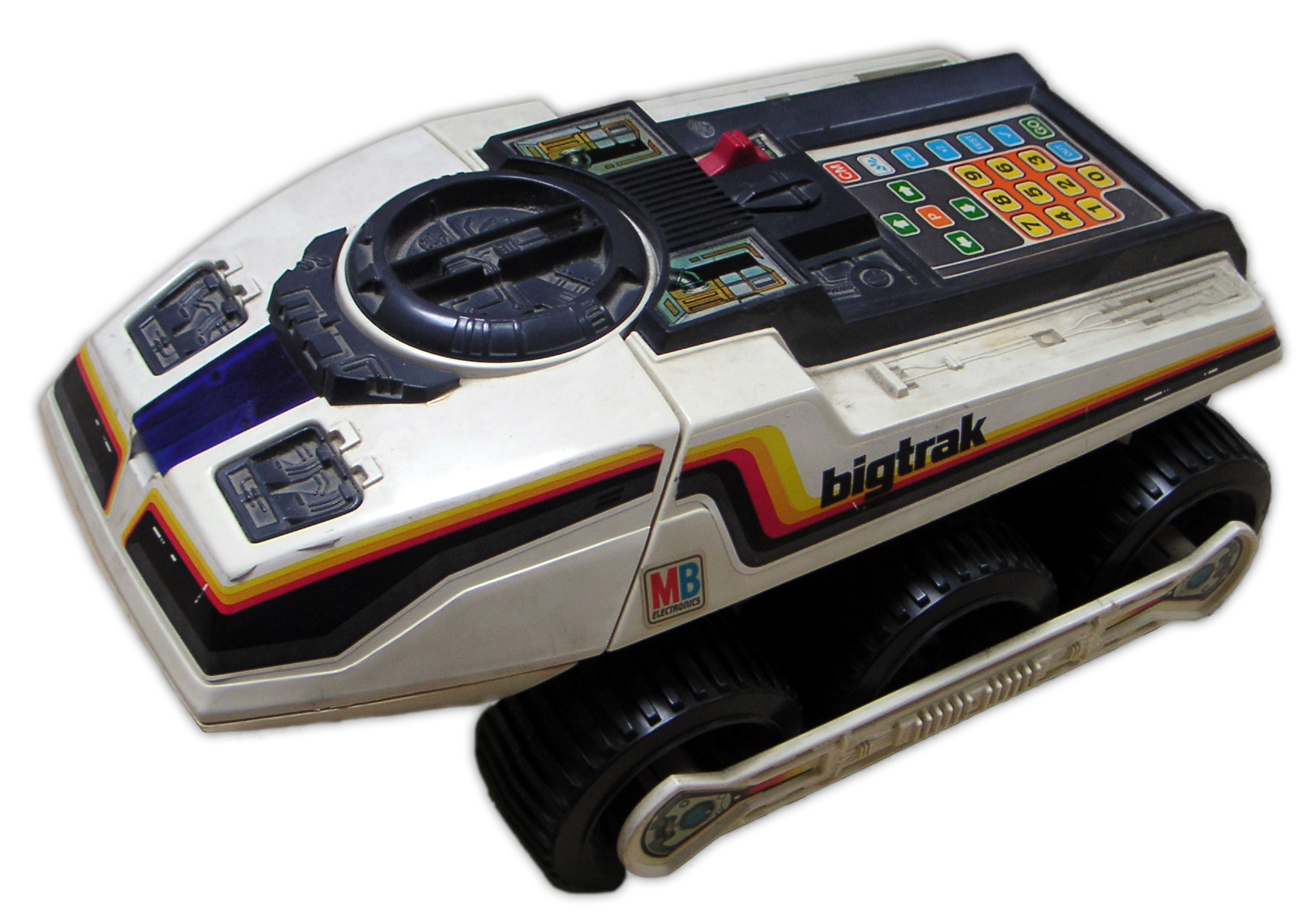
Big Trak is a programmable six-wheeled toy tank created by Milton Bradley in 1979. Resembling a futuristic sci-fi utility vehicle, it features a front-mounted blue 'photon beam' headlamp and a membrane keypad on top. The toy is powered by a Texas Instruments TMS1000 microcontroller and can remember up to 16 commands — forward/backward in body-lengths, left/right turns in 15-degree increments, pause, fire, and a primitive RPT (repeat) loop instruction — which it then executes in sequence. An optional cargo trailer accessory could be programmed to dump its payload.
The interaction is entirely self-contained: there is no screen, no external computer, no compiler. The user builds a program by pressing keys on the toy itself, then presses GO to execute it in the physical world. The feedback is purely embodied — success or failure is measured in whether the tank navigates around furniture or collides with it. This made Big Trak one of the earliest consumer devices to introduce non-experts (children) to procedural/logical sequencing and turtle-graphics-style programming concepts.
The original US version was moulded in gray plastic and labeled 'BIG TRAK', while the UK/European version was white and labeled 'bigtrak' with a different keypad layout. A Soviet clone was produced under the Elektronika IM-11 designation (named 'Lunokhod' after the Soviet Moon rover programme). A licensed replica was released by Zeon Ltd in 2010.
Deep dive
Big Trak was conceived at Milton Bradley, the venerable board game and toy company. The story of its origin became the subject of a 2024 episode of This American Life (Episode 827, Act One), in which Peter Ocko recounts his father's role in the idea and the subsequent lawsuit the family filed against Milton Bradley. The toy launched in 1979, powered by the Texas Instruments TMS1000 — the same 4-bit microcontroller family that powered Speak & Spell — with separate battery supplies for the logic (9V) and motors (4× D cells) to prevent electrical noise from resetting the microcontroller.
The programming interface is a membrane keypad on the vehicle's top surface. Commands include: Forward/Backward (in units of one body-length), Left/Right (in units of roughly 1/60th of a full rotation, or 6 degrees — though labelled as 'minutes' on the keypad), HOLD (pause in 1/10 second units), FIRE (activate the photon beam light), CLR (clear program), CLS (clear last step), RPT (repeat a number of steps — a primitive loop construct), TEST (run a short built-in test program), CK (check last instruction), and OUT (activate optional trailer dump). There were no LED displays or any way to review a stored program other than running it. The IN command was reserved for future expansion but was never fully implemented in production hardware. The programming model resembles turtle graphics from the Logo programming language — spatial commands that move an agent through the world — but with a crucial difference: Logo turtles live on a screen with instant visual feedback. Big Trak executes in physical space, where friction, carpet pile, battery charge, and furniture all affect the outcome. The gap between the abstract program and its embodied execution is the whole point.
In February 1981, Steve Ciarcia published an article in BYTE magazine ('A Computer-Controlled Tank') detailing how to control Big Trak with a personal computer via a radio interface, effectively turning it into a home robot peripheral. In the 2000s and 2010s, hobbyists reverse-engineered the TMS1000 and developed Arduino and Raspberry Pi interfaces, preserving Big Trak as a platform for modern robotics experimentation. The 2010 Zeon replica uses surface-mount components and hall-effect motor sensors instead of the original optical detectors.
In the early 1980s, the psychology of science community led by David Klahr's laboratory at Carnegie Mellon University adopted Big Trak as a research vehicle for studying instructionless learning, scientific discovery, cognitive development, and dual space search. Participants were given a Big Trak with no manual and asked to figure out how it worked. The research was published in Klahr's 2000 book 'Exploring Science: The Cognition and Development of Discovery Processes' (MIT Press). Big Trak remains, to this day, one of the only consumer toys to be adopted as a formal instrument of cognitive science research.
Team & pioneers
- Milton Bradley Company. manufacturer and publisher
- Peter Ocko (father). claimed originator of the concept; family sued Milton Bradley
- Texas Instruments. supplier of the TMS1000 microcontroller
- Steve Ciarcia. published BYTE magazine article on computer-controlling Big Trak via radio (1981)
- David Klahr. Carnegie Mellon University; used Big Trak for cognitive science research in the 1980s
Media