Butler in a Box
The first voice-controlled home automation system, responding 'Yes, boss' 30 years before Alexa — built by a magician and an ex-IBM programmer.
Overview
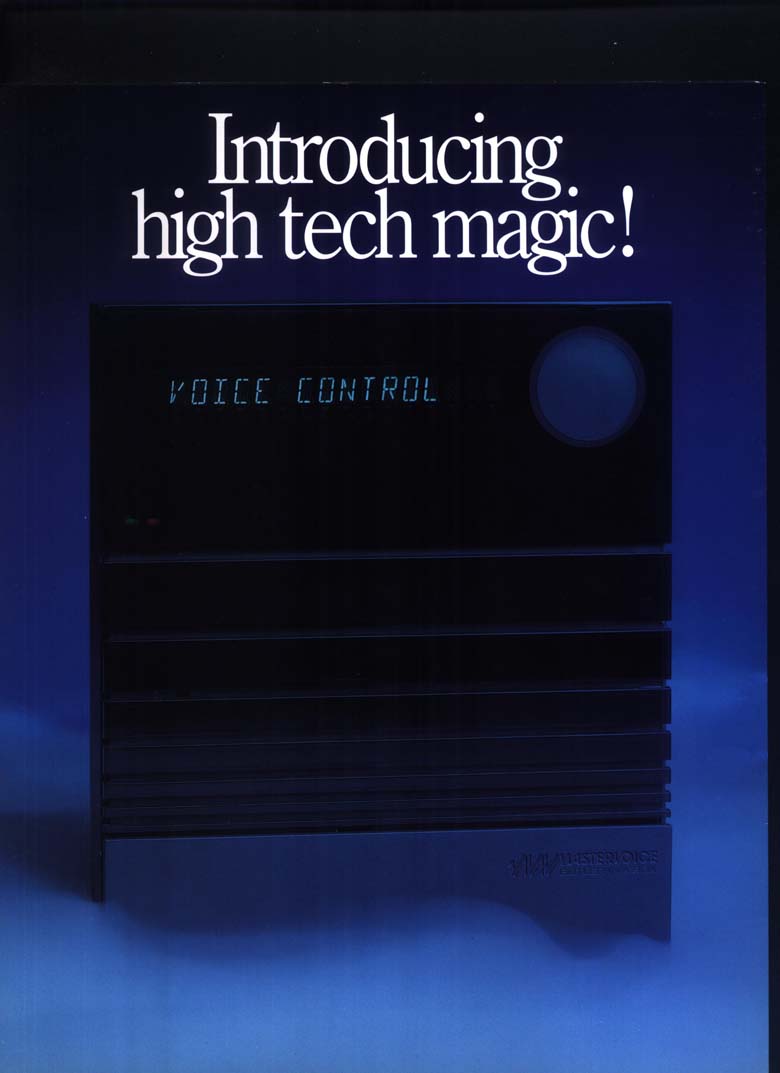
The Butler in a Box was the world's first consumer voice-controlled home automation system, created by professional magician Gus Searcy and former IBM programmer Franz Kavan under their company Mastervoice. Introduced in 1983 and priced at $1,495, it used speaker-dependent speech recognition — each of up to 4 users trained the device to recognize their voice commands using an included cassette tape. The user spoke a wake word (typically a butler name like 'Godfrey' or 'Hobson') and the device responded 'Yes, boss,' then accepted voice commands to control lights (via X10 powerline modules), make and receive phone calls, set up to 16 timers, and function as a security alarm with door/window sensors. It could perform 256 functions, control 42 devices by voice, 42 by timer, and execute macros of up to 16 commands each. It also operated via a membrane keypad, timed schedules, and sensor triggers. The personality was customizable — it could sound like a snobby British butler, Betty Boop, or a seductress. An optional 'Lady' voice cartridge was sold separately. The device predated Amazon Alexa by 30 years, Google Home by 31, and even Ask Jeeves by 13.
Deep dive
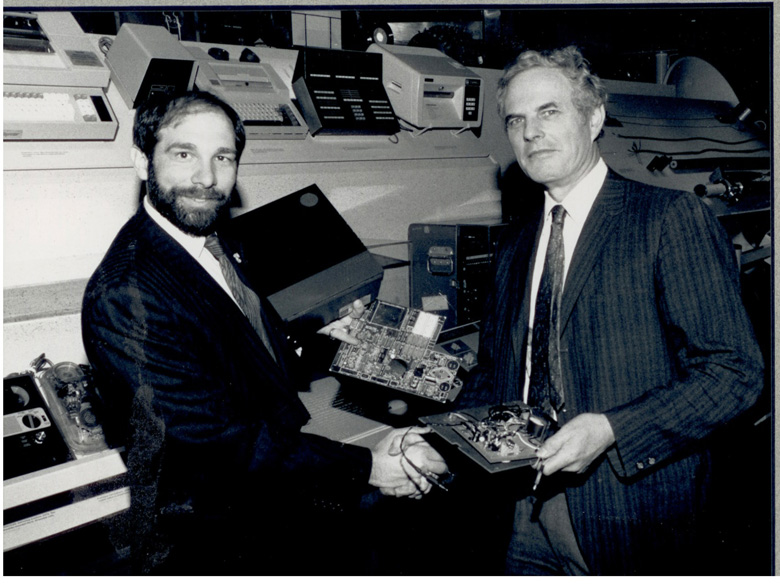
Gus Searcy was a professional magician from Yorba Linda, California. At a Super Bowl party, friends razzed him: 'If you can pull rabbits out of hats, why can't you magically turn the lights on?' The question stuck. Searcy partnered with Franz Kavan, a former IBM programmer from West Germany, and in 1983 they built the first prototype — initially called 'Sidney.' In 1984 they formed Mastervoice, and in 1985 they received $2.3 million in venture capital, establishing offices in Los Alamitos, California. Searcy described his vision: 'I wanted it to be like Thing on The Addams Family — it had to be everywhere, but nowhere.'
The Butler in a Box used a Rockwell R6501Q microprocessor (1 MHz, 6502-compatible) as its main CPU, with an Intel 8748 microcontroller handling telephone functions. Speech data was stored on EPROM chips — two 27256 EPROMs on the main board plus a 2764 EPROM inside a potted (epoxy-sealed) security module designed to prevent tampering. The data bus entering this module was intentionally scrambled (address-line swizzling) to frustrate reverse engineering. A 4-character alphanumeric PIN was required on first power-up; if lost, the unit was rendered inoperable. Speech output used CVSD (Continuously Variable Slope Delta modulation) processed by two custom chips (MV0014 codec and MV0015 filter), believed to be Harris-manufactured military-grade components. Memory was volatile RAM — if power was lost for more than about 3 hours, all settings and voice training were erased. An optional RAM Pack backup module was sold separately. A vacuum fluorescent display provided visual feedback.
Setup was intensive: approximately 25 minutes for a single device. Each user trained all key words ('light,' 'telephone,' etc.) individually using the included cassette tape. Up to 4 different users could each train their own butler name and command set. The device supported four interaction modes: voice command, touch (membrane keypad), time-based scheduling, and situation-based triggers (motion sensors, rain sensors for sprinklers). It incorporated if-then conditional logic — for example, 'turn lights off at 10 p.m. but not if we are having a party.' It knew the day of the week, month of the year, seasons, and holidays. The 134-page owner's manual spoke to the complexity.
The Butler in a Box was not a commercial success. Priced at $1,495 in 1983 — approximately $4,100 in 2025 dollars — it was too expensive and too complex for mainstream adoption. Mastervoice later rebranded the product as the Mastervoice ECU (Environmental Control Unit), targeting the accessibility market, at $2,995 in 1996. The company claimed over 26,000 systems delivered over the product's lifetime and maintained a website until around 2008. Despite commercial failure, the device received significant recognition: it is held by the Smithsonian Institution's National Museum of American History (a prototype and production units), was displayed in the 'Future House' at Disney World's Epcot Center, and was installed at the Western Rehabilitation Institute to help patients transitioning to independent living. Notable customers included William Shatner. In March 2024, Gus Searcy — still alive — commented on a Popular Science YouTube video, offering to recreate lost PINs for owners who could prove ownership.
Team & pioneers
- Gus Searcy. Professional magician turned inventor; conceived the Butler in a Box after friends challenged him to create a device that could 'magically' turn lights on by voice
- Franz Kavan. Former IBM programmer from West Germany; technical co-founder who built the speech recognition system
- Mastervoice / Automated Voice Systems Inc.. Los Alamitos, California company; operated from 1984 to approximately 2008
Media
Sources
- Wikipedia — Butler in a Box
- Smithsonian Institution — Prototype Butler in a Box (NMAH 1346931)
- Popular Science — 'The $15,000 A.I. From 1983' video article (March 2024)
- Hackaday — 'Retrogadgets: Butler In A Box' by Al Williams (March 2024)
- Deseret News, April 17, 1988 — 'Magician's Versatile Box Gives New Meaning to Butler Did It'
- Seattle Times, April 7, 1996 — 'At Your Command, $3,000 Electronic Butler'
- VCFed Forum — 'Secrets Within' teardown and reverse engineering of Butler in a Box
- Gus Searcy's personal site
- Internet Archive — Mastervoice Butler in a Box manual scans
- Popular Science, March 1987 (Google Books) — feature article
- Brady Carlson — 'The Butler in a Box was a smart speaker before there were smart speakers'