Evans & Sutherland Digistar 1
The first computer-graphics planetarium, flown from a 3-by-4-foot console of back-lit buttons and a six-degree-of-freedom joystick — including one labelled 'Boldly Go'
Overview
Digistar is the first computer-graphics-based planetarium projection and content system, designed by Evans & Sutherland and released in 1983. It was created by lifelong amateur astronomers and graphics engineers Stephen McAllister and Brent Watson, who in 1977 were consulting with NASA's Johnson Space Center on astronaut training simulators and who targeted the technology at planetaria to overcome the central limitation of the traditional opto-mechanical star ball: it could only show the sky from the surface of the Earth. Digistar could show accurate star fields — taken from the Yale Bright Star Catalogue, plus random stars — from any point in space and time, and could show the planets and moons for any date. Its projector is a single calligraphic (vector) cathode-ray tube: the electron beam is driven straight to the coordinates of each star or wireframe vertex, painting bright, non-pixelated points onto a phosphor plate that a 160-degree lens throws across the whole dome. Driven by a DEC VAX-11/780 with custom graphics hardware, the system first shipped to the Science Museum of Virginia in 1983 for $595,000, and by 2019 the Digistar line had more than 550 installations worldwide.
Deep dive
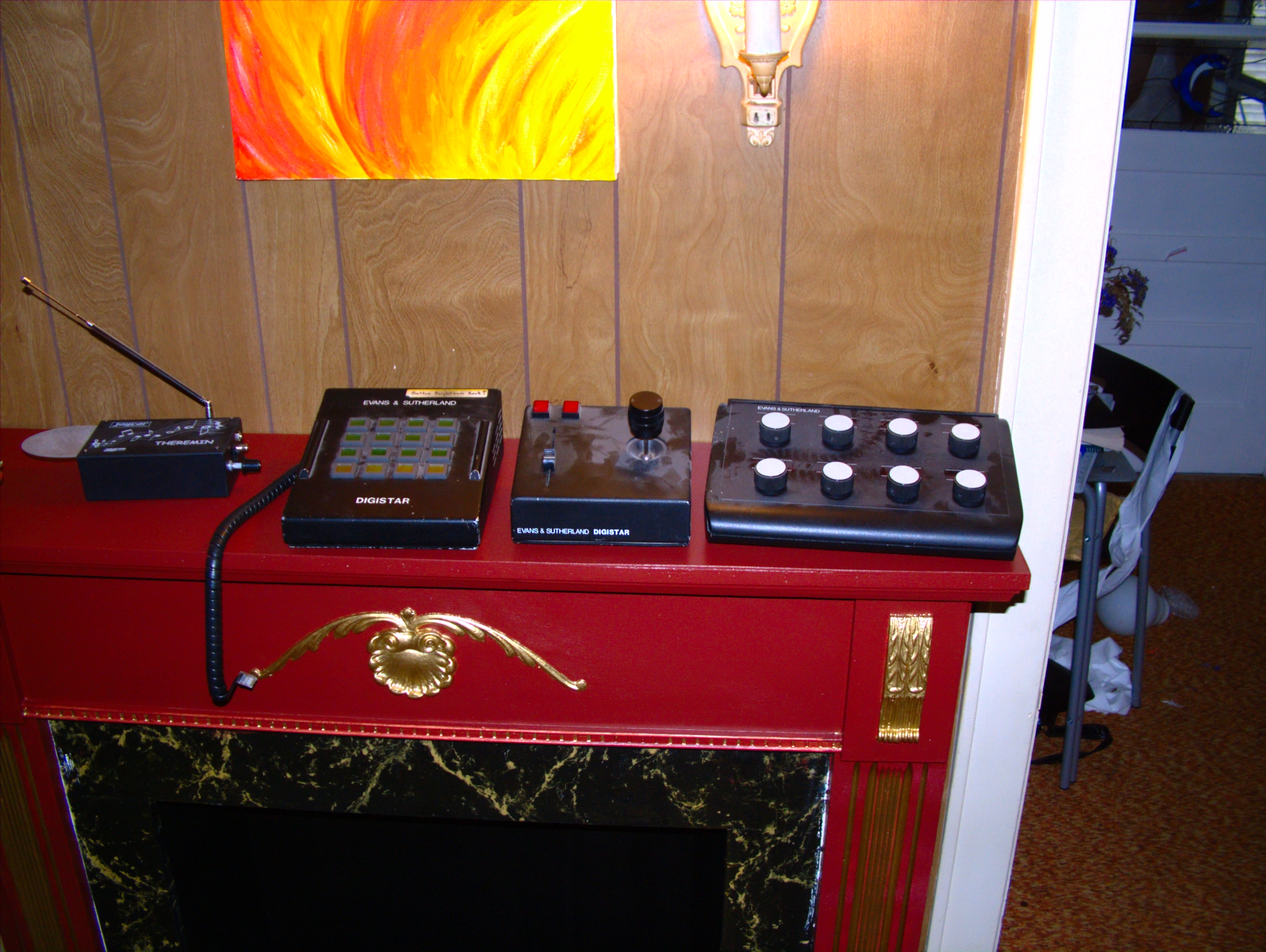
The original Digistar and Digistar II were operated from a physical control panel roughly 3 by 4 feet in size, containing a keyboard, a six-degree-of-freedom joystick, and a large array of back-lit buttons. The operator performed the show with the body — steering the viewpoint through space with the joystick, punching illuminated buttons to summon models and celestial events. It is closer to a theatre organ or an aircraft cockpit than to a graphical user interface, a rare example of a public performance computer driven entirely by physical controls.
Among the back-lit buttons on the Digistar panel was one, used to move the viewpoint forward through space, labelled "Boldly Go" — after Star Trek's "where no man has gone before." The joke was earned. A Digistar laboratory prototype generated the star fields and tactical displays for Star Trek II: The Wrath of Khan (1982), filmed directly from the Digistar display; the film's opening 3.5-minute starfield fly-through became the first entirely computer-generated feature film sequence, and the Digistar team is credited in the film.
The Digistar projector is a calligraphic display: instead of scanning a raster, its single CRT drives the beam straight to each coordinate in a display list. Because a star's phosphor spot glows longer the more often it is hit, short display lists produce very bright stars — far brighter than a raster could — and darker blacks, because the empty sky is never struck. The result is a bright phosphorescent green sky that many visitors and planetarians report they cannot distinguish from white, and a star image free of the blocky artifacts of raster graphics.
Digistar 1 and 2 could only project dots and lines, so only wireframe models were possible; the system compensated by defocusing models to blur lines into surfaces (the Milky Way was a circle of parallel lines, defocused into a band). Focus across a dome from a single lens was imperfect, and the CRT lost brightness after roughly a thousand hours and needed replacement every year or so. Later versions replaced the physical console with an ordinary graphical user interface — the museum-relevant loss is precisely that embodied console. Digistar 3 (2002) finally brought full-dome raster video.
Team & pioneers
- Evans & Sutherland. Salt Lake City graphics pioneer, founded by David C. Evans and Ivan Sutherland; designed and built the Digistar and its custom graphics hardware.
- Stephen McAllister. Amateur astronomer and graphics engineer; Digistar co-creator, who entered the data for 400 bright stars in summer 1977.
- Brent Watson. Former Hansen Planetarium staffer and graphics engineer; Digistar co-creator.
- Wayne Sumner. Digistar team member and co-narrator of the system's oral history.
Media
Sources
- Wikipedia — Digistar (projector, calligraphic CRT, control panel with 6-DOF joystick and back-lit buttons, "Boldly Go", Star Trek II, VAX-11/780, 1983 release, $595,000 first installation)
- McAllister, Watson & Sumner — "Audio History of Digistar Planetarium Projection System by Evans & Sutherland" (1986)
- Smith, Alvy Ray — "Special Effects for Star Trek II: The Genesis Demo Instant Evolution with Computer Graphics," American Cinematographer (Oct 1982)