Grimes Digital Data Entry Glove
A chorded keyboard you wear — type by touching your fingers together
Overview
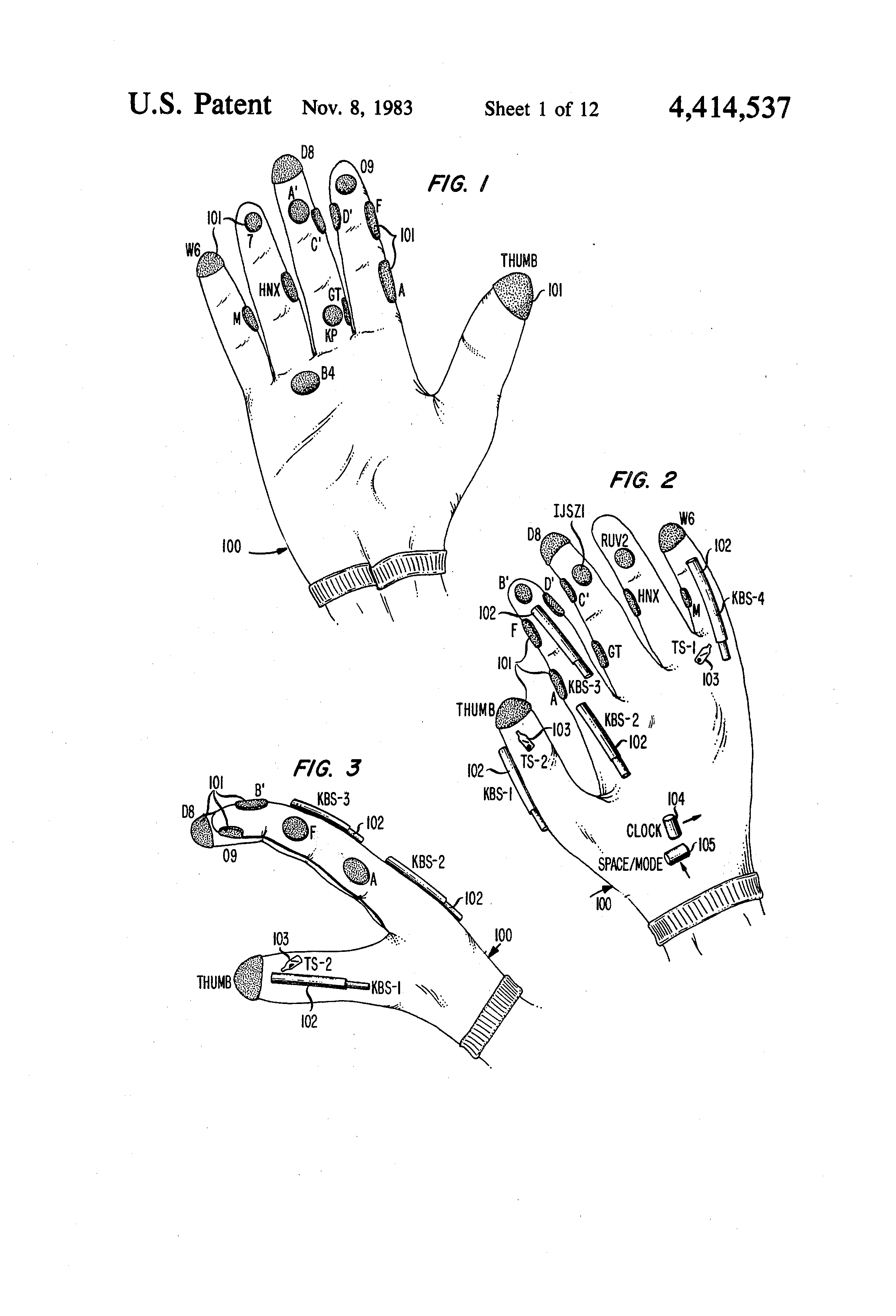
The Grimes Digital Data Entry Glove is a fabric glove instrumented with electrical contacts on each fingertip, the thumb, and the palm. When the wearer touches two fingertips together — or touches a fingertip to the thumb or palm — the contact closes a circuit, and the system registers a specific character. The entire alphabet plus numbers can be typed through combinations of finger-to-finger contacts, with no physical keys and no position tracking. The glove was developed at Bell Telephone Laboratories by Gary J. Grimes, and patented in 1983 (US Patent 4,414,537, filed September 1981).
Unlike the VPL DataGlove (which tracks finger bend angles and hand position in space) or the Power Glove (which uses ultrasonic tracking plus resistive flex sensors), the Grimes Glove has zero motion sensing. It is a purely contact-based device — a keyboard worn on the hand, where the "keys" are your own fingers touching each other. This makes it conceptually closer to a chording keyboard (like the Microwriter or BAT Keyboard, already in the museum) than to a gesture-tracking glove. But unlike those devices, which use physical switches or pressure pads, the Grimes Glove uses the body itself as the switching mechanism.
The glove was intended for one-handed, eyes-free text entry in situations where a conventional keyboard was impractical — the patent mentions "situations where the operator is unable to look at his hands" and applications in "hostile environments" where the operator wears protective gear. It was never commercialized as a product, but it represents a distinct branch of the chorded-keyboard family tree: the wearable, keyless, body-as-switch approach that would not be revisited in earnest for decades.
Deep dive
The glove has thin, flexible electrical contacts sewn or adhered to the palmar surfaces of the fingertips, the thumb, and selected locations on the palm. Each contact is wired to a small electronics module worn on the wrist or back of the hand. When the wearer brings two contacts together — say, index fingertip to thumb tip — a circuit is completed. The module detects which pair of contacts has been closed and maps that combination to a character or command. In Grimes's design, the thumb serves as a common terminal: most characters are typed by touching a specific finger to the thumb (index-to-thumb = one character, middle-to-thumb = another). Touching fingers to the palm or to each other provides additional combinations. A full alphanumeric set requires roughly 30-40 distinct contact patterns, well within the combinatorial space of 5 fingers plus palm locations. The key insight is that this is not gesture recognition — there is no ambiguity about which fingers are touching. Each contact pair is a discrete switch. The glove knows definitively that index touched thumb, not that index was "near" thumb or that the hand was in a particular pose. This makes it far simpler electronically than any flex-sensing or position-tracking glove.
The museum already holds several chorded keyboards: the Microwriter (1980, 6-key handheld), the BAT Keyboard (1990, 7-key desktop), the Twiddler (1992, handheld with 12 keys), and the WriteHander (1978, 12-key stenographic). All of these use physical switches — buttons or keys that the user presses with individual fingers. The Grimes Glove is the only chorded keyboard in the collection where the user's own body provides the switching mechanism. There are no keys, no buttons, no switches — just electrical contacts on the fingertips. The physical act of typing is touching your own fingers together. This is a fundamentally different tactile experience from pressing a key: it is silent, requires no desk surface, and can be done inside a pocket, under a table, or while wearing protective clothing. The glove was patented but never manufactured as a commercial product, making it a research artifact rather than a market entry. It was cited in later glove-survey literature (notably Sturman & Zeltzer's 1994 IEEE Computer Graphics & Applications survey of glove-based input) as an early example of a non-positional, contact-sensing glove interface.
Gary J. Grimes was a researcher at Bell Telephone Laboratories in Murray Hill, New Jersey — the same institution that produced the transistor, the laser, the UNIX operating system, and the C programming language. Bell Labs in the early 1980s was one of the world's most prolific industrial research environments, with an unusually broad portfolio that included speech recognition, computer graphics, human factors, and input device research. The patent was assigned to Bell Telephone Laboratories, Incorporated (later AT&T Bell Laboratories). The assignee at the time of the patent's expiration was AT&T Corp. This places the glove in one of the most storied lineages in computing research history — though Grimes himself is not widely documented beyond this patent.
Team & pioneers
- Gary J. Grimes. Inventor, Bell Telephone Laboratories
- Bell Telephone Laboratories (AT&T). Assignee and research institution
Media
Sources
- US Patent 4,414,537 — "Digital data entry glove interface device" (Grimes, Bell Labs, filed 1981, granted 1983)
- Sturman & Zeltzer, "A Survey of Glove-based Input," IEEE Computer Graphics & Applications, 1994 — cites Grimes Glove as early contact-sensing glove
- Rauterberg, HCI History presentation — Slide 66, "Digital Data Entry Glove (1983)"
- Freepatentsonline — Full patent text and drawings