Heidenhain TNC 110
The first conversational CNC control — a machine tool that held a dialog with its operator through labeled function keys
Overview
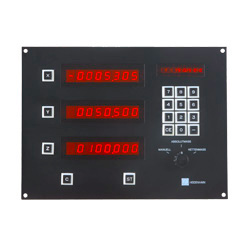
The Heidenhain TNC 110, introduced in 1976, was the first numerical control to use what the company called TNC (Touch Numerical Control) — a conversational, dialog-guided programming system. Instead of requiring the operator to write G-code or prepare punched tape, the TNC 110 presented programming prompts on a compact CRT display, with labeled function keys arranged around the screen. The operator responded by pressing the appropriate key or entering numeric values on the keypad. The complete programming manual was ten pages — a radical departure from the thick binders of G-code reference that dominated machining at the time.
The TNC 110 was a positioning control (Positionssteuerung) built for drilling and milling machines, and it was the first CNC control Heidenhain ever made. The company, founded in 1889, had spent decades making precision measurement equipment — linear encoders, angle encoders, and digital readouts — and that expertise in position measurement made the leap to numerical control a natural evolution. The physical panel pairs a numeric keypad with a grid of labeled function keys (POS, TOOL, CYCLE, PATH, INPUT) whose labels name machining operations, not computer commands. The machine adapted to the language of the workshop rather than the other way around.
Deep dive
In the mid-1970s, CNC programming ran through manual G-code entry or APT programs processed on a mainframe — both requiring specialized training. The TNC 110's third path presented a sequence of dialog prompts (TOOL NUMBER?, POSITION X?, FEED RATE?, CYCLE TYPE?) and let the operator respond with the labeled function keys and numeric keypad, translating the answers into machine motion internally. Skilled machinists who were not programmers could suddenly program their own machines.
The panel arranges labeled function keys around the CRT, separate from the numeric keypad so that command selection and data entry never collide. A row of soft keys below the screen could be relabeled with paper strips, anticipating the soft-key paradigms common in 1990s computer interfaces. The buttons are designed to be pressed wearing gloves in a noisy, lit-inconsistent machine shop.
The conversational TNC paradigm proved so successful that Heidenhain carried it through the TNC 120, 150, 155, 2500, 320, 620, 640, and current TNC 7 series. By 2006 the company had manufactured nearly 200,000 CNC controls. The TNC 110 was the first control to treat the operator as a conversational partner rather than a punched-tape loader — the first machine tool that held a dialog with its human.
The museum's existing machine-instrument exhibits (Tektronix 7854, Fluke 9010A) are general-purpose lab and diagnostic instruments. The TNC 110 is the museum's first dedicated industrial control and its first production machine tool, and its dialog-guided programming is a distinct interaction model — the machine as interrogator, guiding a skilled but non-programmer operator through a task.
Team & pioneers
- Dr. Johannes Heidenhain. Founder of the post-war company (1948), physicist, pupil of Otto Hahn.
- Heidenhain Development Team. Traunreut, Germany — developed the first TNC control in 1976.
Media