Linus Write-Top
The first handwriting recognition tablet — no keyboard, just a pen and 30 minutes of training
Overview
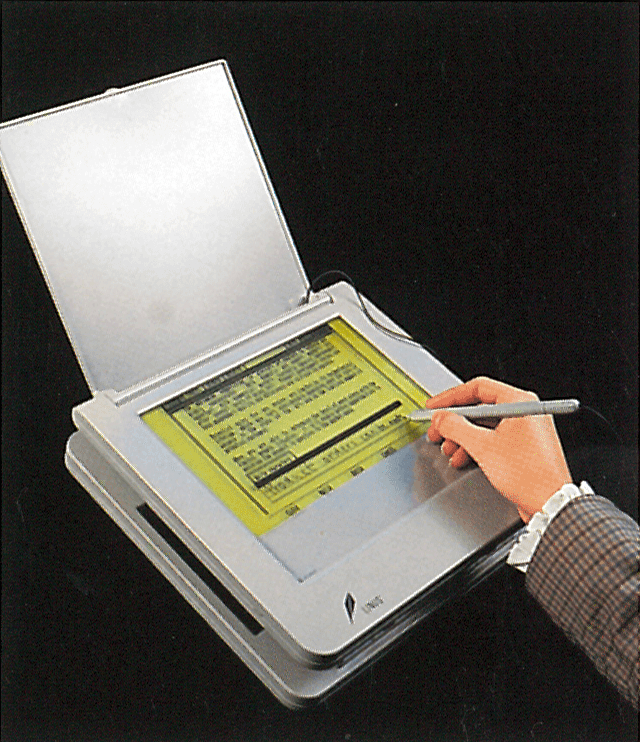
The Linus Write-Top was the first tablet computer released to the public with support for pen input and handwriting recognition software. Released in July 1988 by Linus Technologies, it was an IBM PC-compatible two-piece clamshell (system unit + pen display) with an NEC V20 CPU at 7.16 MHz, 640 KB of static RAM, a 9.4-inch monochrome transflective STN LCD at 640×200 CGA resolution, and MS-DOS 3.30. It had no built-in physical keyboard. Instead, a TSR program called Your-Write converted handwriting entered via a zone at the bottom of the screen into ASCII text, injected live into any DOS application. The recognizer required a 30-minute training session. Priced at $3,000, the Write-Top sold approximately 1,500 units before Linus Technologies went bankrupt in February 1990. The patents were sold to GRiD Systems.
Deep dive
Linus Technologies was founded in 1985 by Ralph Sklarew (who had developed NASA environmental monitoring systems), Robert Nadeau (an English professor at George Mason University working on an e-book reader prototype), and Arthur Rodbell (seed capital and marketing). The two met as neighbors in Virginia when Sklarew discovered Nadeau's e-book prototype. They developed a handwriting digitization system in GW-BASIC and raised $11 million from Venture First of Winston-Salem, NC. Former Atari VP of marketing Richard Mier was brought in as CEO. The final industrial design was executed by Peter H. Muller of Inter4m.
The digitizer used electromagnetic sensing, but the stylus could be nearly any material — the manual specifically noted a mechanical pencil would work. This was an unusual flexibility: most digitizers required a powered or specifically shaped stylus. Handwriting was entered in a dedicated zone at screen bottom; letterforms could not overlap or connect (no cursive recognition). Special pen symbols represented commands: delete-word, copy-paste, and text block selection.
The handwriting recognition engine occupied 40 KB of RAM. Training took 30 minutes: the user wrote multiple samples of their handwriting to build a personal model. Once trained, the recognizer injected recognized ASCII into whatever application was in focus — a word processor, spreadsheet, database. Linus also shipped Just-Write, an 80-column word processor optimized for pen input, and sold Code-Write, an SDK for developers wanting handwriting recognition in their own apps (licensing fee: $5,000).
The Write-Top was marketed to real estate appraisers, actuaries, medical professionals, and construction managers — not consumers. By January 1989, 1,000 units had been sold and Baxter International was developing compatible medical software. But at $3,000 with sparse pen software, the market was tiny. By February 1990, after ~1,500 total units, Linus went bankrupt. Sklarew said: "We were a little too early with not enough staying power." Most of the company's time was spent educating corporate buyers on what pen computing even was.
The Write-Top introduced the core pen-tablet interaction model: a dedicated handwriting zone feeding recognized text into applications. This exact paradigm — scaled and refined — would reappear in the Apple Newton (1993), Palm Graffiti, and eventually iPad Scribble. The patents went to GRiD Systems, whose GridPad 1900 (1989) found the market the Write-Top couldn't. The Write-Top was too early by about five years and too expensive by about $2,000 — but its vision was exactly what eventually became tablet computing.
Team & pioneers
- Ralph Sklarew Co-founder. Previously developed environmental monitoring systems for NASA and founded a chemical plant monitoring company in 1977.
- Robert Nadeau Co-founder. English professor at George Mason University. Developed the early e-book reader prototype that sparked the Write-Top.
- Arthur Rodbell Co-founder. Handled seed capital raising and marketing.
- Richard Mier President and CEO (from 1986). Former VP of marketing at Atari Corporation.
- Peter H. Muller Industrial designer at Inter4m. Executed the final two-piece clamshell design.
Media
Sources
- Wikipedia: Linus Write-Top
- OldComputers.net: Linus Write-Top
- InfoWorld, April 4, 1988: "Linus Write-Top Lets Users Write on Display Screen"
- PC Magazine, June 28, 1988: "Write on Portable's LCD Screen, Your Handwriting Becomes ASCII"
- Atkinson, Paul. "A Bitter Pill to Swallow: The Rise and Fall of the Tablet Computer." Design Issues 24(4), 2008