Petrofsky FES Bicycle Ergometer
A paralyzed person's own pedaling is the computer's input AND its output — an Apple II reads the crank angle and fires timed electrical shocks into the muscles to keep the legs turning
Overview
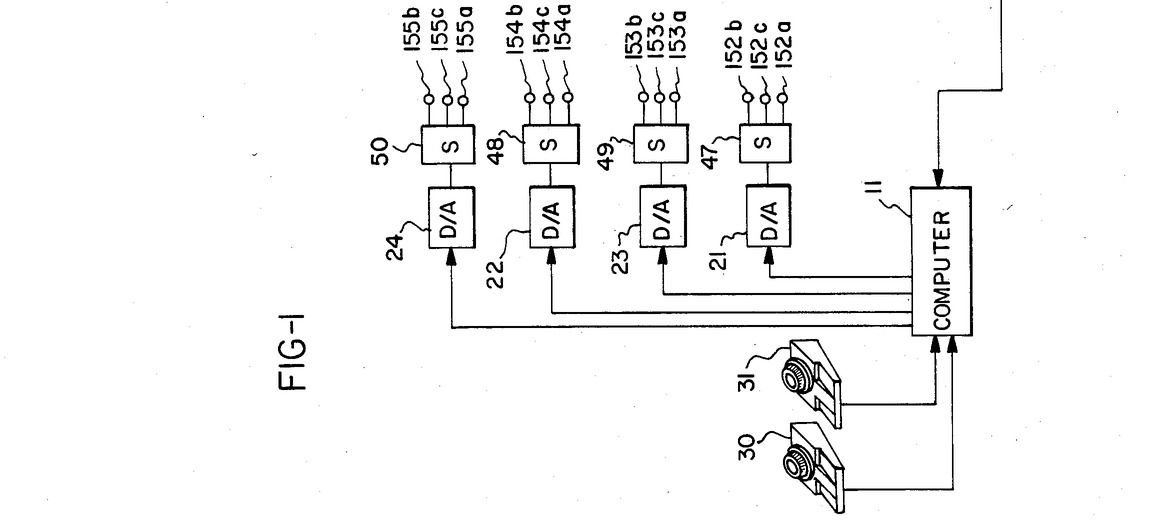
At Wright State University in the early 1980s, biomedical engineers Jerrold Petrofsky and colleagues built a stationary bicycle on which a paralyzed person pedals — not despite the paralysis, but because of it. The rider's legs are strapped to a Monarch ergometer, and they move only because an Apple II Plus watches the crank position through a rotary potentiometer and fires timed transcutaneous electrical stimulation into the iliacus and quadriceps muscles in the precise quarter-turn order a healthy pedal stroke requires. The same motion the computer measures is the motion the computer commands: the leg is simultaneously the sensor and the actuator, closing a loop in which one system — the human body — is both the input and the output.
Deep dive
A rotary potentiometer on the pedal crank feeds the crank angle into the Apple II's 8-bit analog-to-digital converter. The computer divides the revolution into quadrants and, as the free-wheeling crank passes each sector, delivers a burst of stimulation to whichever muscle group should be driving at that instant — iliacus and quadriceps on the forward push, timed relaxation as the leg rides through the dead spots. No external motor turns the pedals; the only torque comes from electrically contracted muscles that the computer is also reading.
This is the collection's cleanest example of a bio-mechatronic loop: the same physiological system provides the sensing channel and the actuation channel. The computer's software model of the pedal stroke is inscribed into the patient's own nervous system and muscles, which must contract and relax on command to keep the loop alive.
Velcro foot attachments held the rider's feet to the pedals, and a break-away safety arrangement released if the stimulation overwhelmed the rider. In a 1984 Journal of Clinical Engineering trial, four paraplegic and quadriplegic subjects rode the ergometer for 30 days, building fitness and demonstrating that paralyzed muscle could be driven through useful work. The same stimulation line of research produced the famous 1983 moment when Nan Davis, paralyzed from the chest down, took her first electrically assisted steps before television cameras.
The system was patented as US4499900A (filed November 1982, granted February 1985) by Petrofsky, Phillips, Glaser, and Heaton, and licensed to Therapeutic Technologies Inc. in 1983 — a commercially odd collision of 1980s microcomputing, clinical medicine, and machine-driven human muscle, and a direct ancestor of today's functional electrical stimulation (FES) bicycles.
Team & pioneers
- Jerrold Petrofsky. Lead investigator; the "Petrofsky" of the patent and a central figure in 1980s FES research, including the Nan Davis walk.
- Chandler A. Phillips, R. M. Glaser, and H. Heaton. Co-inventors on US4499900A.
- Wright State University. Home of the laboratory where the ergometer was developed and trialled.
- Therapeutic Technologies Inc. Licensor that took the system to market.
Media