Soundbeam
The invisible keyboard in space — ultrasonic sonar that turned body movement into music, then accidentally revolutionized disability music therapy
Overview
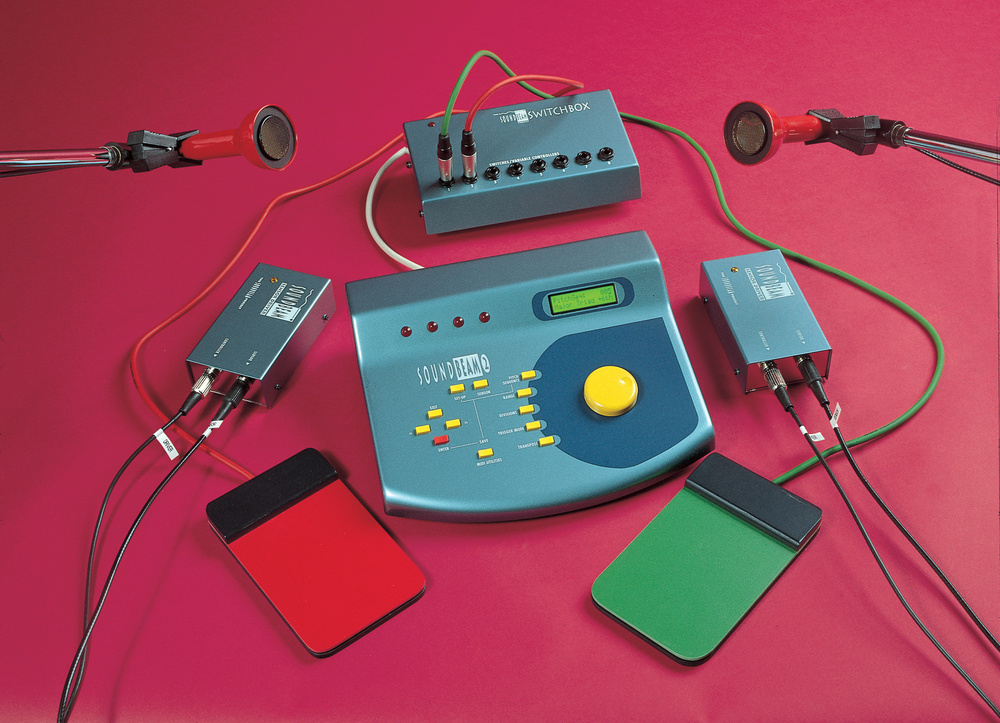
Soundbeam is a touch-free MIDI controller that uses ultrasonic sonar to translate body movement into music. A performer moves within an invisible cone of 50 kHz sound projected into a space; the system measures distance, speed, and direction of movement and converts these into MIDI messages driving any synthesizer, sampler, or DAW. No wearables, no controllers, no physical contact required. Conceived by British composer Edward Williams (1921-2013) as a Theremin descendant enabling dancers to generate their own accompaniment, the prototype was built in 1984 and the first commercial units shipped in 1989.
The hardware was designed and manufactured by Robin Wood and the engineering team at EMS (Electronic Music Studios) in Cornwall — the same legendary company that created the VCS3 "Putney" synthesizer used by Pink Floyd, Brian Eno, and Jean-Michel Jarre. Soundbeam found its most profound impact not on the dance floor but in special education and music therapy, where the extreme sensitivity of the ultrasonic beam meant even children with profound and multiple learning disabilities (PMLD) could play music through minimal movements — a facial twitch, a finger raised, a wheelchair nudged. More than 1,500 systems were in use worldwide by 2001, and the product remains in active production as Soundbeam 6 in 2025.
Deep dive
Edward Williams (1921-2013) was a British composer and electronic music pioneer who scored two Oscar-winning documentary shorts and composed the groundbreaking electronic/orchestral score for David Attenborough's 'Life on Earth' (1979) using three EMS VCS3 synthesizers. According to the official Soundbeam history, Williams spent 18 years searching for a device that would enable dancers to create and shape their accompanying music through body movement, inspired by Léon Theremin's 1920 Thereminvox. Unlike the Theremin's capacitive sensing, Williams conceived of using sonar to create an "invisible expanding keyboard in space."
By the 1980s, main synthesizer production at EMS had wound down and the company had relocated to Ladock, Cornwall. Williams, already a VCS3 power user, brought the Soundbeam concept to EMS. Engineer Robin Wood and the team — who had built one of the most influential synthesizers in music history — designed the commercial Soundbeam hardware. The company that made the synth on 'Dark Side of the Moon' ended up building ultrasonic controllers for children with cerebral palsy.
Each sensor fires a continuous stream of directional 50 kHz ultrasonic tone-bursts into a conical beam (range 0.56m to 6m) and simultaneously listens for echoes. As objects enter the beam, they reflect ultrasound back to the sensor. The controller calculates distance, speed, and direction, translating these into MIDI note, velocity, and continuous controller data. Each beam can trigger up to 64 individual note pitches over its length, divided into equal "divisions" with programmable pitch sequences (pentatonic, harmonic minor, chromatic, or custom). Up to 4 sensors can operate simultaneously, complemented by 8 switch inputs.
Designed for avant-garde dance performance, Soundbeam's critical adoption came in special education. Because the beam requires no physical contact, no fine motor control, and no strength to operate, users with PMLD, cerebral palsy, Rett Syndrome, or locked-in conditions could create music independently. Sound on Sound noted in 2001 it was "literally possible to play a MIDI instrument just by facial activity." The device was adopted by Great Ormond Street Hospital, Nordoff Robbins music therapy, Drake Music, RNIB, and dozens of UK special schools and NHS trusts. Dr. Nicholas Bannan at the University of Reading coined the term "elektrokinaesthetic instruments" to describe Soundbeam-like devices.
Saxophonist David Jackson (Van der Graaf Generator) adopted Soundbeam in 1992 for his 'Tonewall' project, performing with it on the 1997 'Union Chapel Concert' album. Composer Martin Kiszko, a Williams protégé, advocated for Soundbeam in educational and multi-media performance contexts. Led Zeppelin's John Paul Jones later provided a testimonial for Soundbeam 6.
Soundbeam is one of the longest-lived products in electronic music history, now in its sixth generation (Soundbeam 6, 2017-present) with a full touchscreen, built-in sound library, on-board sampler, HDMI film projection, and wireless switches. Its influence extends through Roland's D-Beam, the NIME (New Interfaces for Musical Expression) research community, Drake Music's DMLab accessible instrument network, and conceptually through to Microsoft's Kinect. That a device designed for dancers gave a voice to children who had never been able to make music before is one of the most moving stories in HCI history.
Team & pioneers
- Edward Williams (1921-2013) Originator and composer. Conceived Soundbeam as an 18-year quest for a dancer-controlled musical instrument.
- Judy Williams Co-founder of The Soundbeam Project, business operations.
- Robin Wood EMS engineer, designed the Soundbeam 1 and 2 hardware.
- EMS (Electronic Music Studios) Cornwall-based manufacturing partner. Legendary creators of the VCS3 synthesizer.
- David Jackson Saxophonist (Van der Graaf Generator), early adopter with 'Tonewall' project from 1992.
- Martin Kiszko Composer, Williams protégé, education advocate.
- Dr. Nicholas Bannan University of Reading. Coined the term "elektrokinaesthetic instruments."
Media