Summagraphics Bit Pad
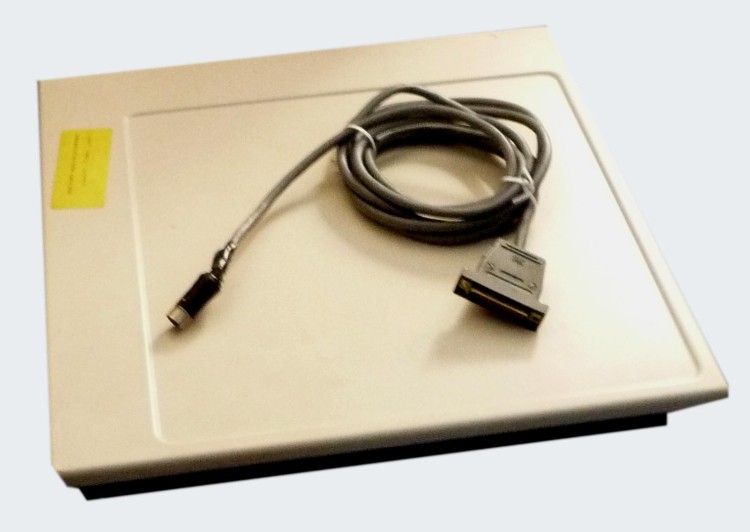
Large electromagnetic digitizing tablet for CAD.
Overview
The Summagraphics Bit Pad (often referred to as the Bit Pad One) is a landmark digitizing tablet introduced in 1977 by Summagraphics Corporation of Fairfield, Connecticut. It was one of the first commercially available, high‑precision absolute‑coordinate input devices targeted at professional users, predating the consumer drawing pads that would arrive years later. Unlike relative pointing devices such as the computer mouse, the Bit Pad enabled direct mapping of physical motion to screen coordinates, making it indispensable for computer‑aided design (CAD), cartographic digitizing, and early computer graphics.
Built around a magnetostrictive sensing grid embedded beneath a hard, flat surface, the tablet accepted input from either a pen‑like stylus or a puck cursor. With an active area of 12 × 12 inches (305 × 305 mm), a resolution of 0.005 inches (0.127 mm), and an accuracy of ±0.015 inches (0.38 mm), the Bit Pad One delivered the level of precision required to trace blueprints, maps, and intricate line art directly into digital form. It connected to host computers through a standard RS‑232 serial interface and was supplied with drivers for popular microcomputer and minicomputer systems of the era.
The Bit Pad firmly established the professional digitizing tablet as a vital peripheral in CAD, GIS, and electronic prepress workflows throughout the 1980s. Its absolute positioning paradigm—where lifting the stylus and placing it elsewhere immediately gave the correct X,Y coordinates—solved the drift and re‑calibration issues that plagued early relative devices. By commercializing a technology that had previously been confined to research labs, Summagraphics shaped the interface language that would later be inherited by modern graphics tablets and pen‑enabled displays.
Deep dive
Summagraphics Corporation was founded in 1972 with a focus on developing advanced digitizer technologies for industrial and scientific applications. While earlier experimental tablets such as the RAND Tablet (1964) had demonstrated the principle of absolute coordinate sensing, they were laboratory curiosities. The Bit Pad One, released in 1977, represented one of the first serious attempts to turn that capability into a reliable, mass‑produced peripheral for the growing market of microcomputers and engineering workstations. It built on magnetostrictive sensor technology that Summagraphics had refined, allowing a pen or puck to be sensed through a robust, non‑membrane surface.
The Bit Pad One housed a magnetostrictive wire grid beneath a rigid 12 × 12‑inch (305 × 305 mm) active area, surrounded by a sturdy metal or plastic enclosure measuring approximately 14.5 × 14.5 × 1.5 inches (368 × 368 × 38 mm) and weighing around 11 pounds (5 kg). The grid produced a magnetic field; when the coil in the stylus or puck passed over it, the tablet electronics measured the time delay of the induced pulse to calculate the absolute X and Y position. Resolution was 0.005 inches (0.127 mm), with a specified accuracy of ±0.015 inches (0.38 mm). Users could choose between a corded pen with a tip‑activated switch or a cursor puck fitted with crosshairs and multiple buttons. Data was transmitted via a standard RS‑232 serial port, and an external power supply provided the necessary operating voltages.
The core interaction paradigm was straightforward yet transformative: wherever the user placed the stylus or puck on the tablet, the corresponding screen coordinate would be registered immediately and absolutely. There was no need to zero the device or move it like a mouse; a drawing or tracing could be paused at any time and resumed without loss of position. This absolute mode was essential for tasks such as tracing paper‑based maps, architectural blueprints, or engineering drawings that were taped to the tablet surface. The tip switch of the stylus (or the buttons on the puck) sent a signal that told the computer when to “lower the pen” or “lift it,” enabling the creation of continuous strokes or isolated points. Drivers for operating systems like CP/M and MS‑DOS mapped the 12‑inch digitizing area to the full video display, giving users a natural, eye‑hand‑coordination‑friendly drawing experience long before on‑screen tablets existed.
Summagraphics rapidly became a market leader in digitizing tablets during the 1980s, with the Bit Pad One at the core of its product line. The tablet found widespread use in industries ranging from aerospace design and naval architecture to printed‑circuit‑board layout and cartography. As the technology matured, Summagraphics introduced larger models (the Bit Pad Two, for example, offered active areas up to 44 × 60 inches) and variants with different interfaces. The company remained an independent entity until 1996, when it was acquired by GTCO Corporation to form GTCO CalComp. Although the Bit Pad name eventually disappeared, the underlying magnetostrictive technology persisted in professional digitizers for decades, and the absolute‑positioning concept influenced the development of later consumer graphics tablets from manufacturers such as Wacom.
The Summagraphics Bit Pad One helped define the look and feel of early computer‑aided design and digital mapping. By offering a reliable, high‑precision absolute input method, it solved a critical human‑interface problem: how to let professionals draw and trace with digital fidelity. The tablet’s RS‑232 interface became a de facto standard for graphics peripherals, encouraging the creation of software that could accept streamed coordinate data. This early “pen and tablet” model established the conceptual foundation for the corded stylus tablets that appeared in the late 1980s and for today’s screen‑equipped drawing displays. In museum collections, the Bit Pad is preserved not only as a piece of hardware but as a milestone in human‑computer interaction, marking the moment when absolute position sensing moved from the laboratory to the everyday toolkit of engineers, artists, and mapmakers.
Team & pioneers
- Summagraphics Corporation. Developer and manufacturer of the Bit Pad series
Media