The Clapper
Clap on, clap off — two sharp handclaps as a consumer gesture command, a decade before Kinect
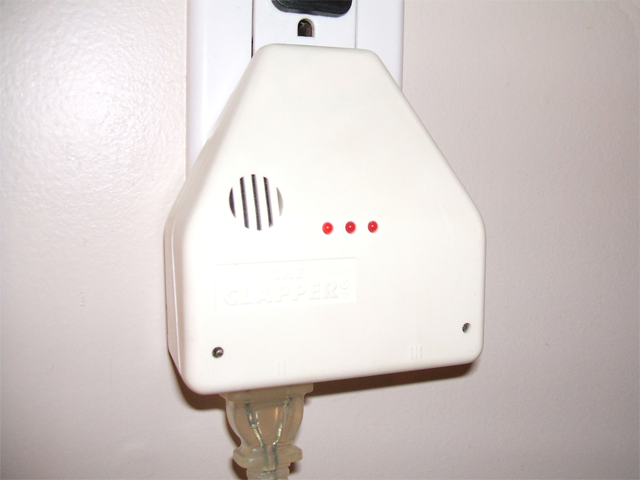
Overview
The Clapper, introduced in 1984 by Joseph Enterprises of San Francisco, is a small box that plugs into a wall outlet and lets you switch any plugged-in appliance on or off with two sharp handclaps. It detects the loud, distinctive double-clap pattern through an acoustic transducer and toggles a relay. No remote, no touch — the command is a percussive gesture made with the body alone, recognized by pattern, not by a button.
The device became an icon of 'the simple interface': absurdly literal, universally recognized, and (per its own framing) freeing the user from 'walking across the room to the switch.' Its interaction model — two sharp claps in quick succession toggle state, a subtle anti-annoyance delay to ignore single claps, sensitivity adjustment — is a complete gesture-recognition pipeline compressed into consumer hardware and sold for under $30. The patent family (US 4,906,995 and successors) protects the double-clap detection and relay latching logic.
As an HCI artifact, The Clapper sits at the meeting of three museum threads: voice/gesture command (it is the archetype of the 'command by body' family), home automation (it predates and in some ways prefigures the smart-home voice assistant), and the consumer-wonderful-commercial success. It is also one of the few devices here that most visitors have personally used or seen in a home, making it an approachable anchor for 'the gesture as interface.'
Deep dive
The Clapper has no keyboard, no display, no switch of its own. Its entire user interface is the acoustic recognition of two sharp claps. The user learns that a single clap is ignored (to avoid false triggers), while two claps in a quick interval toggle the connected appliance. This is pattern recognition in the consumer home a full decade before mainstream commercial speech/gesture recognition. The body itself is the command channel — no intermediary object, no wires, no remote. The clap is a deliberate, percussive, unmistakable gesture, chosen precisely because it is loud and hard to confuse with incidental noise.
The Clapper's electronics are tuned to reject single claps and to require a minimum time gap, so ordinary sounds, telephone rings, or doorbells do not toggle the relay. This sensitivity calibration — distinguishing an intentional double-clap command from ambient noise — is a genuine signal-processing design problem solved in simple analog/digital circuitry. It anticipates the wake-word and always-listening sensitivity tuning of modern voice assistants.
The Clapper's design is protected by a series of patents (notably US 4,906,995 and related applications) covering the sound-activated relay and the double-clap detection logic. Joseph Enterprises defended and licensed this intellectual property aggressively. The device's commercial ubiquity and its cottage industry of imitators (and spoofs) mark it as the canonical example of a single-purpose gesture-recognition appliance.
The Clapper became shorthand for 'ridiculously simple interface.' It appeared across TV, film, and internet memes, and remains a culturally recognized archetype of embodied command. For a museum whose charter is 'interaction model as the point,' the Clapper is the rare artifact where the interface gesture itself became famous.
Team & pioneers
- Joseph Enterprises. Manufacturer, San Francisco; led by Carl Joseph
- William Morrell. Inventor associated with the Clapper electronics and patents
Media