2-XL
A talking toy robot that used 8-track tape track-switching as an interactive branching mechanism — analog HCI at its most elegant.
Overview
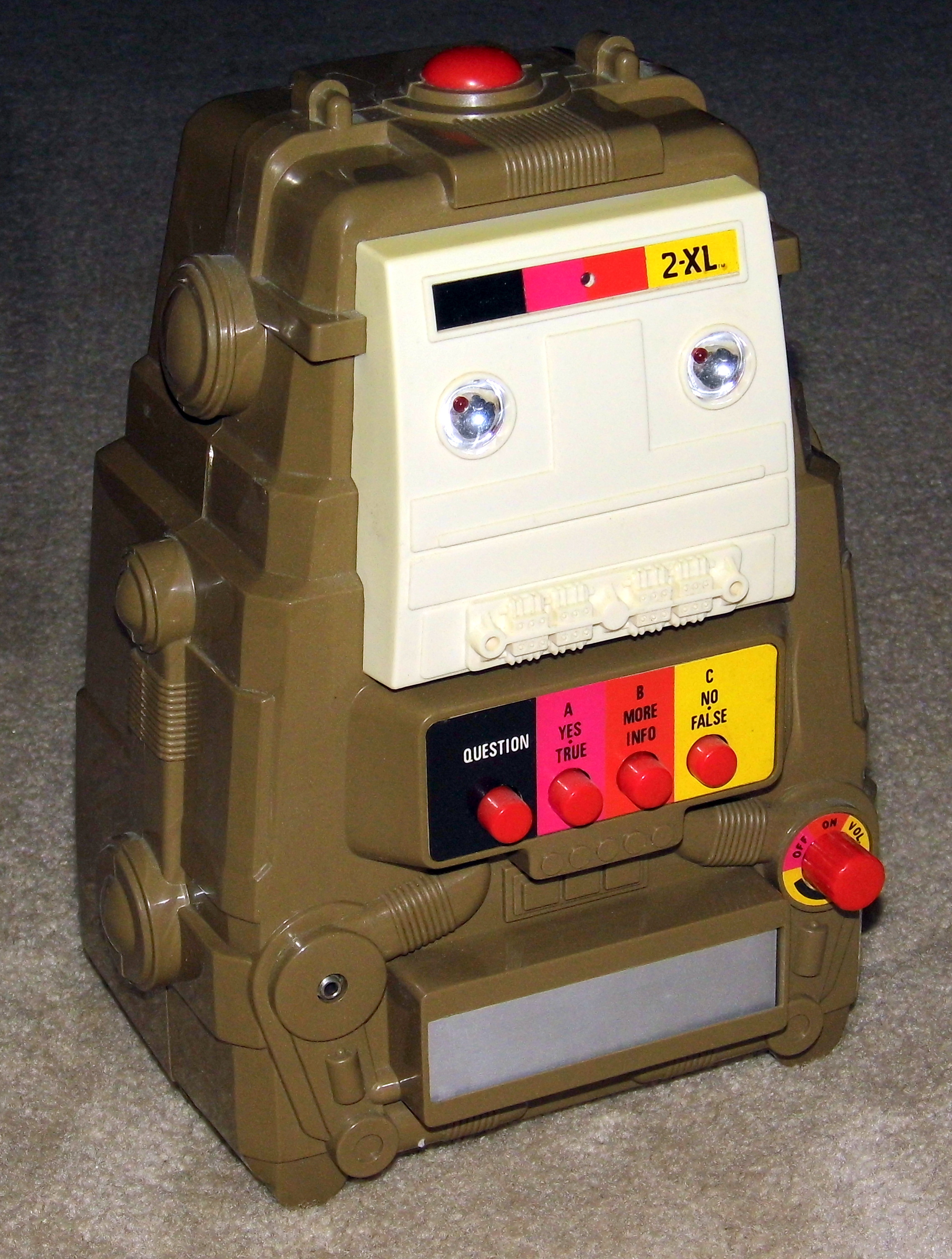
2-XL was an educational toy robot marketed from 1978–1981 by the Mego Corporation and revived 1992–1995 by Tiger Electronics. Shaped like a small standing android with flashing red eyes and a slot for 8-track tape cartridges, it was marketed as "the toy with a personality." Children listened to a program on an 8-track tape containing multiple-choice questions, then pressed one of four response buttons (Question, Yes/True, No/False, More Info). The core innovation was that these buttons did not signal a computer — they simply switched between the four parallel audio tracks on the 8-track tape. Because 8-track cartridges play all tracks simultaneously on a continuous loop, carefully synced recordings on each track could simulate branching conversations. The illusion was so convincing that 2-XL was widely perceived as an intelligent machine.
Freeman voiced the robot using a synthesizer to create a high-pitched, excitable character. The scripts were witty and sarcastic: wrong answers might trigger "Perhaps your brain went on strike!" while correct ones earned "It is amazing that big brain of yours fits into the head of a child." The toy won hundreds of awards, was translated into seven languages, and spawned over 40 tape titles. Playthings magazine placed 2-XL on its 75th-anniversary cover as one of the industry's top ten toys of all time. The 1992 Tiger version updated to compact cassettes, using all four tracks (left/right × side A/B) for the same branching effect with licensed properties including Spider-Man and X-Men.
Deep dive
2-XL was invented by Dr. Michael J. Freeman, who filed US Patent 4,078,316 for a "Real Time Conversational Toy" in 1977. Mego Corporation, a publicly traded New York toy company known for action figures and the Micronauts line, manufactured the original version. The name is a pun on "to excel." The toy debuted in 1978 at a time when educational electronic toys were virtually nonexistent. The 1992 revival by Tiger Electronics updated the format and added licensed entertainment properties.
An 8-track tape cartridge contains four parallel stereo programs on a single continuous loop. The tape head can read any of the four tracks. 2-XL's four buttons map directly to track selection. The program on each track is carefully timed so that pressing a button plays the appropriate response, and all tracks converge for the next question. This creates a four-way branching tree — effectively a state machine in magnetic tape. The user's participation completes the illusion: press the right button at the right moment, and the robot seems to know what you said. The 1992 cassette version achieved the same effect using the four audio tracks of a standard cassette (left and right for each side), with better sound quality and longer runtime. The device could also play any standard audio tape.
One of the final Mego-era tapes implemented a complete board game played against 2-XL. The tape came with a plastic board overlay that slotted over the robot's front, featuring a pyramid of colored squares. Dropping checkers through the slots also pressed specific buttons, and the audio branching logic tracked game state — a remarkable simulation of game-playing AI using only a four-track audio format.
2-XL was a significant commercial success and nostalgic touchstone. It spawned a TV game show spinoff (Pick Your Brain, produced by Marc Summers, with 2-XL as co-host) and appeared in public service announcements with Michael Jordan in 1992–1993. Tiger-era tapes included licensed adventures for Batman, Spider-Man, X-Men, Star Trek: The Next Generation, and Jurassic Park. Today, the toy has a dedicated collector community and a working web-based emulator (2xlbot.com). It is held in the collection of The Strong National Museum of Play.
Team & pioneers
- Dr. Michael J. Freeman. Inventor, voice actor, and scriptwriter for all 2-XL programs
- Mego Corporation. Manufacturer and distributor, 1978–1981
- Tiger Electronics. Manufacturer and distributor of the revived version, 1992–1995
Media
Sources
- 2-XL — Wikipedia
- Boing Boing: The 1978 Mego 2-XL Talking Robot was a brilliant illusion of interactive computing
- World of 2-XL (enthusiast site with comprehensive tape list and history)
- 2-XL Bot (online emulator with dozens of original programs)
- Mental Floss: Remembering the First Smart Toy: 2-XL
- The Strong National Museum of Play: 2-XL in collection
- US Patent 4,078,316: Real Time Conversational Toy