VCR Plus+
A whole recording schedule compressed into a printed number you type into a box
Overview
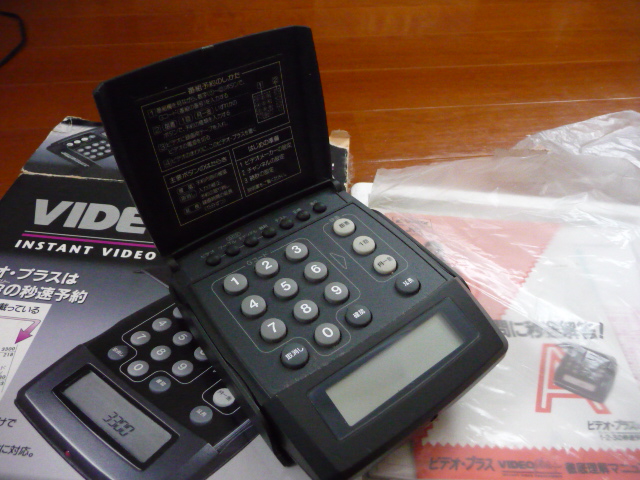
The VCR Plus+ is a small set-top box that let a viewer program a VCR by typing a short number printed next to a program in the TV listings. It was created by Gemstar Development Corp., founded in 1989 by Henry C. Yuen and Daniel S. Kwoh. The origin story: in the fall of 1988, Yuen — a Caltech-trained applied mathematician — failed to record a Red Sox game because he could not face the VCR's programming menus, and concluded that "taping a program should be as easy as dialing a telephone." The patent he and Kwoh filed, "Apparatus and method using compressed codes for scheduling broadcast information recording" (priority date December 23, 1988), describes how a 1-to-8-digit code (typically 5) can encode a program's channel, start time, duration, and day of the month; month and year are not encoded because the unit's own clock supplies them, which is why the codes changed monthly.
The device retailed for about $60 starting in November 1990, and the New York Times began printing PlusCodes in its listings on November 25, 1990. Newspapers and then TV Guide magazine printed the bold "+" codes; a one-time setup taught the box which local channels matched which numbers and which infrared codes its owner's VCR understood. At the scheduled time the box simply beamed those codes: power on, select channel, record. It became "the hottest accessory item in the country," and by the late 1990s the company behind it earned $40 million in profit on $126 million in sales and had merged with TV Guide itself.
Deep dive
PlusCode is the museum's clearest example of printed language as a compressed machine command. The digits encode channel, half-hour start slot, duration (from a table of 48 possible start times), and day of the month; decoding uses a no-carry multiply against a fixed key plus table lookups. Ken Shirriff, Curt Welch, and Andrew Kinsman reverse-engineered the commercial algorithm and published it as "Decoding a VCR Controller Code" in Cryptologia 16(3), July 1992 — a consumer product's secret encoding treated as a code to be broken. The human-side interaction is the ritual: find the bold "+" number in the newspaper, punch the digits into the box, press Once/Daily/Weekly, and aim the box at the TV.
VCR programming was the era's most notorious interface failure — "blinking 12:00" became shorthand for a whole category of gadget anxiety. Yuen's insight was to move programming out of the machine entirely: the schedule lives in print, the code is a compressed pointer, and the box only needs to emit infrared at the right moment. The user performs a lookup in the most reliable database of the 1980s, the newspaper, instead of navigating menus on a tiny screen. The box emulated each household's own VCR remote, learned once during setup.
Gemstar sold the hardware to consumers and the codes to publishers — the PlusCodes that made the boxes useful. The company merged with TV Guide Inc. in 1999, and the listings service ran until the last PlusCode was published in 2010. The G-Code variant took the same scheme to Japan and ShowView did the same for much of Europe; both survived as physical rituals into the 2000s.
The museum's other printed-media devices are machine-scanned: Cauzin Softstrip and Pioneer LaserBarcode are read by a wand, and the TI Magic Wand reads barcodes. VCR Plus+ requires the human to read the code and type it — a hand-transcription ritual between print and machine, closer in spirit to a telephone number than a barcode.
Team & pioneers
- Gemstar Development Corp. Founded 1989 by Henry C. Yuen and Daniel S. Kwoh; maker of VCR Plus+.
- Henry C. Yuen. Co-founder and CEO; Caltech-trained applied mathematician; the "taping should be as easy as dialing a telephone" origin story.
- Daniel S. Kwoh. Co-founder; co-inventor of the PlusCode compressed-code system.
- Ken Shirriff, Curt Welch, Andrew Kinsman. Reverse-engineered the PlusCode algorithm; published in Cryptologia 16(3), 1992.
Media
Sources
- Ken Shirriff — Decoding a VCR Controller Code (Cryptologia 16(3), 1992)
- Wikipedia — Gemstar–TV Guide International
- Los Angeles Times (Nov 16, 1990) — VCR Plus+ now available for about $60
- Sun-Sentinel (Dec 16, 1990) — Here's the scoop on Gemstar
- Newsweek — VCR Plus: Dial M for Late Night Movie
- The Straight Dope — How do the TV program codes for VCR Plus work
- Google Patents — Apparatus and method using compressed codes (priority 1988-12-23)
- Wikimedia Commons — File:Video-plus.JPG