Vectrex 3D Imager
Color 3D from a black-and-white screen — using a motorized spinning filter disk strapped to your face
Overview
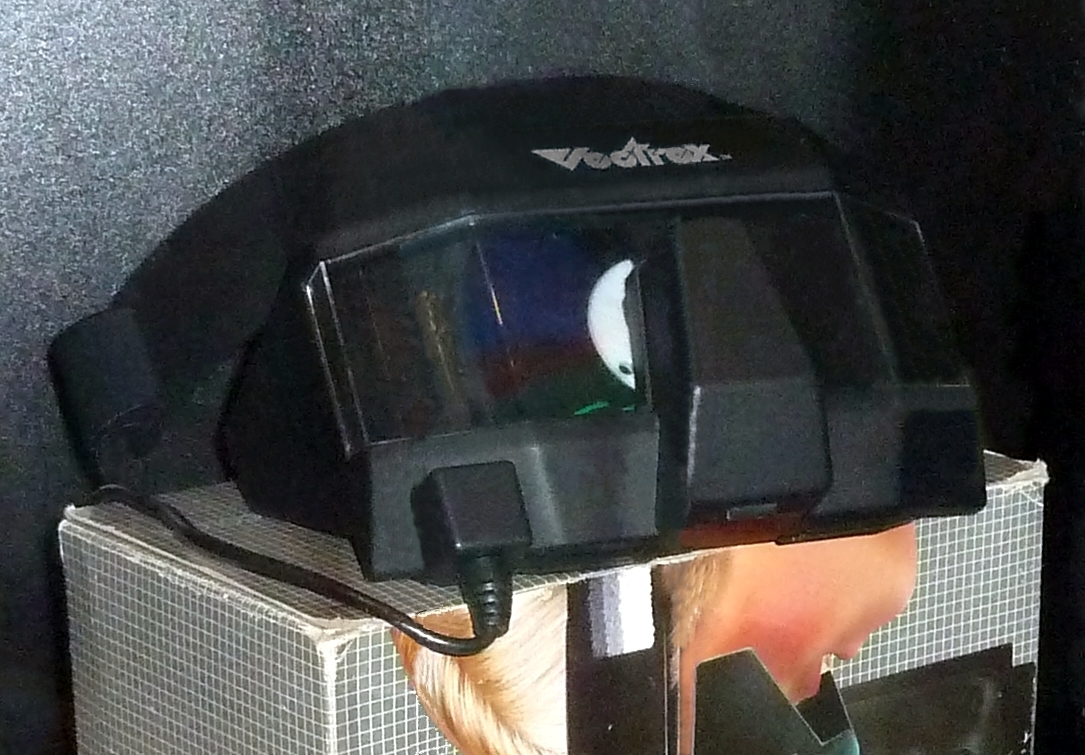
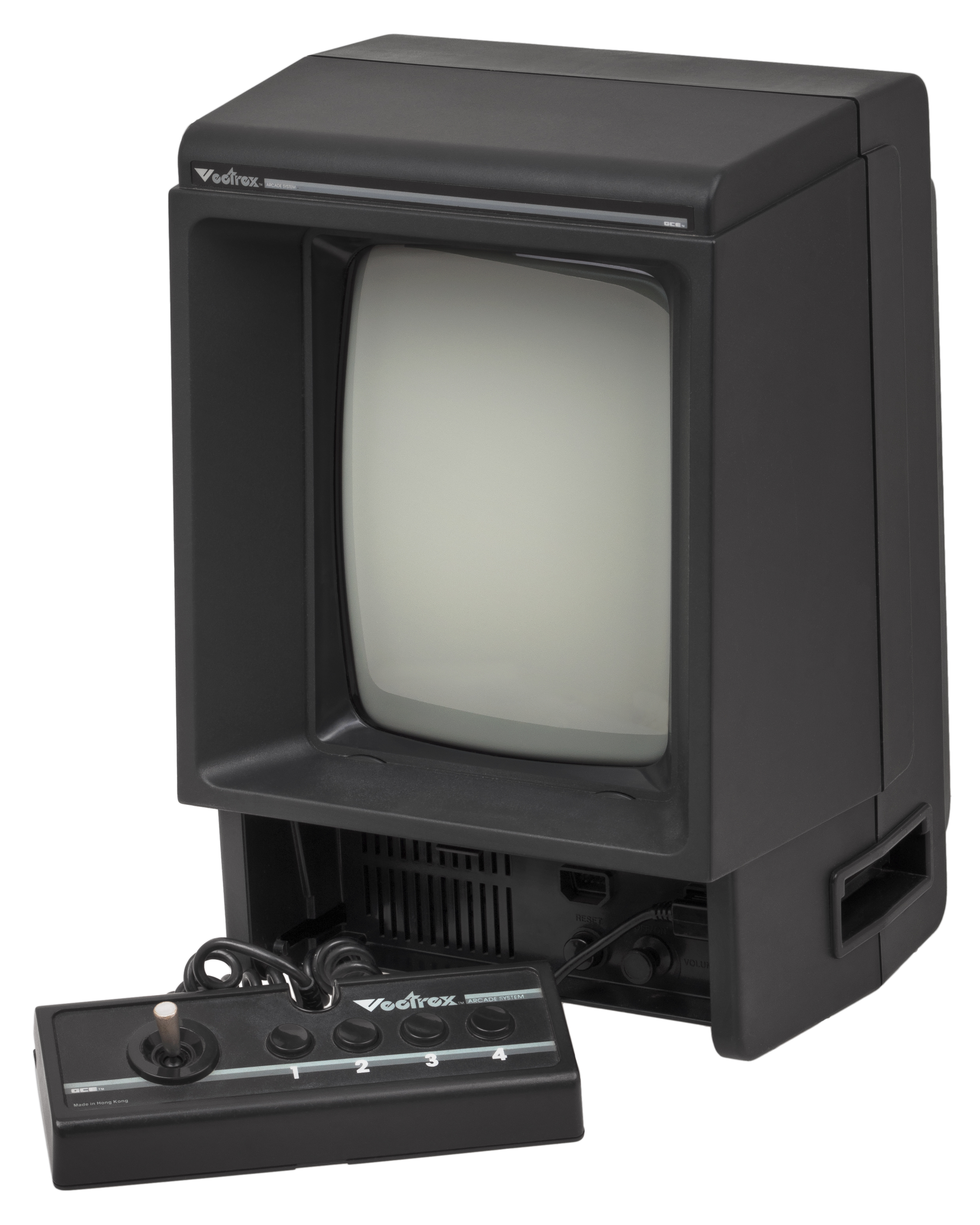
The Vectrex 3D Imager was a stereoscopic 3D headset peripheral for the GCE/Milton Bradley Vectrex home console — the first commercially released 3D gaming peripheral in history. Rather than using LCD shutters or electronics in the headset, it used a DC motor spinning a translucent disk directly in front of the wearer's eyes. Half the disk was opaque black; the other half was divided into 60-degree transparent red, green, and blue wedges. The Vectrex 6809 CPU synchronized the disk rotation to its vector-drawing frame rate using PWM motor control, drawing six alternating sub-frames (left-eye RGB, right-eye RGB) per rotation. Each eye saw a slightly different perspective, and the brain fused them into a color stereoscopic 3D image — all from a monochrome vector CRT.
Invented by John Ross at Smith Engineering/Western Technologies (who also conceived the Vectrex itself), the 3D Imager was demonstrated at the June 1983 CES and released in limited quantities in early 1984 for $50 — just as the Vectrex was being discontinued after Milton Bradley lost $31.6 million on the console during the 1983 video game crash. Only about 2,000-3,000 units were produced, and just three games were released: 3D Mine Storm (bundled), 3D Narrow Escape, and 3D Crazy Coaster. Sega later had to retract advertisements for their SegaScope 3D (1987) that claimed to be the world's first 3D gaming system — the Vectrex 3D Imager had beaten them by four years.
Deep dive
John Ross, a hardware designer at Western Technologies / Smith Engineering, conceived the 3D Imager after designing the original Vectrex concept in 1980 from a surplus 1-inch CRT. Jay Smith (founder of Smith Engineering, previously designer of the Mattel Microvision in 1979) headed the project. The prototype housing was reportedly built from recycled View-Master casework. Gerry Karr designed the Vectrex's computer and vector generator; John Hall wrote the built-in game Mine Storm; Tom Sloper coined the 'Vectrex' name.
The 3D Imager plugs into the second controller port. A small DC motor spins the filter disk at roughly 1,800-2,200 RPM. The disk is divided into a 180° opaque black half and a 180° half segmented into 60° red, green, and blue transparent wedges. As the disk spins, only one eye at a time sees the screen, and each eye sees through a different color filter in sequence. The Vectrex compares its software frame rate to an once-per-revolution index signal from the Imager, dynamically adjusting motor power via PWM to keep the disk phase-locked. For stereo depth, each object is drawn at least twice from slightly different angles — the angular displacement determining perceived depth in front of or behind the screen plane. The system produces 15-18 full stereo frames per second per eye.
US Patent 4,630,767, assigned to Ross/Smith Engineering, covers the spinning filter disk and synchronization mechanism. The approach is field-sequential color stereoscopy — the same principle as the CBS field-sequential color television system of the 1940s, miniaturized into a gaming peripheral.
John C. Dvorak reported from CES 1983: "You put on some weird spinning glasses, and when you look at the screen, you see a full-color, 3-D image." But by the time it shipped in early 1984, the Vectrex was already dead — destroyed by the 1983 crash, $31.6M in losses, and a price slashed from $199 to $100. Users complained the spinning disk created a gyroscopic effect resisting head movement, causing nausea. Only three games were produced. Today boxed units sell for $500-900+ among collectors.
Sega was forced to pull its 'world's first 3D gaming' advertising for SegaScope 3D (1987) after the Imager's prior existence was pointed out. Modern active-shutter 3D glasses use the same alternating-eye principle. A homebrew community (madtronix, Fury Unlimited) built replacement imagers and new games in the 2000s.
Team & pioneers
- John Ross Hardware designer. Invented the Vectrex 3D Imager (and the Vectrex itself). Designed optics, motor drive, and sync electronics.
- Jay Smith Founder of Smith Engineering / Western Technologies. Previously designed the Mattel Microvision (1979). Project lead.
- Gerry Karr Vectrex computer and vector generator design, system ROM (RUM).
- John Hall Early system ROM, wrote built-in game Mine Storm.
- Tom Sloper Named the Vectrex; game designer, created the Spike mascot.
- Walter Nakano and Colin Vowles Industrial design and model building.
- Bill Hawkins Programmed key Vectrex games (Bedlam, Star Castle, Cosmic Chasm).
- Duncan Muirhead Trigonometry routines for the RUM system ROM.
- Manufacturer General Consumer Electronics (GCE) / Milton Bradley Company.
Media
Sources
- Wikipedia: Vectrex (3D Imager section)
- Vectrex Museum — 3D Imager page
- Vectrex Museum — History (full team credits)
- Gamasutra — A History of Gaming Platforms: The Vectrex (Barton & Loguidice, 2007)
- Popular Science, November 1983 — "What's New in Electronics" (p. 116)
- InfoWorld, July 4, 1983 — John C. Dvorak CES report
- Patent US 4,630,767 — Ross/Smith Engineering 3D display system
- Electronic Games, September 1984 — "Farewell To Vectrex" (Joyce Worley)