Performance-Driven Facial Animation
The first system to use a live actor's real face as a real-time input device for computer-generated animation
Overview
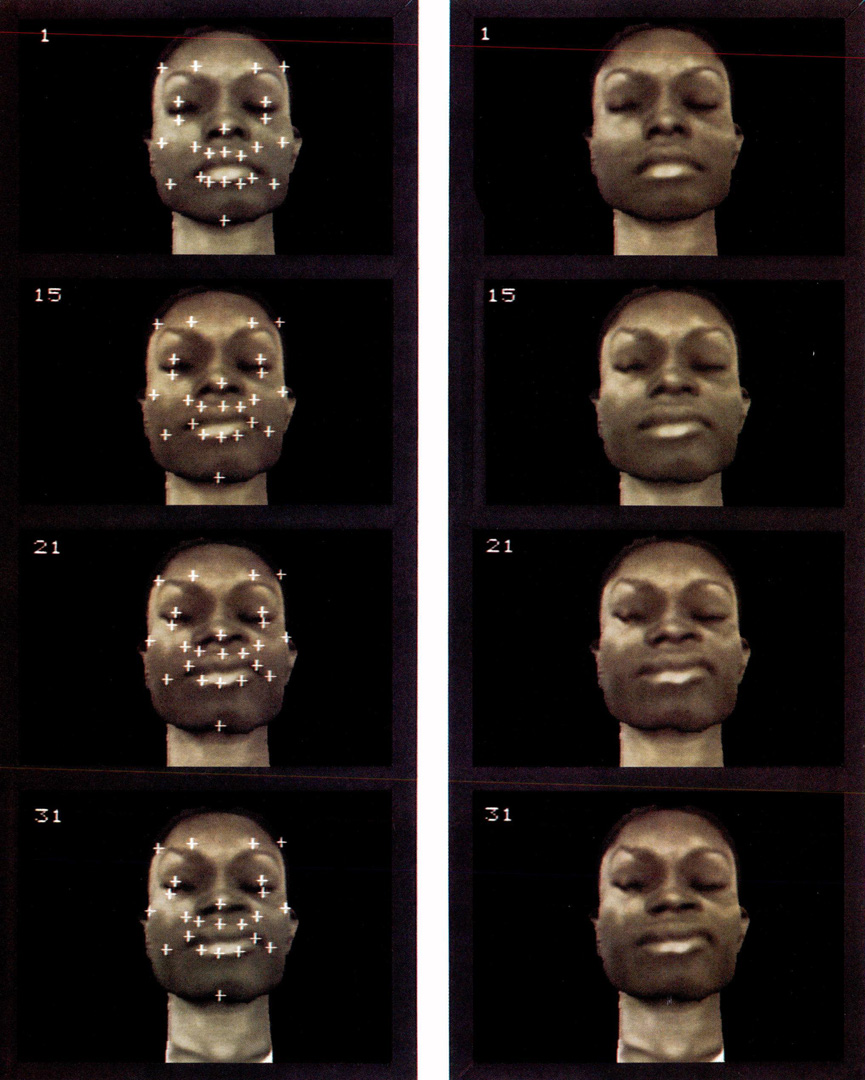
Lance Williams' 'Performance-Driven Facial Animation,' presented at SIGGRAPH 1990 in Dallas, introduced the concept of the 'electronic mask': a live human actor whose facial expressions are captured in real time and used to drive a computer-generated 3D face. The system combined two novel subsystems: a photorealistic CG head model built by laser-scanning a human subject with a Cyberware 4020/RGB 3D color scanner and projecting photographic textures onto the geometry, and a real-time vision-based tracking system that captured the 3D positions of small retroreflective markers placed on a performer's face.
The tracking system illuminated the actor's face, captured bright reflections from the retroreflective dots via one or more cameras, computed their 3D centroids in real time, and used the displacement data to deform the CG face model. Williams explicitly framed this as a solution to the 'performance problem' — the fact that physical simulation of muscles and skin could produce realistic deformations but failed to capture the nuanced timing and emotional expressiveness of an actual human performance. The paper cited early facial modeling work by Parke (1974), Badler & Platt (1981), and Waters (1987), but was the first to close the loop: a real face as real-time controller.
This single-author paper, produced during Williams' tenure at Apple's Advanced Technology Group (1987–1993), is recognized as the foundational work of facial performance capture. Its influence extends through Disney's Gemini Man project (where Williams served as technical architect), modern film VFX (Avatar, Benjamin Button), and ultimately to consumer-grade facial tracking in Apple's ARKit. The Wikipedia article on 'Facial motion capture' opens its history section by citing this as 'one of the first papers discussing performance-driven animation.'
Deep dive
Lance Williams came from the pioneering University of Utah computer graphics program (studying under Ivan Sutherland and David Evans) and the NYIT Computer Graphics Lab, where he invented mipmapping (1983) and shadow mapping (1978). His consulting work for Jim Henson Associates exposed him to puppetry and real-time performance, likely inspiring the 'electronic mask' concept. At Apple ATG, he had access to the Cyberware 3D scanner and the vision-tracking hardware needed to realize the system. Williams framed the motivation precisely: 'The gestures and expressions of a human actor are not the solution to a dynamic system' — a human performance cannot be generated by physics equations alone; it must be captured from a real person.
The system had two pipelines. First, model creation: a Cyberware 4020/RGB 3D color scanner laser-scanned a human subject's head to produce a dense polygonal mesh with per-vertex color. Photographs of the subject were projected onto the geometry as texture maps for photorealistic skin detail. The tracking pipeline used retroreflective markers — small dots that reflect light directly back to its source — placed at key facial feature points. A vision system with controlled illumination captured the dots as bright spots against a dark background. Software detected the centroid of each dot in the camera image, computed 3D positions via triangulation, and mapped the sparse dot positions into smooth full-face deformations using scattered data interpolation. The entire pipeline ran at interactive frame rates — a radical departure from the laborious keyframing that dominated facial animation at the time.
Williams' paper established the paradigm that drives all modern facial performance capture. He later served as Chief Scientist at Walt Disney Animation Studios and technical architect on Disney's Human Face Project (the Gemini Man test), which directly extended his 1990 work. He received a 2001 Technical Academy Award for 'pioneering influence in the field of computer-generated animation and effects for motion pictures.' The 2006 SIGGRAPH Course on 'Performance-Driven Facial Animation' and a 2023 Springer survey on facial capture for digital humans both trace their lineage to this work. From marker-based optical capture to head-mounted camera rigs to Apple's TrueDepth camera and ARKit face tracking — all descend from the concept Williams demonstrated in 1990.
Beyond the technical contribution, the paper's philosophical stance was influential: that computer animation should preserve and transmit human performance rather than replace it. Williams wrote that the 'electronic mask offers a means for the traditional talents of actors to be flexibly incorporated in digital animations.' Lance Williams died in 2017, having shaped computer graphics through mipmapping, shadow mapping, view interpolation, and this foundational work on performance-driven facial animation.
Team & pioneers
- Lance J. Williams (1949–2017). Sole author. Researcher at Apple ATG, previously NYIT Computer Graphics Lab. Inventor of mipmapping and shadow mapping. Later Chief Scientist at Walt Disney Animation Studios. 2001 ACM SIGGRAPH Coons Award, 2002 Academy Award for Technical Achievement.
Media
Sources
- Williams, L. 'Performance-Driven Facial Animation,' ACM SIGGRAPH Computer Graphics, Vol. 24, No. 4, pp. 235–242, August 1990
- SIGGRAPH History Archive — Performance-Driven Facial Animation by Williams
- Wikipedia — Lance Williams (graphics researcher)
- Wikipedia — Facial Motion Capture (cites Williams 1990 as foundational)
- Cartoon Brew — The Secret History of Disney's Gemini Man (confirms Williams as technical architect)
- University of Utah obituary for Lance Williams
- Macworld — Williams' 2002 Academy Award coverage