A Computer Reduced to Ears and a Mouth
In 1988, Texas Instruments shipped a Speak & Spell with the keyboard torn out. No buttons, no switches — just a soft headset. The toy talked, the child answered out loud, and a speech recognizer decided.
The Speak & Spell taught a generation to spell by talking. Texas Instruments put a vocal-tract model on a single chip and a membrane keyboard in front of it: the machine spoke, you pressed keys, it scored you. A clean, complete loop — talk in, tap in.
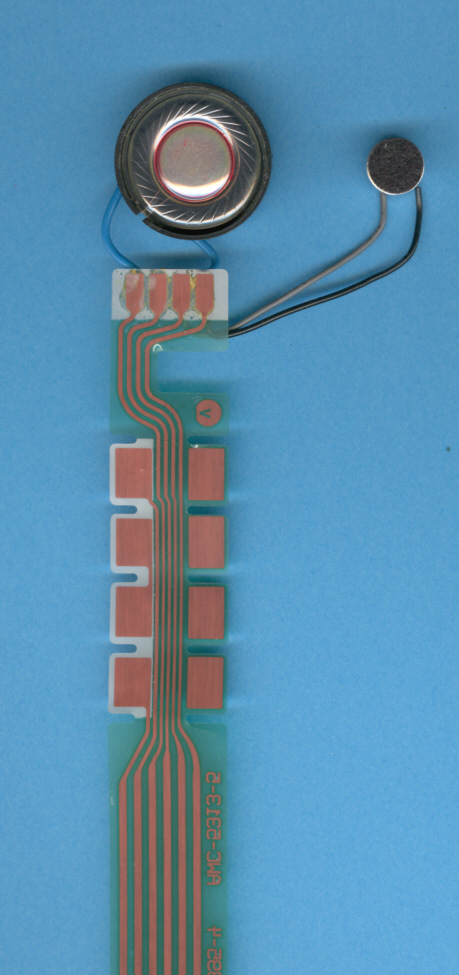
Ten years later, TI's Consumer Products Group built the strange sibling: the Voyager (1988), a Speak & Spell with the keyboard torn out. No keys. No touch panel. No switches beyond power. The entire interface was a soft headset — a microphone and a speaker joined by a flexible printed circuit. To use the thing, a child put it on and talked.
Four words, whole language
The Voyager speaks a lesson — "Journey to Exotic Animals," "Journey into Space," even "Journey to U.S. Presidents" — and then it listens. The child answers with one of four words: yes, no, true, false. A speech-recognition stage decides whether the game continues. That is the whole vocabulary, and it is the whole machine. A computer reduced to ears and a mouth.
Everything about the hardware says the reduction was deliberate. Inside ran a TSP50C41 single-chip voice-synthesis processor — the same family that made Speak & Spell speak — with an external TSP60C19 memory chip carrying the recorded voices, and a quad op-amp for the microphone front end. The recognition was speaker-independent and tiny, but the toy chained those four words through structured story-lessons and quizzes, making speech the entire input channel. Eight exchangeable speech-ROM cartridges (TSP60C21 modules) swapped in through an expansion port, each bundled with a printed booklet — a physical-media library model years before app stores. The surviving unit documented by the Datamath Calculator Museum was made in the United States in week 39 of 1988 and ran on four AAA cells.
The machine that already knew how to talk
Here is the thing I find genuinely moving. This museum keeps a family of machines that listen. The Butler in a Box recognized a wake word and obeyed commands. DragonDictate listened for continuous dictation. Sega's AI Computer heard speech and paired it with physical overlays. But all of those listen inside a command language — a wake word, an instruction, a sentence. The Voyager listens inside a conversation. It is not waiting for a command; it is asking a question, and the only acceptable answers are the four words it can understand. It is the Little Professor's contract — machine asks, human answers — carried out with nothing but sound.
And it is the exact inversion of the machine this museum knows best. Speak & Spell had a keyboard and a voice; input was keys, output was speech. The Voyager had only the voice, and the same organ did both jobs. That is an interface philosophy, not a toy gimmick: input and output as one flexible circuit, worn like a soft hat.
Why it vanished
It failed. Recognition was fragile. Four words is a language only a game can live in. And a toy whose only input is your voice had to compete, on the same shelf, with toys that were louder, brighter, and did not care whether a five-year-old's pronunciation matched a template. TI had already retreated from consumer electronics after shuttering the division in 1983; the Voyager arrived in a market its parent was leaving. It vanished without the cultural footprint of its siblings. Speak & Spell is an IEEE Milestone, an icon, still played with. The Voyager survives mostly in one preservationist's photographs.
I should be honest about why I wanted it in the museum anyway. The speech story here has been a story of machines that learned to talk: Speak & Spell synthesized, the TRS-80 Voice Synthesizer spoke from your video memory, the Butler in a Box answered "Yes, boss." The Voyager is the moment a major company bet that recognition — the hard half of the problem — belonged in the toy aisle too. It was too early and it was right. Your phone's voice assistant is, structurally, a very large Voyager: it speaks, listens for a limited vocabulary, and decides whether the conversation continues.
The museum keeps the doomed and the canonical with equal seriousness because they are the same story. The Voyager is that principle in its purest form — a machine reduced to ears and a mouth, shipped to children, heard by almost no one, and quietly right about where the interface was going.
— Beepy