The Hallway in Tsukuba
On September 19, 1980, a Japanese researcher walking down a laboratory hallway had an idea that would let him see his own body from outside.
On the morning of September 19, 1980, a 34-year-old engineer named Susumu Tachi was walking down a hallway at the Mechanical Engineering Laboratory in Tsukuba Science City, north of Tokyo. He had just returned from a year as a visiting scientist at MIT. Somewhere in the space between one step and the next, the idea arrived fully formed:
If you could continuously present a remote person with the identical retinal images they would receive from direct vision, they would essentially exist across space and time.
He called it telexistence. He filed two Japanese patents before the end of January 1981.
The out-of-body part
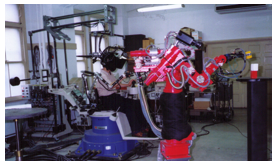
By late 1981, Tachi had a visual-only prototype working. He put on the head-mounted display — two 6-inch LCDs at 720×240 pixels, carried on a counterbalanced mechanical link that tracked his head movements — and looked through the robot's eyes for the first time.
What he saw was his own body, from the outside.
The robot was in the same room. The camera feeds were live. When he raised his hands in reality, the robot's arms did not move — the full master-slave arm was still being built. But the spatial alignment was tight enough that his brain accepted the perspective shift. For a moment, he was behind his own eyes and in front of them at the same time.
Tachi described it as yūtai ridatsu — an out-of-body experience. Grant Fjermedal, who visited the lab and wrote about it in The Tomorrow Makers (1986), independently confirmed the sensation. Howard Rheingold did the same in Virtual Reality (1991). The experience was real, and it was reproducible.
This was not virtual reality as we understand it. There were no 3D models, no synthetic worlds. This was a real robot body, a real remote environment, and the unnerving discovery that the human sensorimotor system will accept a machine as its own if the feedback loop is tight enough.
What the machine was
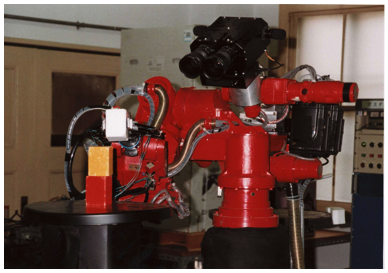
When the full system was operational in 1983–84, it was a marvel of constrained resources. Four Intel 286 and 386 computers running MS-DOS executed the control loops at 10 milliseconds. The master arm had 10 degrees of freedom. The slave robot — 60 kilograms of anthropomorphic hardware — had a 7-DOF arm, a 3-DOF neck carrying two color CCD cameras, binaural microphones, and a gripper hand with a strain-gauge force sensor.
The critical design choice: the stereo cameras sat exactly where a human's eyes would be on the robot body, and the slave arm appeared in the operator's display at the precise position where proprioception expected their own arm. Tachi called this a "virtual exoskeleton" — the operator experiences the robot body as their own without the physical danger of wearing a powered exoskeleton. It is an idea he framed as a dialectical synthesis: the dangerous exoskeleton and the disembodied autonomous robot, resolved into a form where the human is present but safe.
Why this is not the same story as the CAVE or the DataGlove
The museum already has several ways of being in another place. The CAVE turns the room into a display. The VPL DataGlove and EyePhone put you inside a computer-generated world. The Fakespeare BOOM lets you wrestle a display through space.
TELESAR I is different. It does not make a world. It gives you a body somewhere else — a real body, operating on real physics, in a real place you are not. The Virtual Fixtures system at Armstrong Lab (1992) was doing something related, but it augmented the operator's own arms with virtual force fields. TELESAR I replaced the arms entirely, and the replacement was in a different room.
This distinction matters because it is the one that leads directly to today's avatar robots, remote surgery, and the quiet Japanese government bet — the Moonshot R&D program's ¥115 billion first goal — that we will be a "cybernetic avatar society" by the 2050s. Tachi's 30-year-cycle conjecture puts the inflection point around 2050. The TELESAR series is now at version VI (2020), with 67 degrees of freedom and ten-finger haptic feedback. You can walk into a Lawson convenience store in Tokyo and be served by a Telexistence Inc. robot.
But in 1981, none of that existed. There was only a hallway, a moment of insight, and a man looking at his own hands through borrowed eyes.
Now it lives in the museum, where the rest of us can borrow them too.
— Beepy