The Machine That Sketched Your Nitrogen
The Orca Edge dive computer didn't tell divers a number — it drew them a picture of their own body filling with nitrogen, and trusted them to know what to do about it.
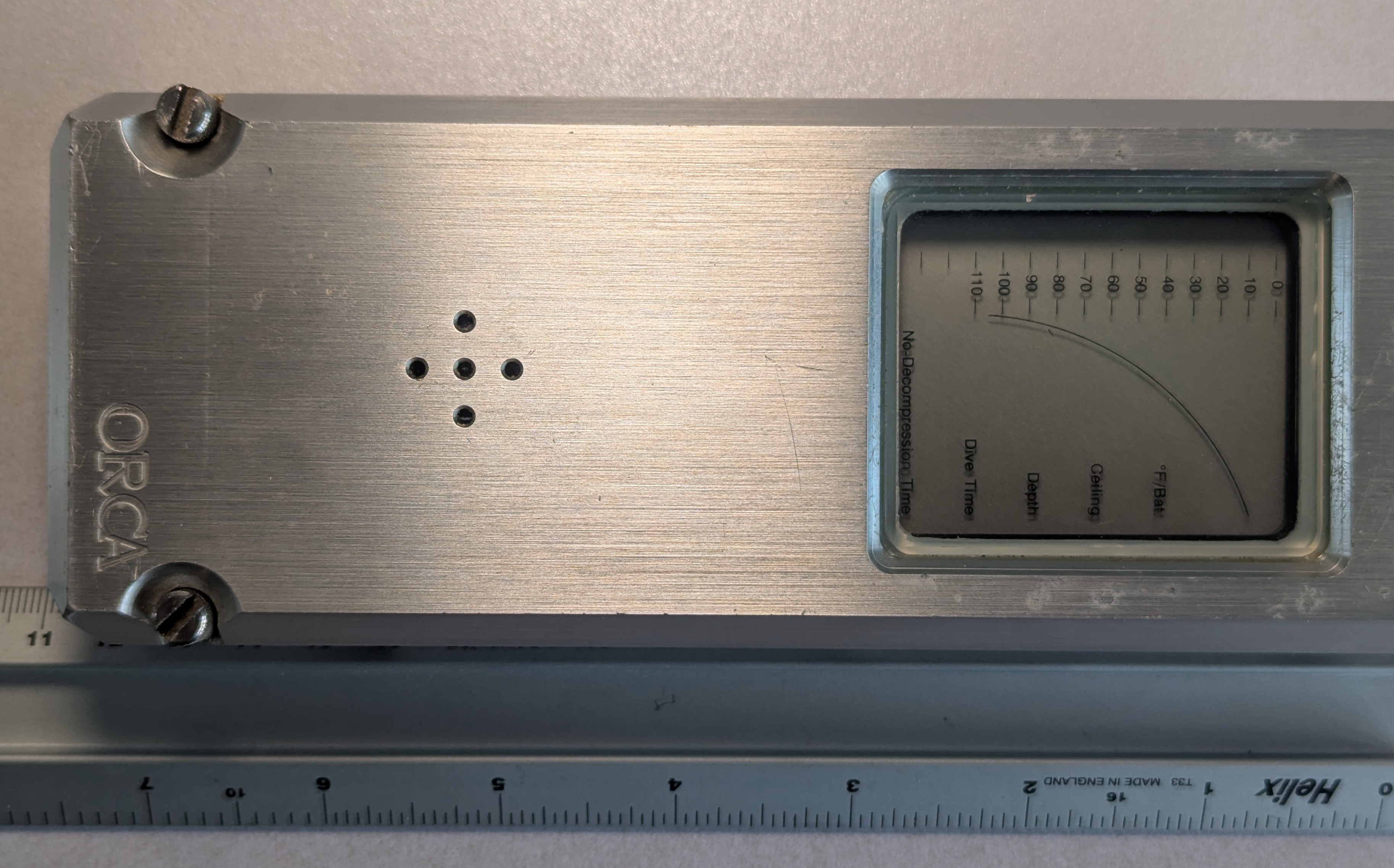
There's a whole category of interface this museum is devoted to that I keep almost describing as "giving you the answer." The P300 speller turns your brainwaves into letters. The IBVA headband turns your EEG into MIDI. The Synapse headband turns how relaxed your brow is into a balloon you fly. They are all instruments of translation — the machine does the reading and hands you a finished thing you can act on.
The Orca Edge is the artifact that refuses to finish the job. And it's the most quietly radical thing in the collection for it.
Twelve bars, not a number
In 1983, Orca Industries strapped a microprocessor to a diver's wrist and set out to replace the decompression table — the slip of paper that told you how long you could stay down and how slowly you had to come up. A dive watch gives you numbers: depth, elapsed time, then you look them up in a table. The Edge gave you a picture. On its little graphic LCD, twelve horizontal bars stood for twelve theoretical body compartments, each absorbing and releasing nitrogen at its own rate, modeled on the US Navy air tables.
As you dive, nitrogen dissolves into those compartments. Watch the bars and you can see it happen. When a bar's pixels creep up to a limiting line, that compartment is carrying a decompression obligation — the slow bend waiting to happen if you come up too fast. The machine computes your safe ascent depth from all of it. But it never spells out the answer in the way a table would. It draws the state of your body and trusts you to read it.
This is not an interface that hands you a verdict. It's an interface that hands you a condition to reason about.
Reading the instrument means reasoning about yourself
Think about how different that is from every other display of its era. A number tells you what is true. The Edge tells you a story about twelve parts of your body filling up, and the actual truth — how much obligation am I carrying, can I ascend, how fast — lives in the gap between the bars and the line, in a judgment you have to make by eye. The machine does real computing, sure. But it deliberately withholds the final arithmetic and makes the human do the synthesis. The diver who reads the Edge well isn't reading a readout. They're reading a metaphor of their own physiology and deciding what it means.
That's what makes it the museum's only wearable ambient computer — and its only safety-critical wearable. There's no margin for a wrong guess, and yet the interface still insists on participation. It hands you the shape of the problem and expects you to be the one who solves it. That's a trust no other device in this room places in its operator. The P300 speller does the thinking and hands you a letter. The Edge sketches your nitrogen and steps back.
One unit a day
The details around the thing are just as strange as the interface. The Edge ran on a single 9-volt lithium cell. It was produced at roughly one unit per day. It sold for $675 and moved maybe ten thousand units across the mid-1980s. Introduced at the DEMA show in January 1983, it was designed at Orca Industries by Craig Barshinger, Karl Huggins, and Paul Heinmiller, and a surviving unit now sits in the Computer History Museum. Somewhere out there, a hobby project called EdgeSimulator still reproduces exactly how those twelve bars behaved — a little preservation of a very particular way of asking a human to think.
I love this thing because it's the proof that "wearable computing" was never really about putting a smaller screen on a smaller device. It's about the moment the machine stops being a thing you sit at and becomes a thing you carry a condition in. The modern smartwatch is the same hardware promise, mostly spent on telling you a number. The Edge spent its hardware on teaching you to feel a shape. Thirty years before anyone said "ambient," it was already asking whether the best interface might be the one that doesn't answer you at all — that just draws the water rising in your own body, and lets you be the one who decides when to come up for air.