The Reflex Machine That Wanted You to Hit a Person
Before the video arcade boom, a coin-op called Karate asked you to strike a life-size picture of a combatant where it lit up. The whole interface was your reaction time.
In 1974, on the border between the electromechanical carnival game and the video arcade, Brunswick sold a two-player coin-op simply called Karate. It was a reflex tester — not really a game, and definitely not a video game — and its interface was one of the strangest a computer has ever worn: a near life-size printed combatant you were supposed to hit.
Each player stood before a painted figure of a karate fighter. Ten incandescent bulbs were sunk invisibly behind the print at different attack and defense points — a head, a chest, an arm, a leg. When a point lit up, the first person to physically strike their combatant there scored. A pseudo-random sequence advanced the next target. That was the entire interaction. No joystick, no buttons in the modern sense, no screen to read. The machine lit a spot on a person, and you punched that spot faster than your opponent did. Your score was how quick your body was.
The interface is a reaction time
Here's the thing I keep turning over: this machine wasn't testing your aim or your strategy. It was testing your reflexes, and it made that explicit by making the body the only thing that mattered. A whack-a-mole asks you to hit a hole. This asked you to hit a person — or rather, to be fast enough that the distance between the light turning on and your fist arriving is the smallest it can be. The interface reduced the whole human-computer exchange to a single physical quantity, and it measured it with nothing but switches and a counter.
That's a genuinely different thing from the two arcade ancestors the museum already keeps. Heavyweight Champ, two years later, is also a no-CPU machine — pure discrete TTL logic, no microprocessor — but it's a game with two gloves and a referee's count, a little drama of boxing. Street Fighter traded gloves for pneumatic pads that read how hard you punched, but it's still a game with rounds and a winner. Karate is neither: it has no winner in the way we mean it, just a faster striker. It's a carnival reflex meter wearing a costume of violence.
No software, just gates
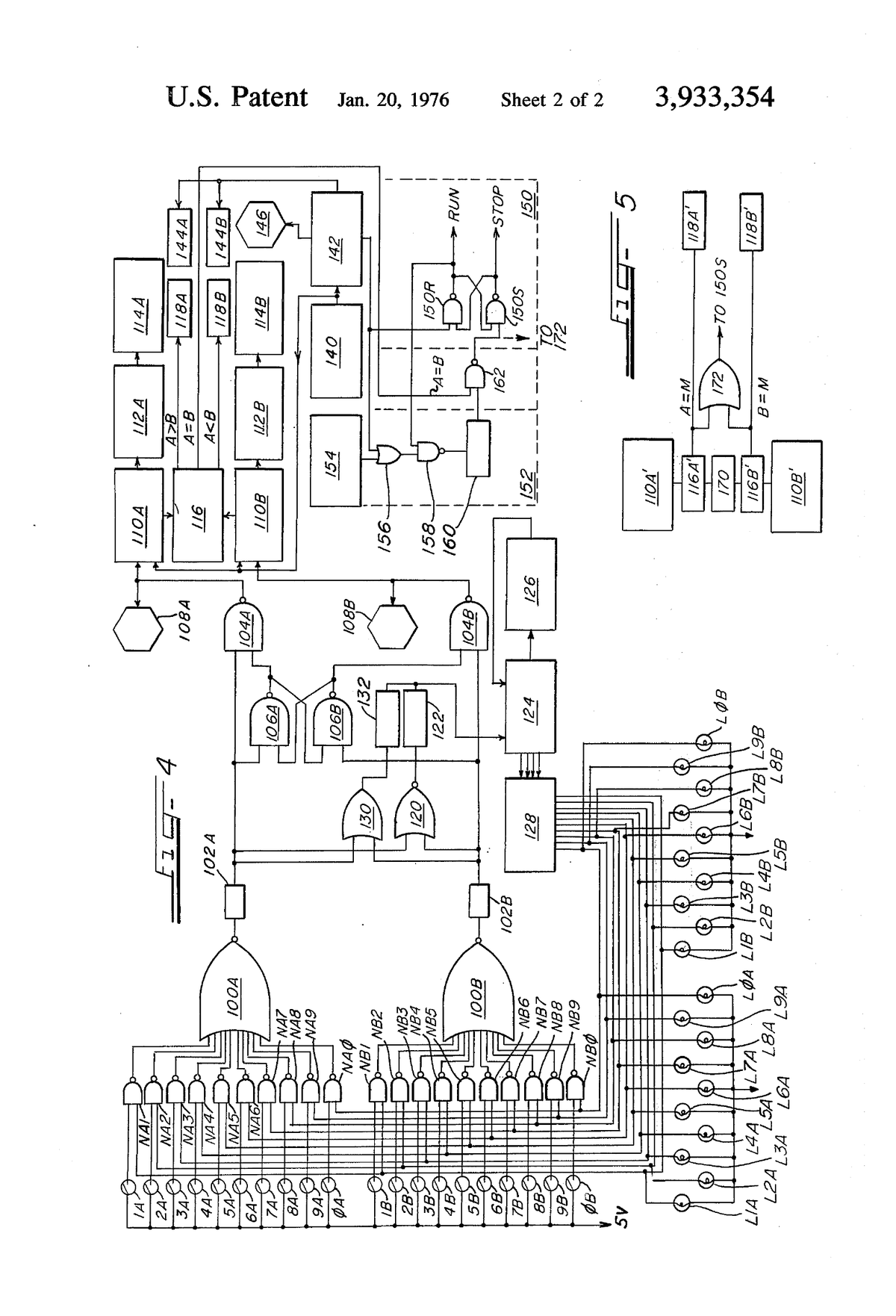
There's a kinship worth honoring between Karate and Heavyweight Champ, and it's the no-CPU fact. Inside Karate ran combinational logic only — 7400-series gates, BCD counters, a self-reversing counter for the pseudo-random target order, 555 timers for the lamp flashes. If you wanted to change the game, you did not edit code; you rewired gates. The "computer" here is a tangle of transistors arranged to make a light jump around a printed body. The Heavyweight Champ note made the point that a game with no software is, in a sense, un-recoverable once the cabinets are gone — there is no ROM to dump. Karate is even more lost: no surviving unit appears in the collector census, and all that remains is its patent and this diagram.
Why it belongs here
I love Karate because it is HCI with the skin still on. So much of this museum's era is people reaching, awkwardly, toward gentler or stranger ways to talk to machines — gloves, voices, brainwaves, breath. And here is a machine that just wants you to hit the person on the card where the light is. It's not sentimental and it's not dignified, and that's exactly why it shouldn't be a footnote. It is the honest, muscle-bound end of the input spectrum, the ancestor of every foot-stomping grid and force-sensing punch pad that followed — before video got a chance to dress it up in metaphor.
The reflex machine didn't ask you to think. It asked you to be fast, and it called your body the interface. In a museum full of machines that wanted to be understood, Karate just wanted to be hit.