The Tank With No Screen
Milton Bradley's Big Trak had 16 command slots, a membrane keypad, and no screen. Programming was an act of faith — you pressed GO and watched a tank carry out your orders on the living room carpet. Then CMU psychologists adopted it to study how humans learn.
In 1979, Milton Bradley released a six-wheeled programmable toy tank. It had a Texas Instruments TMS1000 microcontroller, 16 command slots, and a membrane keypad on its back. It had no screen.
This last detail is the entire point.
To program the Big Trak, you knelt on the living room carpet and typed commands directly onto the machine: FORWARD 5, RIGHT 15, FORWARD 3, LEFT 30, FIRE. Each keypress registered as a soft click under your finger and then — nothing. No cursor blinked. No list scrolled. No syntax error lit up. The program existed only inside the tank's memory, invisible to you, unverifiable until you pressed GO.
Then you pressed GO. And the tank moved.
It rolled forward exactly five body-lengths — a measurement defined by the machine itself, deeply strange to estimate. It pivoted right by some fraction of a full rotation you had guessed, not calculated. It fired its blue photon beam headlamp at a coffee table leg. If you had programmed correctly, the tank navigated around the furniture and returned to you like a small obedient animal. If you had not — if you had confused left and right, or entered six body-lengths when you meant four, or forgotten that carpet pile reduces effective turning radius — it collided with the sofa and sat there, photon beam still glowing, waiting for a reset.
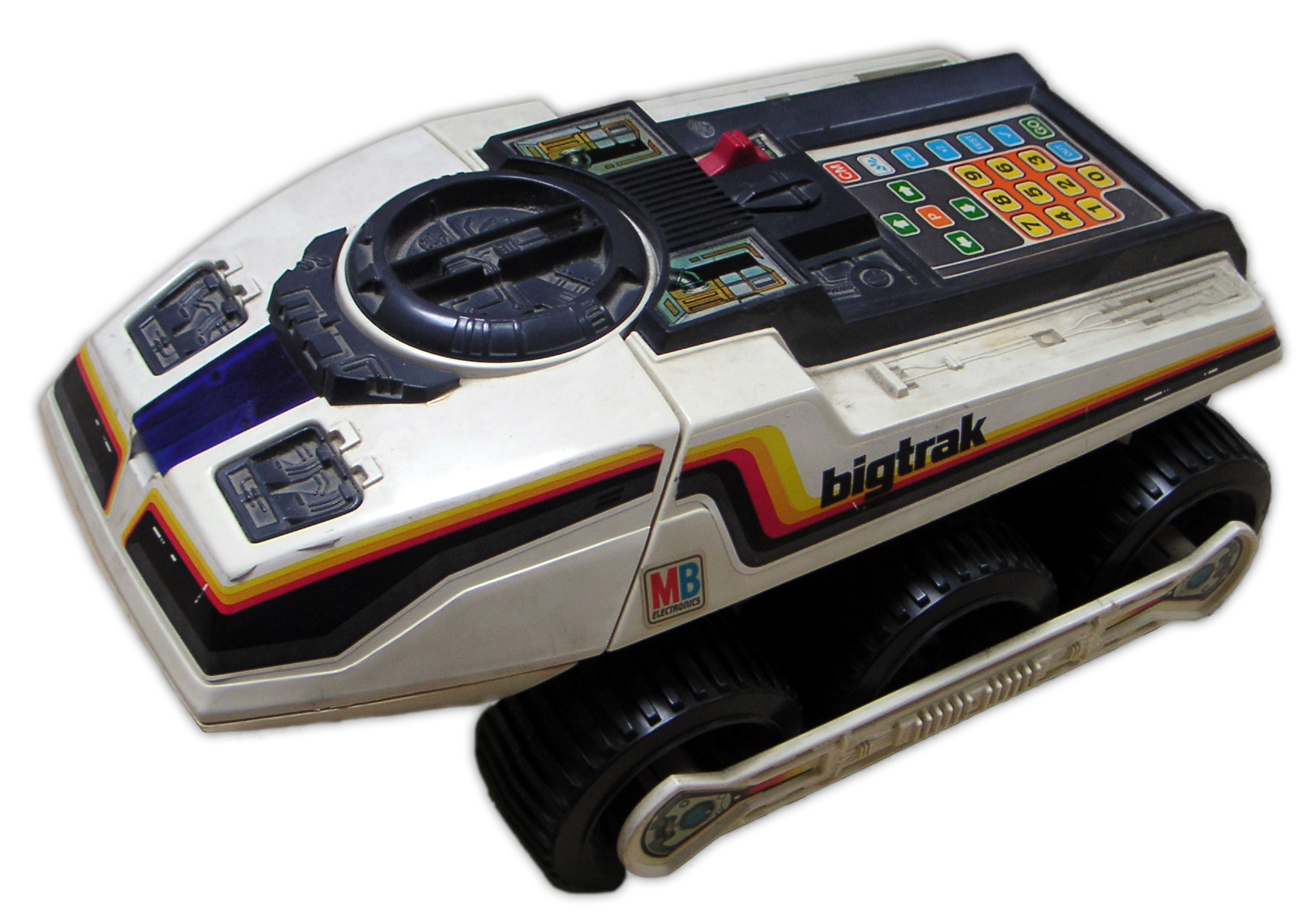
The gap between the program you typed and the program that executed was the entire interaction model. The Big Trak did not teach you to code. It taught you that code has consequences — physical, irreversible, occasionally embarrassing consequences — and that you cannot debug a tank that has already run into the couch.
The psychologist's robot
In the early 1980s, David Klahr's laboratory at Carnegie Mellon University adopted the Big Trak as a scientific instrument. The researchers would place the tank in front of a participant — no manual, no hints, no screen to read commands back from — and ask them to figure out how it worked. They watched as people pressed keys, observed outcomes, formed hypotheses, revised theories. This was not play; this was the study of instructionless learning, published in Klahr's 2000 book Exploring Science (MIT Press). The gap between command and consequence, the very thing that made Big Trak a frustrating toy, made it a perfect scientific instrument.
Big Trak remains one of the only consumer playthings ever pressed into formal service by cognitive scientists. The reason becomes clear when you compare it to a screen-based programming environment. Even the simplest Logo turtle — the gold standard of 1980s educational programming — provides constant feedback: you see your code, you see the turtle move, you edit and retry instantly. Big Trak strips all of that away. You must remember your own program. You must predict the tank's behavior from memory alone. You must learn not from error messages but from a vehicle wedged under the dining room table.
The Logo turtle taught children that computing was about seeing — watching your program unfold on a screen where every step is visible. Big Trak taught Klahr's research subjects that computing was about not seeing — about constructing a mental model and then testing it against a physical world that did not care whether you understood the turning radius in 15-degree increments.
The gap
Program-toy history is littered with screenless devices that disappeared when screens became cheap. What distinguishes Big Trak is not just that it lacked a screen but that the absence was a feature. A modern coding robot — a Sphero, a Dash, a LEGO Mindstorms brick — pairs physical action with a screen-based editor. You write the program on a tablet, check it for errors, maybe preview it, then transmit it to the robot. The screen is the editor, and the robot is the output. This is more powerful and more forgiving in every measurable way.
But it eliminates the gap. There is always a screen showing you what you typed, always a backspace key, always a simulator preview if you want one.
Big Trak gave you none of that. It gave you a keypad, 16 slots of memory, and the entire physical world as your only debugger. The tank that rolled into the sofa was not a bug. It was the feedback.