Cracklebox / Kraakdoos
The electronic instrument where the human body becomes a variable circuit component
Overview
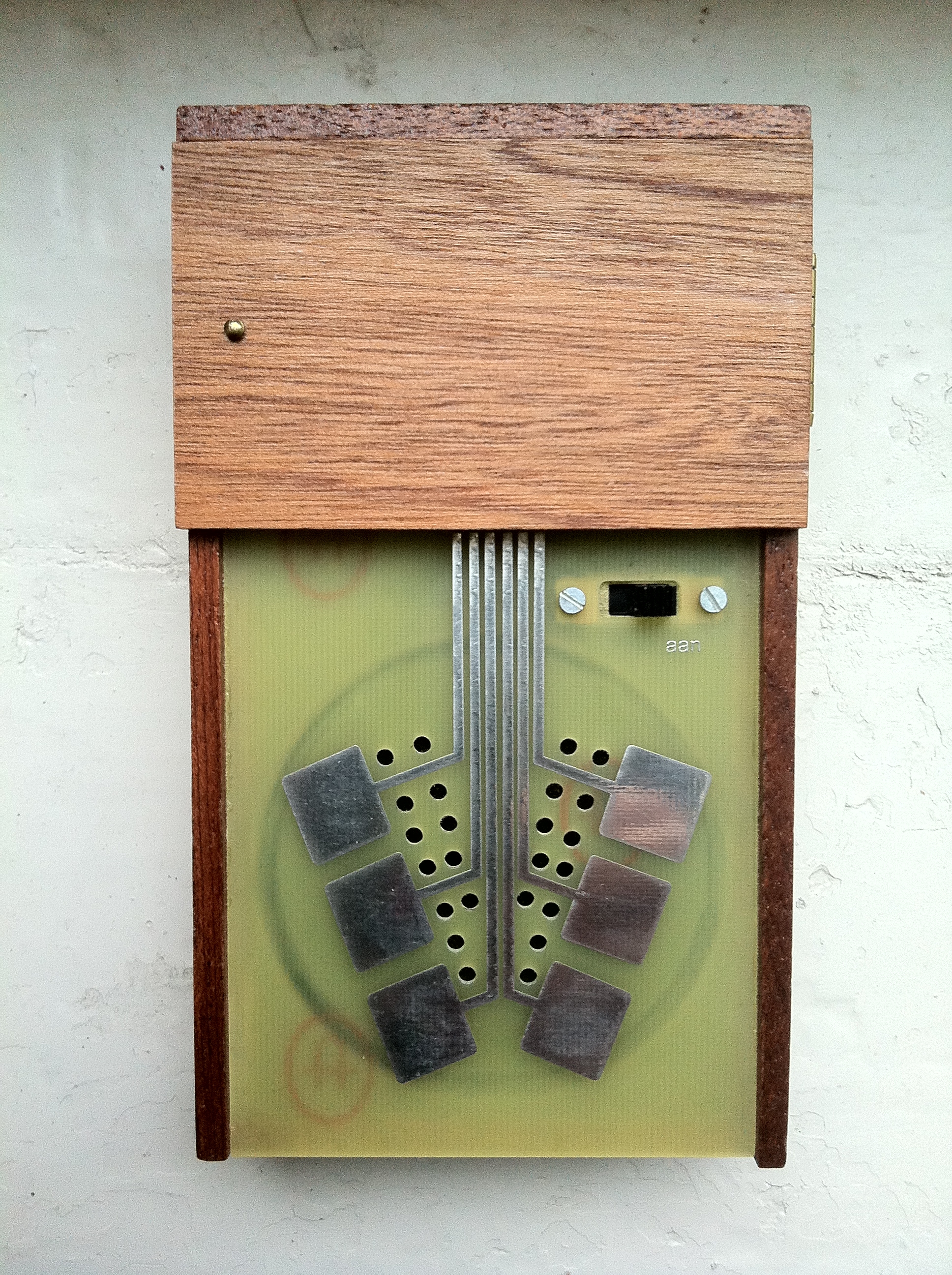
The Kraakdoos (Dutch for 'crackle box') is a small wooden box with six exposed metal contacts on top connected directly to an unstable LM709 operational amplifier circuit. When a performer touches the contacts, their body completes the circuit — skin conductivity becomes a variable component in the oscillator's feedback loop. The LM709 is an early op-amp that lacks frequency compensation, meaning it operates unpredictably as a phase-shift oscillator driving transistors in a dead band, producing highly distorted, crackling output. The result is not musical notes but squelches, crackles, pops, and tones that vary wildly based on who is playing, how moist their skin is, and how they press their fingers.
The concept was first conceived by Michel Waisvisz and Geert Hamelberg in the 1960s and developed further in the 1970s when Waisvisz joined the STEIM (Studio for Electro-Instrumental Music) foundation in Amsterdam. The instrument reached wider recognition through the 1978 LP 'Crackle' and subsequent DIY dissemination through STEIM workshops. It became a cult artifact of circuit-bending and experimental electronic music, influencing generations of artists who sought to blur the boundary between performer and instrument.
Deep dive
The cracklebox is built around a single LM709 operational amplifier — one of the earliest op-amp models ever produced. Unlike later op-amps, the LM709 lacks internal frequency compensation, meaning it is inherently unstable and prone to oscillation. The circuit is intentionally left bare: six metal contacts are wired directly to the op-amp's inputs. When a performer touches different combinations of contacts with their fingers, their body's variable resistance and capacitance alter the feedback characteristics of the circuit, sending it into different modes of chaotic oscillation. There is no enclosure to isolate the performer from the electronics — the human body IS part of the circuit path. The output is amplified and sent to a speaker, producing the characteristic crackles, whooshes, and shrieks.
Waisvisz described the cracklebox as an instrument where 'the interface is the content.' Unlike a traditional instrument where a keyboard or fretboard mediates between the player and the sound production, the cracklebox removes all mediation: your skin touches bare electronics, and the sound is a direct consequence of that contact. The 'playing technique' is not about learning positions or scales — it is about developing a tactile sensitivity to the instrument's response, entering into what Waisvisz called a 'tactile and sonic dialogue.' This philosophy of direct touch-as-interface would later influence Waisvisz's work on The Hands (1984) and STEIM's broader mission of rethinking the relationship between performer and electronic instrument.
STEIM (Studio for Electro-Instrumental Music) was founded in 1969 in Amsterdam as a research and development lab for new electronic performance instruments. Waisvisz became its artistic director in 1981. The cracklebox was never sold commercially; instead, STEIM published the schematic and encouraged musicians to build their own. It became one of the foundational artifacts of the circuit-bending movement — the practice of creatively short-circuiting consumer electronics to produce unexpected sounds. The cracklebox's radical simplicity (one op-amp, a battery, a speaker, and six contacts) made it accessible to anyone with basic electronics knowledge, embodying STEIM's ethos of demystifying the electronic instrument.
Team & pioneers
- Michel Waisvisz. Dutch composer, performer, and inventor; artistic director of STEIM (1981–2008); co-creator of the Cracklebox
- Geert Hamelberg. Co-creator of the original Cracklebox concept in the 1960s
- Peter Beyls. Contributor to Cracklebox development at STEIM
- Nico Bes. Contributor to Cracklebox development at STEIM
- STEIM. Studio for Electro-Instrumental Music, Amsterdam; hosted development and disseminated the design (1970s–1980s)
Media