Valiant Turtle / Valiant Logo Turtle
A floor-roving infrared-controlled robot that made Logo programs physically visible
Overview
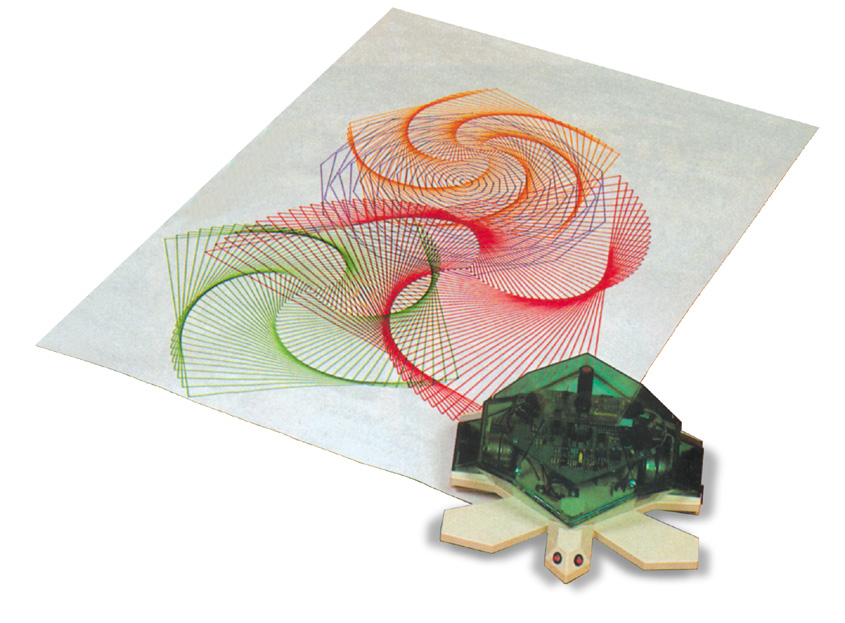
The Valiant Turtle is a floor-roving educational robot launched in 1983 by Valiant Technology Ltd of London. It was designed to be programmed via the Logo programming language running on a host computer (typically the BBC Micro, but also Apple II, Commodore, and others). The turtle communicated with its host via an infrared serial link — a tetherless connection that allowed the robot to roam freely on the classroom floor. It carried a retractable pen that could be lowered to draw on paper taped to the floor, making the student's Logo program visible as a physical trace.
The turtle was hemispherical, approximately 25 cm in diameter, with a transparent dome revealing its internal electronics. It had two independently driven wheels (differential steering) and a rear caster. It carried bump sensors for collision detection and could emit sounds. The IR link operated at 300 baud, translating Logo commands like FORWARD, BACK, LEFT, RIGHT, PENUP, PENDOWN into motor movements. The robot was robust enough for daily classroom use and remained in production until 2011 — a 28-year production run.
Valiant Technology was founded by Dave Catlin, who personally designed the turtle and remained the company's CEO and product designer. The company also produced the Roamer (a more advanced descendant with onboard programming) and MathAmigo. The Valiant Turtle was used in classrooms across the UK and elsewhere, supported by the Microelectronics Education Programme (MEP) and the BBC Micro's dominance in British schools.
Deep dive
The Valiant Turtle embodies Seymour Papert's concept of 'body-syntonic' learning — the idea that children can understand and debug a program by imagining what they would do if they were the turtle. A child who types FORWARD 50 RIGHT 90 FORWARD 50 and watches the turtle draw an L-shaped path can immediately see that turning RIGHT 90 produces a 90-degree turn. If the turtle goes off the paper, the child can physically walk the path the turtle would take and correct the code. This makes debugging a full-body, kinesthetic experience, not an abstract symbol-manipulation task. The turtle is not just an output device; it is a prosthesis for thinking about geometry, angle, distance, and iteration. Papert's book Mindstorms (1980) had argued for this approach, and the Valiant Turtle was its most commercially successful hardware embodiment.
The Valiant Turtle used infrared serial communication at 300 baud, connecting to the host computer's serial port via an IR transmitter unit. The tetherless design was crucial: it allowed the turtle to roam freely on the floor, drawing on a large sheet of paper, without the constraint of a physical cable. The IR link worked at ranges up to several meters, sufficient for a typical classroom. The IR link also reinforced the turtle's independence: the child's program was sent as a complete instruction set, and the turtle executed it autonomously, not under constant computer control. This made the turtle feel like an independent creature responding to the child's commands.
The retractable pen was the Valiant Turtle's most important output device. When lowered, the pen traced the turtle's path on paper, turning the robot's motion into a permanent visual record. The child could see the program's output accumulate over time — a square taking shape, a spiral growing, a complex L-system fractal emerging. The pen made the temporal dimension of computation visible in a way that screen-based turtle graphics could not match. The physical trace also served as a shareable artifact: the child could take the paper home, show it to parents, pin it on the wall. It was the program made tangible.
Team & pioneers
- Valiant Technology Ltd. Founded by Dave Catlin. Based in London, UK. Produced the Valiant Turtle (1983–2011), Roamer, MathAmigo, and other educational technology products.
- Dave Catlin. CEO and product designer at Valiant Technology. Designed the Valiant Turtle and its successor, the Roamer.
Media