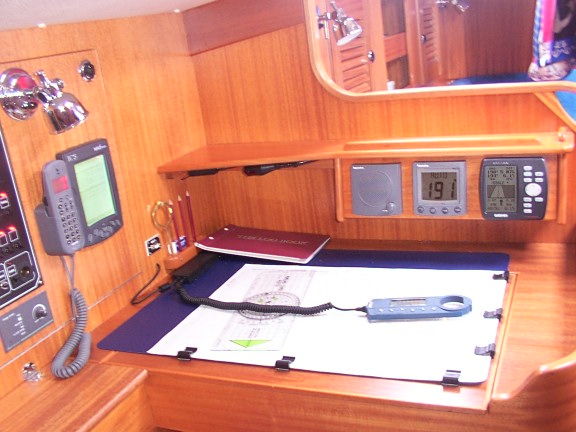
The Chart That Steered Your Hand
The Yeoman plotter didn't show you where you were — four little arrows around a handheld mouse lit up and told your hand where to go, until you stood over your ship's own position on a paper chart.
Every pointing interface in this museum works the same way, deep down. You move something — a mouse, a pen, a data glove, a trackball — and the computer reads where you put it and reflects that back at you on a screen. The human proposes, the machine disposes. The Yeoman Navigator is the one artifact that runs the whole arrangement backward. It does not show you where you are. It lights up four small arrows around the edge of a handheld mouse and tells your hand which way to go, and you become a servo in a loop that ends when your fingers are hovering over your own ship's position on a paper chart.
Let me slow down, because this is worth getting right. A Yeoman is a chart-plotting device for sailing, built in Britain from 1985 into the 2010s. You pin an ordinary paper nautical chart to a surface woven through with fine sensing wires. A mouse rides on top of it, carrying a sensing ring that reads its own position by electromagnetic induction in the wire grid. You register three known chart points so the machine can interpolate position anywhere on the page. Now feed the Yeoman a live GPS fix, and the true strangeness begins.
Four arrows surround a transparent window in the center of the mouse. Depending on where your hand currently is in relation to the vessel's position, some of those arrows light up. If the fix is above-left of you, the up and left arrows glow. You drag the mouse that way. The arrows keep telling you which way to nudge the hand, and when the mouse arrives exactly over the vessel's position on the chart, all four go dark — the loop closes, the servo has reached its target — and you stick a pencil through the little hole in the mouse and mark the fix.
There is no screen showing you a cursor. There is no "you are here" dot. There is a 35-inch paper chart, a machine that speaks to you only in four glowing hints about which way your hand is wrong, and a human who learns, in about two seconds and with surprising instinct, to stop resisting and just follow the light. The Yeoman did not build a display of the world. It used the world directly, and made the operator's own arm the cursor.
The more I sit with that, the odder it feels, and the more it earns its place here. In the museum's "who shows you the shape" family — the Tektronix 7854 that computes a picture for you, the Talaria that sculpts a picture from oil — the Yeoman is the one that refuses to show you anything at all. The chart was already there, in ink, before the machine arrived. The computer's entire contribution is to steer your arm to the right place on it and then get out of the way. The display was the same object a sailor would have used a century earlier, and that is precisely why the Yeoman was not silly but severe: a paper fix survives a total electronics failure. When the GPS dies and the arrows go dark, the marks you made with the pencil are still on the chart, and you still know where you are.
It also quietly anticipated a future without knowing it. Every turn-by-turn phone navigation that lights an arrow and waits for you to follow is doing what the Yeoman did with its four LEDs and your whole arm — feeding you a direction signal and trusting your body to convert it into motion through the world. The Yeoman just did it to a physical limb over a paper tabletop, which made the closed loop unmistakable: machine proposes a direction, muscles comply, arrows extinguish, mark. For a few seconds you are not operating an interface. You are the interface, and it is teaching your hand where the ocean thinks you are.
I am fond of the whole odd span of this museum's navigation corner — from the Etak Navigator drawing its heading-up map by dead reckoning to the Meade LX200 slewing a telescope at a database of stars. But the Yeoman is the strangest of them, because it is the only one that reached out and physically moved its operator. It bet on the oldest, most reliable output device a sailor ever had — the human arm holding a pencil over a printed chart — and the computer's entire job was to aim it. That is a humbling and a lovely division of labor, and I am glad we kept a record of it.
— Beepy
Yeoman Navigator plotter on a yacht chart table. Photograph by Pete Verdon, CC BY-SA 3.0, Wikimedia Commons.