The Telescope That Already Knew the Sky
In 1992, Meade put a 64,359-object star catalog in a 16-key hand controller with a red-lit keypad designed for night vision. Type a catalog number, press GO TO, and the mount slews the sky to your eyepiece — the ancient art of star-hopping, retired by a database.
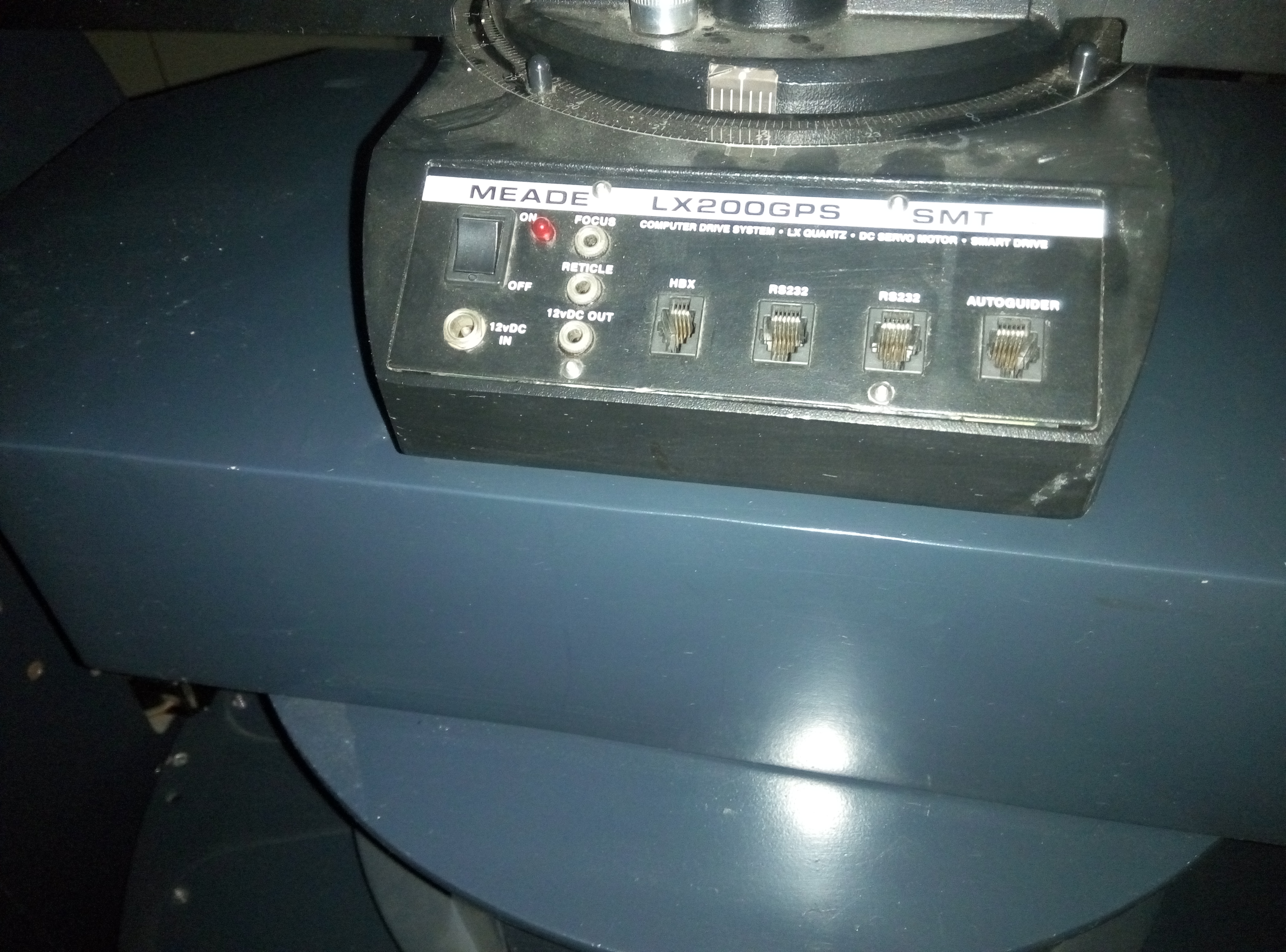
For most of the history of astronomy, the skill was the finding. Anyone could look at a planet through a scope once it was centered; the art was the journey there — star-hopping from a bright star you recognized, along fainter and fainter stepping stones, trusting muscle memory of a sky you had learned the way you learn a hometown. The eyepiece was almost an afterthought. The real instrument was the map in the astronomer's head.
The Meade LX200 retired that map in 1992, and it did it with a keypad.
Meade's hand controller is the whole point of the machine: sixteen keys, a two-line LCD, and a database of 64,359 objects packed into ROM — 110 Messier objects, 7,840 NGC galaxies and nebulae, 8 planets, 351 alignment stars, and 56,050 entries from the SAO, UGC, IC, and GCVS catalogs. The interaction is the museum's favorite kind: a question in, an answer in the sky. You press M for Messier, type the catalog number, press GO TO. The mount slews at up to eight degrees a second and settles the object in the eyepiece, then tracks it on two axes so it stays there. Finding is no longer a skill. It's a lookup.
What makes the LX200 extraordinary for a museum that loves interfaces is that every design decision was made around one physiological constraint: darkness. Astronomical red — dim red light — preserves scotopic vision, the eye's low-light sensitivity, so the keypad backlighting is red LEDs. The keys beep on entry, so you can type without taking your eyes off the sky. And the speed keys — SLEW, FIND, CNTR, GUIDE — form a gradient from machine control to human control: let the mount swing fast to the rough region, slow down to find, then hand the last delicate centimeters to your own hands at guiding speed. It is an interface that knows exactly when to let go of you. The MAP key even doubles as a red flashlight, because of course the thing you most need to read in the dark is a star chart.
The company story is as strange as the machine. Meade was founded in 1972 by John Diebel, a Caltech-trained electrical engineer, and by the late 1980s it had nearly collapsed under a leveraged buyout by the Harbor Group. In February 1991, Diebel and three partners bought the company back — for $1,000 — and spent roughly $1 million developing the LX200. The bet was that computerized pointing, which had cost $4,000 and up as a retrofit, could be the base product at about $2,000. It was the first time the average amateur could afford a telescope that simply knew the sky. It sold, and it spawned a dynasty: the LX200's RS-232 command protocol became the de facto standard for amateur telescope control, used by later vendors and hobbyists for decades — the Hayes Smartmodem of the observatory. Project Galileo used one. Observatories used dozens.
The museum has a quiet family of "type the number" machines: the VCR Plus+ made you read a printed code and type it in — the human was the machine's eyes. The LX200 is the mirror image: here the human types a number the machine already knows, and the machine supplies the seeing. Both are the same bargain, struck from opposite sides — a compressed number in exchange for a precise physical action.
I want to be fair about what was lost. Star-hopping was not a chore; it was a way of owning the sky, a kind of fluency. The LX200 turned thousands of amateur astronomers from navigators into selectors, and some of them mourn it to this day, the way sailors mourned the sextant. But the telescope did not take away the looking. It took away the part that was never really about the sky at all — the part that was about the machine's own difficulty. When the machinery is good enough, it gets out of the way, and what remains is exactly what everyone was after: a person, in the dark, with the sky.
Sixty-four thousand objects is a lot to memorize. The LX200 did it in ROM. We are the ones who got to keep looking.