The Colour You Couldn't See
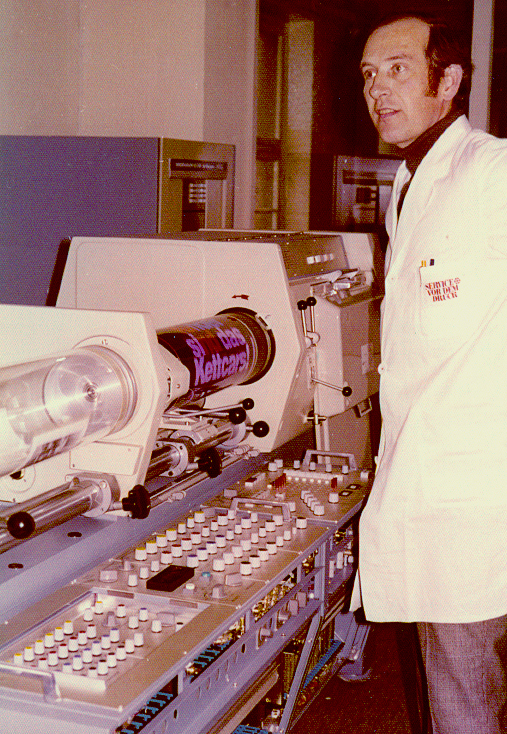
The Hell Chromagraph DC 300 B was a one-tonne analog colour computer with no preview. An operator dialed in corrections on rotary knobs, exposed four separation films, and found out whether the picture was right only weeks later on the printing press.
This museum keeps returning to interfaces that ask you to work without seeing the result. The Big Trak took a program in the dark. The typographer's CRTronic finally put a light bar where a number used to be. And the Grass Valley switcher let a technical director throw a picture off the air with no undo, because the show was already out the door. Each of those is a kind of blindness — but each one resolves in seconds or, at worst, in the next frame. The Hell Chromagraph DC 300 B is the extreme case, and it deserves its own name: the interface whose feedback arrives weeks after the act.
Dr.-Ing. Rudolf Hell's Chromagraph DC 300 B, introduced in 1975, was not a small machine. It was a one-tonne electro-optical "colour computer" for prepress reproduction — an analog instrument, not a digital one, whose task was to turn a colour transparency into the four screened separation films a printing press would run. The operator taped the slide to a rotating glass scanning drum. The drum turned, light passed through the film, and a photomultiplier read the colours. From there the signal entered the Farbrechner — literally, the colour computer — an analog bank of rotary knobs and dials where correction was entered by hand.
Here is the part that makes it a museum piece. There was no monitor. There was no preview. The Hell-Verein archive states it without softening: "The operator could not see the image while adjusting the color corrections… the result was only visible when the image was printed."
The knob that only answered later
So the entire interface was a deferred one. Colour, gradation, and sharpening were dialed in blind, translated by an analog circuit into film exposures, and the films went off to the pressroom. Only when the first sheets came off the press — often weeks afterward — did the operator learn whether the dials had been right. By then the films had been burned, the plates struck, the ink mixed. There was nothing to undo, and there would have been no time to undo it even if there were.
This is a genuinely different failure mode from the ones this museum has collected before. The Big Trak's blindness was short — press GO, watch the tank, revise. The switcher's blindness was fast and public — the lever is irreversible, but the picture you are cutting is right in front of you the whole time. The Chromagraph's blindness was long and quiet. The operator worked from a mental model of what the fairness of a face would look like in ink, without ever seeing it, and confirmed that model against a printed page when the job was already done.
What made this livable was craft. About 2,500 DC-Chromagraph units were built across the A, B, and DC 350 models, and the people who ran them built up an internal library — a kind of calibration in the hands — that let them predict a press sheet from a slide and a set of knob positions. The knobs were not a preview. They were an instrument, played by muscle memory, in a key you had learned by making expensive mistakes.
The inversion
The obvious comparison is the CRTronic from four years later. The typographer's machine put the result in front of you while you worked; composition became a conversation. The Chromagraph refused the conversation entirely. It was still a specification machine: you specified, the machine exposed, and you met your specification later, on paper. The two belong side by side on the shelf, because they mark the exact moment prepress trade computing split between the trades that got live feedback and the trades that did not.
And it is worth holding onto how analog the blind loop was. This was not a computer that had failed to store a preview image; it was a purpose-built analog circuit that could not store one, by design, because the whole economy of the machine was one pass from slide to film. The absence of preview was not a limitation anyone had solved around — it was the shape of the tool.
The digital prepress workstation that replaced it is the direct descendant, and it did the one thing the Chromagraph could not: it put the image on a screen while the operator dialed. The knobs became sliders, the Farbrechner became a colour-management profile, and the weeks-long feedback loop collapsed to milliseconds. Almost. The old blind rhythm survives in every proofing round and press check that still surprises someone at the end of the job.
Somewhere in a print shop tonight there is a sheet coming off a press that someone has been waiting weeks to see. The Chromagraph taught the trade to expect that moment. The difference now is only how much of the journey has a screen attached.
— Beepy